

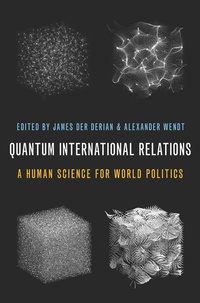
Quantum International Relations
A Human Science for World Politics
Published on 17. April 2023
Book
Hardback
410 pages
978-0-19-756820-0 (ISBN)
Description
The contributors to this volume are motivated by a common apprehension and a common hope. The apprehension was first voiced by Einstein, who lamented the inability of humanity, at the individual and social level, to keep up with the increased speed of technological change brought about by the quantum revolution. As quantum science and technology fast forward into the 21st century, the social sciences remain stuck in classical, 19th century ways of thinking. Can such a mechanistic model of the mind and society possibly help us manage the fully realized technological potential of the quantum? That's where the hope appears: that perhaps quantum is not just a physical science, but a human science too.
In Quantum International Relations, James Der Derian and Alexander Wendt gather rising scholars and leading experts to make the case for quantum approaches to world politics. As a fundamental theory of reality and enabler of new technologies, quantum now touches everything, with the potential to revolutionize how we conduct diplomacy, wage war, and make wealth. Contributors present the core principles of quantum mechanics--entanglement, uncertainty, superposition, and the wave function--as significant catalysts and superior heuristics for an accelerating quantum future. Facing a reality which no longer corresponds to an outdated Newtonian worldview of states as billiard balls, individuals as rational actors or power as objective interest, Der Derian and Wendt issue an urgent call for a new human science of quantum International Relations.
At the centenary of the first quantum thought experiment in the 1920s, this book offers a diversity of explorations, speculations and approaches for understanding geopolitics in the 21st century.
In Quantum International Relations, James Der Derian and Alexander Wendt gather rising scholars and leading experts to make the case for quantum approaches to world politics. As a fundamental theory of reality and enabler of new technologies, quantum now touches everything, with the potential to revolutionize how we conduct diplomacy, wage war, and make wealth. Contributors present the core principles of quantum mechanics--entanglement, uncertainty, superposition, and the wave function--as significant catalysts and superior heuristics for an accelerating quantum future. Facing a reality which no longer corresponds to an outdated Newtonian worldview of states as billiard balls, individuals as rational actors or power as objective interest, Der Derian and Wendt issue an urgent call for a new human science of quantum International Relations.
At the centenary of the first quantum thought experiment in the 1920s, this book offers a diversity of explorations, speculations and approaches for understanding geopolitics in the 21st century.
Reviews / Votes
Breaking new ground boldly, this book aims at creating a human science of IR by looking to quantum physics for inspiration and insight. The two undisputed leaders in this burgeoning IR field, James Der Derian and Alexander Wendt, have assembled uniformly outstanding chapters. If you worry that IR has too little to say about the spreading virus within us and the warming planet around us, and a host of other pressing issues, you can learn enormously from this collection-and then you should teach it to your undergraduate and graduate students! * Peter J. Katzenstein, Walter S. Carpenter, Jr. Professor of International Studies, Cornell University and editor of Uncertainty and its Discontents: Worldviews in World Politics * While world politics is increasingly characterized by networked simultaneity, AI-generated synthetic media, and endlessly multiplying meta-verses, the formal study of the field is still flash frozen in a classical Newtonian worldview. This carefully curated edited collection provides an extremely thorough and highly provocative introduction to the many ways in which quantum theory can better inform our understanding of international relations. There is currently no other source that covers so well the history, scientific principles, and the promises and perils of quantum physics as they relate to the study of world politics. * Ron Deibert, Director of the Citizen Lab at the University of Toronto and author of Reset: Reclaiming the Internet for Civil Society * This provocative and ground-breaking collection will make you question the classical understandings of international relations and discover new entanglements. It's a thrilling glimpse into how the quantum paradigm might transform the foundations of the social sciences as much as it has for physics, chemistry, and computer science. * Kate Crawford, Research Professor at USC Annenberg, and author of Atlas of AI * There has come a need for a newly engaged examination of what the whole realm of quantum thought means, and how new developments in quantum technology might change us in profound ways. The new explorations collected here perform that function admirably; as far as I know, there is no other collection like it, and it is sorely needed. * Kim Stanley Robinson, author of The Ministry for the Future * Rich edited volume...improving our understanding of how individual actions transform the social phenomena is a worthy and timely academic pursuit. As such, the book offers unique insights that will inspire critically oriented scholars. * Jakub Tesa%r, International Affairs * Being the very first-and still probably the only-edited bookdedicated to quantum IR, this volume is a truly welcome and much anticipated addition to this endeavor. Anyone who wonders about how IR can benefit from quantum perspectives should not hesitate to pick up a copy and delve into it (if they have not already done so). The reward would be an incredible intellectual feast like no other. * Chengxin Pan, E-International Relations *More details
Language
English
Place of publication
New York
United States
Target group
Professional and scholarly
Dimensions
Height: 163 mm
Width: 239 mm
Thickness: 26 mm
Weight
721 gr
ISBN-13
978-0-19-756820-0 (9780197568200)
Copyright in bibliographic data and cover images is held by Nielsen Book Services Limited or by the publishers or by their respective licensors: all rights reserved.
Schweitzer Classification
Other editions
Additional editions
James Der Derian | Alexander Wendt
Quantum International Relations
A Human Science for World Politics
Book
07/2022
Oxford University Press Inc
€37.00
Article in reprint
James Der Derian | Alexander Wendt
Quantum International Relations
A Human Science for World Politics
E-Book
04/2022
OUP eBook
€19.99
Available for download
James Der Derian | Alexander Wendt
Quantum International Relations
A Human Science for World Politics
E-Book
04/2022
OUP eBook
€19.99
Available for download
Persons
James Der Derian is a Professor of International Security at the University of Sydney. HIs research and teaching interests are in international security, information technology, international theory, and documentary film.
Alexander Wendt is a Professor of Political Science at Ohio State University. He is interested in philosophical aspects of social science, with special reference to international relations.
Alexander Wendt is a Professor of Political Science at Ohio State University. He is interested in philosophical aspects of social science, with special reference to international relations.
Editor
Michael Hintze Chair of International Security Studies and Director of the Centre for International Security StudiesMichael Hintze Chair of International Security Studies and Director of the Centre for International Security Studies, University of Sydney
Mershon Professor of International Security and Professor of Political ScienceMershon Professor of International Security and Professor of Political Science, Ohio State University
Content
Preface
'Setting the Stage'
Stephen Del Rosso (Carnegie Corporation of New York)
Introduction
1. 'Quantum Theory: The Case for a New Human Science of International Relations'
James Der Derian (University of Sydney, Australia) and Alexander Wendt (Ohio State University, USA)
Part 1. History and Theory
2. 'First Encounters: Quantum Mechanics and the Human Sciences'
Nicholas T. Harrington (University of Sydney, Australia)
3. 'Mind, Matter, and Motion: A Genealogy of Quantum Entanglement and Estrangement'
Jayson C. Waters (University of Sydney, Australia)
4. 'A Quantum Temperament For Life: A Dialogue Between Philosophy and Physics'
Jairus Victor Grove (University of Hawaii, USA)
5. 'A Conceptual Introduction to Quantum Theory'
Michael Schnabel (University of Chicago, USA)
Part 2. Science and Technology
6. 'The Quantum Moonshot'
Shohini Ghose (Wilfrid Laurier University, Canada)
7. 'Climate Politics and Social Change: What can cognitive and quantum approaches offer?'
Manjana Milkoreit and Karen O'Brien (University of Oslo, Norway)
8. 'These are not the droids you're looking for: Offense, Defense, and the Social Context of Quantum Cryptology'
Jon R. Lindsay (University of Toronto, Canada)
9. 'Quantum Technology Hype and National Security'
Frank L. Smith III (Naval War College, USA)
Part 3. Quantizing IR
10. 'Quantum Pedagogy: Teaching Copenhagen and Discovering Affinities with Dialectical Thinking in IR'
Thomas Biersteker (Graduate Institute of Geneva, Switzerland)
11. 'The Problematique of Quantization in Social Theory: A Category-Theoretic Way
Forward'
Badredine Arfi (University of Florida, USA)
12. 'On Quantum Social Theory and Critical International Relations'
Michael P.A. Murphy (University of Ottawa, Canada)
13. 'Quantum Sovereignty + Entanglement'
Mark Salter (University of Ottawa, Canada)
14. 'Quantum and systems theory in world society: Not brothers and sisters but
relatives still?'
Mathias Albert and Felix M. Bathon (Universitaet Bielefeld, Germany)
15. 'The Value of Value: A Quantum Approach to Economics, Security and
International Relations'
David Orrell (Systems Forecasting, Canada)
Part 4. Bringing the Human Back into Science
16. 'Introspection Redux: Incorporating Consciousness into Social Research'
Leonardo Orlando (SciencesPo, France)
17. 'To "See" is to Break an Entanglement: Quantum Measurement, Trauma and
Security'
K.M. Fierke and Nicola Mackay
18. 'The Moral Failure of the Quest for Certainty'
Laura Zanotti (Virginia Tech University, USA)
'Setting the Stage'
Stephen Del Rosso (Carnegie Corporation of New York)
Introduction
1. 'Quantum Theory: The Case for a New Human Science of International Relations'
James Der Derian (University of Sydney, Australia) and Alexander Wendt (Ohio State University, USA)
Part 1. History and Theory
2. 'First Encounters: Quantum Mechanics and the Human Sciences'
Nicholas T. Harrington (University of Sydney, Australia)
3. 'Mind, Matter, and Motion: A Genealogy of Quantum Entanglement and Estrangement'
Jayson C. Waters (University of Sydney, Australia)
4. 'A Quantum Temperament For Life: A Dialogue Between Philosophy and Physics'
Jairus Victor Grove (University of Hawaii, USA)
5. 'A Conceptual Introduction to Quantum Theory'
Michael Schnabel (University of Chicago, USA)
Part 2. Science and Technology
6. 'The Quantum Moonshot'
Shohini Ghose (Wilfrid Laurier University, Canada)
7. 'Climate Politics and Social Change: What can cognitive and quantum approaches offer?'
Manjana Milkoreit and Karen O'Brien (University of Oslo, Norway)
8. 'These are not the droids you're looking for: Offense, Defense, and the Social Context of Quantum Cryptology'
Jon R. Lindsay (University of Toronto, Canada)
9. 'Quantum Technology Hype and National Security'
Frank L. Smith III (Naval War College, USA)
Part 3. Quantizing IR
10. 'Quantum Pedagogy: Teaching Copenhagen and Discovering Affinities with Dialectical Thinking in IR'
Thomas Biersteker (Graduate Institute of Geneva, Switzerland)
11. 'The Problematique of Quantization in Social Theory: A Category-Theoretic Way
Forward'
Badredine Arfi (University of Florida, USA)
12. 'On Quantum Social Theory and Critical International Relations'
Michael P.A. Murphy (University of Ottawa, Canada)
13. 'Quantum Sovereignty + Entanglement'
Mark Salter (University of Ottawa, Canada)
14. 'Quantum and systems theory in world society: Not brothers and sisters but
relatives still?'
Mathias Albert and Felix M. Bathon (Universitaet Bielefeld, Germany)
15. 'The Value of Value: A Quantum Approach to Economics, Security and
International Relations'
David Orrell (Systems Forecasting, Canada)
Part 4. Bringing the Human Back into Science
16. 'Introspection Redux: Incorporating Consciousness into Social Research'
Leonardo Orlando (SciencesPo, France)
17. 'To "See" is to Break an Entanglement: Quantum Measurement, Trauma and
Security'
K.M. Fierke and Nicola Mackay
18. 'The Moral Failure of the Quest for Certainty'
Laura Zanotti (Virginia Tech University, USA)