

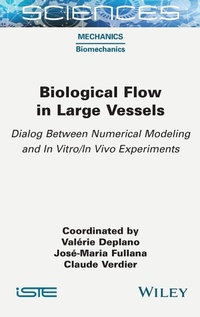
Biological Flow in Large Vessels
Dialog Between Numerical Modeling and In Vitro/In Vivo Experiments
1st Edition
Published on 23. August 2022
Book
Hardback
256 pages
978-1-78945-065-1 (ISBN)
Description
This book examines recent methods used for blood flow modeling and associated in vivo experiments, conducted using experimental data from medical imaging. Different strategies are proposed, from small-scale models to complex 3D modeling using modern computational codes. The geometries are wide-ranging and deal with the narrowing and widening of sections (stenoses, aneurysms), bifurcations, geometries associated with prosthetic elements, and even cases of vessels with smaller dimensions than those of the blood cells circulating in them.
Biological Flow in Large Vessels provides answers to the question of how medical and biomechanical knowledge can be combined to address clinical problems. It offers guidance for further development of numerical models, as well as experimental protocols applied to clinical research, with tools that can be used in real-time and at the patient's bedside, for decision-making support, predicting the progression of pathologies, and planning personalized interventions.
Biological Flow in Large Vessels provides answers to the question of how medical and biomechanical knowledge can be combined to address clinical problems. It offers guidance for further development of numerical models, as well as experimental protocols applied to clinical research, with tools that can be used in real-time and at the patient's bedside, for decision-making support, predicting the progression of pathologies, and planning personalized interventions.
More details
Language
English
Place of publication
London
United Kingdom
Target group
Professional and scholarly
Product notice
sewn/stitched
Cloth over boards
Dimensions
Height: 240 mm
Width: 161 mm
Thickness: 18 mm
Weight
554 gr
ISBN-13
978-1-78945-065-1 (9781789450651)
Copyright in bibliographic data and cover images is held by Nielsen Book Services Limited or by the publishers or by their respective licensors: all rights reserved.
Schweitzer Classification
Other editions
Additional editions
Valerie Deplano | Jose-Maria Fullana | Claude Verdier
Biological Flow in Large Vessels
Dialog Between Numerical Modeling and In Vitro/In Vivo Experiments
E-Book
06/2022
1st Edition
Wiley
€126.99
Available for download
Valerie Deplano | Jose-Maria Fullana | Claude Verdier
Biological Flow in Large Vessels
Dialog Between Numerical Modeling and In Vitro/In Vivo Experiments
E-Book
06/2022
1st Edition
Wiley
€130.99
Available for download
Persons
Valerie Deplano is research director at CNRS, and an active member of the CNRS research group MECABIO, GDR3570, dealing with the mechanics of materials and biological fluids. She is the former head of the GDR2760 research group, focusing on the biomechanics of fluids and transfers, fluid-biological structure interaction, and President of the Biomechanics Society 2018-2021.
Jose-Maria Fullana is a Professor at Sorbonne University, Paris, and an active member of the CNRS research group MECABIO, GDR3570, dealing with the mechanics of materials and biological fluids.
Claude Verdier is research director at CNRS, and an active member of the CNRS research group GDR3570, MECABIO, dealing with the mechanics of materials and biological fluids. He is the former leader of the GDR3570 research group.
Jose-Maria Fullana is a Professor at Sorbonne University, Paris, and an active member of the CNRS research group MECABIO, GDR3570, dealing with the mechanics of materials and biological fluids.
Claude Verdier is research director at CNRS, and an active member of the CNRS research group GDR3570, MECABIO, dealing with the mechanics of materials and biological fluids. He is the former leader of the GDR3570 research group.
Content
Preface xi
Valerie DEPLANO, Jose-Maria FULLANA and Claude VERDIER
Chapter 1. Hemodynamics and Hemorheology 1
Thomas PODGORSKI
1.1. Structure and function of the circulatory system 1
1.2. Blood composition 5
1.3. The red blood cell: structure and dynamics 8
1.3.1. Red blood cell properties 8
1.3.2. Erythrocyte pathologies 11
1.3.3. Red blood cell dynamics 15
1.4. Rheology and dynamics 17
1.4.1. Phenomenology of blood rheology 17
1.4.2. Red blood cell aggregation 21
1.4.3. Dynamics of microcirculation 27
1.5. Conclusion 31
1.6. References 32
Chapter 2. CFD Analyses of Different Parameters Influencing the Hemodynamic Outcomes of Complex Aortic Endovascular Repair 43
Sabrina BEN-AHMED, Jean-Noel ALBERTINI, Jean-Pierre FAVRE, C. Alberto FIGUEROA, Eugenio ROSSET, Francesca CONDEMI and Stephane AVRIL
2.1. Introduction 43
2.2. Methods 45
2.3. Results 48
2.3.1. Model without stenosis 50
2.3.2. Model with 40% diameter stenosis 53
2.3.3. Model with 70% diameter stenosis 56
2.4. Discussion 58
2.4.1. Velocity and flow 59
2.4.2. Pressure 60
2.4.3. TAWSS 60
2.4.4. PAS 61
2.4.5. Limitations 62
2.5. Conclusion 63
2.6. Acknowledgments 63
2.7. References 64
Chapter 3. Vascular Geometric Singularities, Hemodynamic Markers and Pathologies 69
Valerie DEPLANO and Carine GUIVIER-CURIEN
3.1. Introduction 69
3.2. General characteristics of blood flows at the macroscopic scale 70
3.3. Several geometric singularities of the cardiovascular system 73
3.3.1. Curvatures and bifurcations 73
3.3.2. Cross-section constriction 78
3.3.3. Cross-section enlargement 80
3.3.4. Valves 82
3.4. Hemodynamic markers 85
3.4.1. Indexes derived from wall shear stress 86
3.4.2. Indexes describing VSs 88
3.5. Correlation between hemodynamic markers and pathologies: some examples 90
3.5.1. WSS and pathologies 92
3.5.2. Hemodynamic markers and thrombus 95
3.6. Conclusion and perspectives 98
3.7. References 99
Chapter 4. Role of Arterial Blood Flow in Atherosclerosis 109
Guillermo VILAPLANA and Abdul I. BARAKAT
4.1. Introduction 109
4.2. Role of arterial fluid mechanics in atherosclerosis 110
4.2.1. Atherosclerosis initiation and progression 110
4.2.2. Role of arterial flow in atherosclerosis 113
4.3. An illustrative example of the complexity of arterial flow fields: fluid dynamic interactions between two arterial branches 115
4.3.1. The specific problem addressed 115
4.3.2. Materials and methods 116
4.3.3. Results 118
4.3.4. Discussion 134
4.4. Concluding remarks 135
4.5. References 136
Chapter 5. Patient-specific Hemodynamic Simulations: Model Parameterization from Clinical Data to Enable Intervention Planning 139
Irene E. VIGNON-CLEMENTEL and Sanjay PANT
5.1. Introduction 139
5.2. Multiscale models: do we need patient-specific data? 142
5.2.1. Assessing function of a new procedure/device 142
5.2.2. Optimizing the procedure/device for an individual patient 143
5.2.3. Population studies 143
5.3. How do we include patient-specific data? 144
5.3.1. Type of clinical data available and associated challenges 145
5.3.2. Establishing if the resistance of the 3D part is negligible or not, and parameterization in case it is 147
5.3.3. Resistance of the 3D part is not negligible 149
5.4. When models fall short of expectations: toward adaptation 154
5.4.1. Liver hepatectomy and blood loss 154
5.4.2. Pulmonary stenosis alleviation and vascular adaptation 155
5.5. Conclusion 156
5.6. Acknowledgments 157
5.7. References 158
Chapter 6. Reduced-order Models of Blood Flow: Application to Arterial Stenoses 163
Jeanne VENTRE, Jose-Maria FULLANA, Pierre-Yves LAGREE, Francesca RAIMONDI and Nathalie BODDAERT
6.1. Introduction 163
6.2. Blood flow modeling 165
6.2.1. Two-dimensional axisymmetric model 166
6.2.2. Multi-ring model 167
6.2.3. One-dimensional model 169
6.2.4. Zero-dimensional model 169
6.3. Validation of the models 170
6.3.1. The entry effect 170
6.3.2. The Womersley solution in an elastic artery 171
6.4. Application to arterial stenoses 173
6.5. Conclusion 179
6.6. References 179
Chapter 7. YALES2BIO: A General Purpose Solver Dedicated to Blood Flows 183
Simon MENDEZ, Alain BEROD, Christophe CHNAFA, Morgane GARREAU, Etienne GIBAUD, Anthony LARROQUE, Stephanie LINDSEY, Marco MARTINS AFONSO, Pascal MATTEOLI, Rodrigo MENDEZ ROJANO, Dorian MIDOU, Thomas PUISEUX, Julien SIGUEENZA, Pierre TARACONAT, Vladeta ZMIJANOVIC and Franck NICOUD
7.1. Methods and validation 184
7.1.1. Food and Drug Administration case 186
7.1.2. Optical tweezers 187
7.1.3. Red blood cell self-organization 189
7.2. Simulation as support of modeling efforts 189
7.2.1. Single cell dynamics 190
7.2.2. Flow diverters 191
7.2.3. Echocardiography 192
7.3. Simulations for industrial applications 194
7.3.1. Flow in the Carmat artificial heart 194
7.3.2. Red blood cell dynamics in Horiba Medical's blood analyzers 195
7.4. Current developments 195
7.4.1. Thrombosis 196
7.4.2. In Silico MRI 197
7.4.3. Multi-cells 199
7.5. Acknowledgments 200
7.6. References 200
Chapter 8. Capsule Relaxation Under Flow in a Tube 207
Bruno SARKIS, Anne-Virginie SALSAC and Jose-Maria FULLANA
8.1. Introduction 207
8.2. Overview of the physical problem 209
8.2.1. Fluid solver 210
8.2.2. Solid solver 212
8.2.3. Fluid-structure coupling by the IBM method 213
8.3. Transient flow of a microcapsule into a microfluidic channel with a step 215
8.3.1. Capsule flow in the Stokes regime 215
8.3.2. Relaxation dynamics in the Stokes regime 217
8.3.3. Relaxation dynamics in the Navier-Stokes regime 221
8.4. Discussion and conclusion 223
8.5. Acknowledgements 225
8.6. References 225
Conclusion: Words and Things 229
Valerie DEPLANO, Jose-Maria FULLANA and Claude VERDIER
List of Authors 233
Index 237
Valerie DEPLANO, Jose-Maria FULLANA and Claude VERDIER
Chapter 1. Hemodynamics and Hemorheology 1
Thomas PODGORSKI
1.1. Structure and function of the circulatory system 1
1.2. Blood composition 5
1.3. The red blood cell: structure and dynamics 8
1.3.1. Red blood cell properties 8
1.3.2. Erythrocyte pathologies 11
1.3.3. Red blood cell dynamics 15
1.4. Rheology and dynamics 17
1.4.1. Phenomenology of blood rheology 17
1.4.2. Red blood cell aggregation 21
1.4.3. Dynamics of microcirculation 27
1.5. Conclusion 31
1.6. References 32
Chapter 2. CFD Analyses of Different Parameters Influencing the Hemodynamic Outcomes of Complex Aortic Endovascular Repair 43
Sabrina BEN-AHMED, Jean-Noel ALBERTINI, Jean-Pierre FAVRE, C. Alberto FIGUEROA, Eugenio ROSSET, Francesca CONDEMI and Stephane AVRIL
2.1. Introduction 43
2.2. Methods 45
2.3. Results 48
2.3.1. Model without stenosis 50
2.3.2. Model with 40% diameter stenosis 53
2.3.3. Model with 70% diameter stenosis 56
2.4. Discussion 58
2.4.1. Velocity and flow 59
2.4.2. Pressure 60
2.4.3. TAWSS 60
2.4.4. PAS 61
2.4.5. Limitations 62
2.5. Conclusion 63
2.6. Acknowledgments 63
2.7. References 64
Chapter 3. Vascular Geometric Singularities, Hemodynamic Markers and Pathologies 69
Valerie DEPLANO and Carine GUIVIER-CURIEN
3.1. Introduction 69
3.2. General characteristics of blood flows at the macroscopic scale 70
3.3. Several geometric singularities of the cardiovascular system 73
3.3.1. Curvatures and bifurcations 73
3.3.2. Cross-section constriction 78
3.3.3. Cross-section enlargement 80
3.3.4. Valves 82
3.4. Hemodynamic markers 85
3.4.1. Indexes derived from wall shear stress 86
3.4.2. Indexes describing VSs 88
3.5. Correlation between hemodynamic markers and pathologies: some examples 90
3.5.1. WSS and pathologies 92
3.5.2. Hemodynamic markers and thrombus 95
3.6. Conclusion and perspectives 98
3.7. References 99
Chapter 4. Role of Arterial Blood Flow in Atherosclerosis 109
Guillermo VILAPLANA and Abdul I. BARAKAT
4.1. Introduction 109
4.2. Role of arterial fluid mechanics in atherosclerosis 110
4.2.1. Atherosclerosis initiation and progression 110
4.2.2. Role of arterial flow in atherosclerosis 113
4.3. An illustrative example of the complexity of arterial flow fields: fluid dynamic interactions between two arterial branches 115
4.3.1. The specific problem addressed 115
4.3.2. Materials and methods 116
4.3.3. Results 118
4.3.4. Discussion 134
4.4. Concluding remarks 135
4.5. References 136
Chapter 5. Patient-specific Hemodynamic Simulations: Model Parameterization from Clinical Data to Enable Intervention Planning 139
Irene E. VIGNON-CLEMENTEL and Sanjay PANT
5.1. Introduction 139
5.2. Multiscale models: do we need patient-specific data? 142
5.2.1. Assessing function of a new procedure/device 142
5.2.2. Optimizing the procedure/device for an individual patient 143
5.2.3. Population studies 143
5.3. How do we include patient-specific data? 144
5.3.1. Type of clinical data available and associated challenges 145
5.3.2. Establishing if the resistance of the 3D part is negligible or not, and parameterization in case it is 147
5.3.3. Resistance of the 3D part is not negligible 149
5.4. When models fall short of expectations: toward adaptation 154
5.4.1. Liver hepatectomy and blood loss 154
5.4.2. Pulmonary stenosis alleviation and vascular adaptation 155
5.5. Conclusion 156
5.6. Acknowledgments 157
5.7. References 158
Chapter 6. Reduced-order Models of Blood Flow: Application to Arterial Stenoses 163
Jeanne VENTRE, Jose-Maria FULLANA, Pierre-Yves LAGREE, Francesca RAIMONDI and Nathalie BODDAERT
6.1. Introduction 163
6.2. Blood flow modeling 165
6.2.1. Two-dimensional axisymmetric model 166
6.2.2. Multi-ring model 167
6.2.3. One-dimensional model 169
6.2.4. Zero-dimensional model 169
6.3. Validation of the models 170
6.3.1. The entry effect 170
6.3.2. The Womersley solution in an elastic artery 171
6.4. Application to arterial stenoses 173
6.5. Conclusion 179
6.6. References 179
Chapter 7. YALES2BIO: A General Purpose Solver Dedicated to Blood Flows 183
Simon MENDEZ, Alain BEROD, Christophe CHNAFA, Morgane GARREAU, Etienne GIBAUD, Anthony LARROQUE, Stephanie LINDSEY, Marco MARTINS AFONSO, Pascal MATTEOLI, Rodrigo MENDEZ ROJANO, Dorian MIDOU, Thomas PUISEUX, Julien SIGUEENZA, Pierre TARACONAT, Vladeta ZMIJANOVIC and Franck NICOUD
7.1. Methods and validation 184
7.1.1. Food and Drug Administration case 186
7.1.2. Optical tweezers 187
7.1.3. Red blood cell self-organization 189
7.2. Simulation as support of modeling efforts 189
7.2.1. Single cell dynamics 190
7.2.2. Flow diverters 191
7.2.3. Echocardiography 192
7.3. Simulations for industrial applications 194
7.3.1. Flow in the Carmat artificial heart 194
7.3.2. Red blood cell dynamics in Horiba Medical's blood analyzers 195
7.4. Current developments 195
7.4.1. Thrombosis 196
7.4.2. In Silico MRI 197
7.4.3. Multi-cells 199
7.5. Acknowledgments 200
7.6. References 200
Chapter 8. Capsule Relaxation Under Flow in a Tube 207
Bruno SARKIS, Anne-Virginie SALSAC and Jose-Maria FULLANA
8.1. Introduction 207
8.2. Overview of the physical problem 209
8.2.1. Fluid solver 210
8.2.2. Solid solver 212
8.2.3. Fluid-structure coupling by the IBM method 213
8.3. Transient flow of a microcapsule into a microfluidic channel with a step 215
8.3.1. Capsule flow in the Stokes regime 215
8.3.2. Relaxation dynamics in the Stokes regime 217
8.3.3. Relaxation dynamics in the Navier-Stokes regime 221
8.4. Discussion and conclusion 223
8.5. Acknowledgements 225
8.6. References 225
Conclusion: Words and Things 229
Valerie DEPLANO, Jose-Maria FULLANA and Claude VERDIER
List of Authors 233
Index 237