

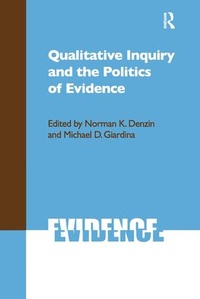
Qualitative Inquiry and the Politics of Evidence
1st Edition
Published on 15. May 2008
Book
Hardback
352 pages
978-1-59874-321-0 (ISBN)
Description
What is evidence in qualitative inquiry and how is it evaluated? What is true or false in research is strongly influenced by socially defined criteria and by the politics of academia. In providing an alternative to conservative science, qualitative researchers are often victimized by these politics. The use of qualitative evidence within the policy arena is also subject to social and political factors. Within qualitative inquiry itself, evidence is defined differently in different discourses-law, medicine, history, cultural, or performance studies. The interdisciplinary, international group of contributors to this volume address these questions in an attempt to create evidential criteria for qualitative work. Sponsored by the International Center for Qualitative Inquiry.
More details
Series
Language
English
Place of publication
Walnut Creek
United States
Target group
College/higher education
Illustrations
Illustrations
Dimensions
Height: 229 mm
Width: 152 mm
Weight
572 gr
ISBN-13
978-1-59874-321-0 (9781598743210)
Copyright in bibliographic data and cover images is held by Nielsen Book Services Limited or by the publishers or by their respective licensors: all rights reserved.
Schweitzer Classification
Other editions
Additional editions
Norman K. Denzin | Michael D. Giardina
Qualitative Inquiry and the Politics of Evidence
E-Book
09/2016
Routledge
€55.49
Available for download
Norman K. Denzin | Michael D. Giardina
Qualitative Inquiry and the Politics of Evidence
E-Book
09/2016
Routledge
€55.49
Available for download
Norman K. Denzin | Michael D. Giardina
Qualitative Inquiry and the Politics of Evidence
Book
08/2009
1st Edition
Left Coast Press Inc
€69.51
Shipment within 3-4 weeks
Persons
Norman K. Denzin, Michael D. Giardina
Content
Introduction, Norman K. Denzin, Michael D. Giardina; Policy Intentions; Chapter 1 Building Confidence in Qualitative Research, Harry Torrance; Chapter 2 On Promoting Rigor in Educational Research, Ian Stronach; Chapter 3 Isolating Science from the Humanities, Kenneth R. Howe; Chapter 4 A Fine Line, Julianne Cheek; Theoretical and Methodological Interruptions; Chapter 5 The Evidentiary Narrative, David L. Altheide; Chapter 6 I The Value of a Realist Understanding of Causality for Qualitative Research, Joseph A. Maxwell; Chapter 7 (Post)Feminist Methodology, Lather Patti; Chapter 8 Qualitative Researchers' Conceptualizations of the Risks Inherent in Qualitative Interviews, Janice M. Morse, Linda Niehaus, Stanley Varnhagen, Wendy Austin, Michele McIntosh; Performative Interventions; Chapter 9 Narrative Poetics and Performative Interventions, D. Soyini Madison; Chapter 10 From Politicized Knowledge to Standardized Knowing, Christopher Darius Stonebanks; Chapter 11 Heartbeats, Mary E. Weems, Carolyne J. White, Lois Melina, Phoenix deCarteret, Ruth Nicole Brown, Clarence Shelley, Jonathan Wyatt, Jackie Goode, Tim Bond, Patricia Alvarez McHatton, Lois Ann Scheidt; Chapter 12 Cancer and Death, Leah Vande Berg, Nick Trujillo, Kimo Ah Yun, Janis Andersen, Sylvia Fox, Rona Halualani, Janellen Hill, Thom McCain, Juliane Mora, Carol Pagelson, Laurie St. Aubin, Jillian Tullis Owen, Morrie Vande Berg, David Zuckerman; Chapter 13 Let's Get Personal, Carolyn Ellis, Arthur P. Bochner, Norman K. Denzin, H. L. (Bud) GoodallJr., Ron Pelias, Laurel Richardson;