

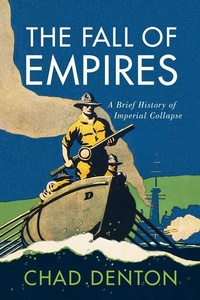
The Fall of Empires
A Brief History of Imperial Collapse
Published on 28. May 2020
Book
Hardback
240 pages
978-1-59416-334-0 (ISBN)
Description
A Historical Survey of the Many Ways Empires have Succumbed to External and Internal Pressures
There are no self-proclaimed empires today. After the twentieth century, with its worldwide wave of decolonizing and liberation movements, the very word "empire" conjures images of slavery, war, repression, and colonialism. None of this is to say that empires are confined to the past, however. By at least some reasonable definitions, empires do exist today. Many articles and books speak about the decline of the "American Empire," for example, or compare the history of the United States to that of Rome or the British Empire. Yet no public official would speak candidly of American "imperial" interests in the Middle East or use the word "empire" in discussions of the nation's future the same way British politicians did in the twentieth century. In addition, empires don't have to fit the classical Roman mold; there are many kinds of empire and varieties of international authority, such as cultural imperialism and economic imperialism. But it is clear empires do not last, even those that once harnessed great wealth, strong armies, and sophisticated legal systems.
InThe Fall of Empires: A Brief History of Imperial Collapse, historian Chad Denton describes the end of seventeen empires throughout world history, from Athens to Qin China, from the Byzantium to the Mughals. He reveals--through stories of conquest, corruption, incompetence, assassination, bigotry, and environmental crisis--how even the most seemingly eternal of empires declined. For Athens and Britain it was military hubris; for Qin China and Russia it was alienating their subjects through oppression; Persia succumbed with the loss of its capital; the Khmer faced ecological catastrophe; while the Aztecs were destroyed by colonial exploitation. None of these events alone explains why the empires fell, but they do provide a glimpse into the often-unpredictable currents of history, which have so far spared no empire. A fascinating and instructive survey, The Fall of Empiresprovides compelling evidence about the fate of centralized regional or global power.
There are no self-proclaimed empires today. After the twentieth century, with its worldwide wave of decolonizing and liberation movements, the very word "empire" conjures images of slavery, war, repression, and colonialism. None of this is to say that empires are confined to the past, however. By at least some reasonable definitions, empires do exist today. Many articles and books speak about the decline of the "American Empire," for example, or compare the history of the United States to that of Rome or the British Empire. Yet no public official would speak candidly of American "imperial" interests in the Middle East or use the word "empire" in discussions of the nation's future the same way British politicians did in the twentieth century. In addition, empires don't have to fit the classical Roman mold; there are many kinds of empire and varieties of international authority, such as cultural imperialism and economic imperialism. But it is clear empires do not last, even those that once harnessed great wealth, strong armies, and sophisticated legal systems.
InThe Fall of Empires: A Brief History of Imperial Collapse, historian Chad Denton describes the end of seventeen empires throughout world history, from Athens to Qin China, from the Byzantium to the Mughals. He reveals--through stories of conquest, corruption, incompetence, assassination, bigotry, and environmental crisis--how even the most seemingly eternal of empires declined. For Athens and Britain it was military hubris; for Qin China and Russia it was alienating their subjects through oppression; Persia succumbed with the loss of its capital; the Khmer faced ecological catastrophe; while the Aztecs were destroyed by colonial exploitation. None of these events alone explains why the empires fell, but they do provide a glimpse into the often-unpredictable currents of history, which have so far spared no empire. A fascinating and instructive survey, The Fall of Empiresprovides compelling evidence about the fate of centralized regional or global power.
More details
Language
English
Product notice
sewn/stitched
Cloth over boards
Dimensions
Height: 240 mm
Width: 160 mm
Thickness: 22 mm
Weight
470 gr
ISBN-13
978-1-59416-334-0 (9781594163340)
Copyright in bibliographic data and cover images is held by Nielsen Book Services Limited or by the publishers or by their respective licensors: all rights reserved.
Schweitzer Classification
Other editions
Additional editions

E-Book
05/2020
Westholme Publishing
€34.49
Available for download
Person
Chad Denton received his PhD in History from the University of Missouri. He is the author of Decadence, Radicalism, and the Early Modern French Nobility: The Enlightened and Depraved.