

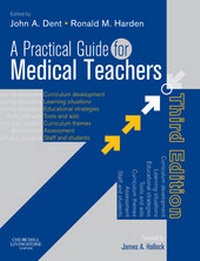
A Practical Guide for Medical Teachers
3rd Edition
Published on 18. June 2009
Book
Paperback/Softback
452 pages
978-0-7020-3123-6 (ISBN)
Description
This third edition of the highly-praised "Practical Guide for Medical Teachers" continues to provide a bridge between theoretical aspects of medical education and the practical delivery of enthusiastic teaching. As in its previous editions it will act as an invaluable aid to clinicians as well as other healthcare teachers in their understanding of contemporary educational principles, providing practical help in the delivery of the variety of teaching situations which characterise present day curricula. Key concepts and tips are presented in a digestible form and in a way which indicates both their immediate relevance and practical implications.
More details
Edition
3rd Revised edition
Language
English
Place of publication
London
United Kingdom
Publishing group
Elsevier Health Sciences
Target group
Professional and scholarly
All involved in teaching within healthcare disciplines
Edition type
Revised edition
Illustrations
Illustrated
Dimensions
Height: 189 mm
Width: 246 mm
ISBN-13
978-0-7020-3123-6 (9780702031236)
Copyright in bibliographic data and cover images is held by Nielsen Book Services Limited or by the publishers or by their respective licensors: all rights reserved.
Schweitzer Classification
Other editions
New editions
John Dent | Ronald M. Harden
A Practical Guide for Medical Teachers
Book
07/2013
4th Edition
Churchill Livingstone
€88.08
Article exhausted; check for reprint
Previous edition

John A. Dent | Ronald M. Harden
A Practical Guide for Medical Teachers
Book
06/2005
2nd Edition
Churchill Livingstone
€58.17
Article exhausted; check for reprint
Content
SECTION 1 CURRICULUM DEVELOPMENT 1. New horizons in medical education 2. Curriculum planning and development 3. The undergraduate curriculum 4. Clinical learning in the early years 5. Early years of postgraduate training 6. Later years of postgraduate or specialist training 7. Continuing professional development 8. Preparing for general practice 9. Educational environment SECTION 2 LEARNING SITUATIONS 10. Lectures 11. Learning in small groups 12. Clinical skills centre teaching 13. Bedside teaching 14. Ambulatory care teaching 15. In the community 16. Rural and remote locations 17. Distance education 18. Peer-assisted learning 19. Mentoring SECTION 3 EDUCATIONAL STRATEGIES 20. Outcome-based curriculum 21. Independent learning 22. Problem-based learning 23. Integrated learning 24. Interprofessional education 25. Core curriculum and student-selected components SECTION 4 TOOLS AND AIDS 26. Instructional Design 27. Study Guides 28. Simulators and simulation-based medical education 29. Simulated/standardised patients 30. e-learning and e-teaching 31. Healthcare education informatics 32. m-learning SECTION 5 CURRICULUM THEMES 33. Basic and clinical sciences 34. Basic sciences and curriculum outcomes 35. Clinical communication 36. Ethics and attitudes 37. Professionalism 38. Preparing for practice 39. Evidence-based medicine SECTION 6 ASSESSMENT 40. Principles of assessment 41. Standard setting 42. Choosing assessment instruments 43. Written assessments 44. Performance assessment 45. Workplace-based assessment 46. Portfolios, dissertations and projects 47. Giving feedback SECTION 7 STAFF AND STUDENTS 48. Student selection 49. Student support 50. Study skills 51. Staff development 52. Academic standards and scholarship 53. Publishing and research