

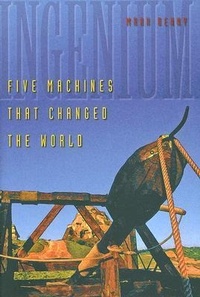
Ingenium
Five Machines That Changed the World
Published on 25. July 2007
Book
Hardback
200 pages
978-0-8018-8586-0 (ISBN)
Description
Ingenium is medieval English vernacular for "an ingenious contrivance." In this fascinating book, physicist Mark Denny considers five such contrivances-the bow and arrow, the waterwheel, the counterpoise siege engine (including the trebuchet), the pendulum clock anchor escapement, and the centrifugal governor-and demonstrates how they literally changed the world. Interweaving an entertaining narrative with diagrams, equations, and drawings, Denny shares the history of each device, explains the physics behind it, and describes how it was used, how it evolved, and why it is significant in today's world. Consider the bow and arrow, which transformed warfare by allowing soldiers to attack their enemies at a safe distance. Or the waterwheel, which enabled Old World civilizations to grind grain, pump water, and power machines during a period of extreme labor shortages. Medieval warriors engaged in an early form of biological warfare by using the trebuchet to launch dead animals or plague-ridden corpses over enormous fortress walls.
The pendulum clock forever enslaved modern humans to the clock by linking the accurate measure of time to the burdens of schedules, deadlines, promptness, and tardiness. And the centrifugal governor gave rise to an entire branch of modern engineering science: feedback control. Reflecting on the inventors of these ancient machines and the times in which they lived, Denny concludes with thought-provoking observations about inventors, inventiveness, genius, and innovation. Whether you dream of making a better mousetrap or launching pumpkins into the stratosphere, Ingenium will tickle your fancy.
The pendulum clock forever enslaved modern humans to the clock by linking the accurate measure of time to the burdens of schedules, deadlines, promptness, and tardiness. And the centrifugal governor gave rise to an entire branch of modern engineering science: feedback control. Reflecting on the inventors of these ancient machines and the times in which they lived, Denny concludes with thought-provoking observations about inventors, inventiveness, genius, and innovation. Whether you dream of making a better mousetrap or launching pumpkins into the stratosphere, Ingenium will tickle your fancy.
Reviews / Votes
Denny has produced a book that is both educational and entertaining. Physics World 2007 This book will give the reader an appreciation of the effectiveness of ancient technology. It will also be a useful reference for engineering and physics instructors. -- Eugene E. Nalence Science Books and Films 2007 User friendly, filled with humor and practicality... not only 'technology wizes' but 'history buffs' and humanists too will enjoy and profit from this book. -- Ilia Stambler European Legacy 2008 The subject matter is extremely well described. -- Brian Gee School Science Review 2008 A well-written, illustrated, and informative book that is readable to all but the mentally lazy. Choice 2008 [ Ingenium] is a good place to learn how they actually worked and how far they could effectively serve the purposes of those who made and used them. -- Alex Keller Technology and Culture 2010More details
Language
English
Place of publication
Baltimore, MD
United States
Product notice
sewn/stitched
Paper over boards
With dust jacket
Illustrations
23 s/w Zeichnungen, 52 s/w Photographien bzw. Rasterbilder
52 Halftones, black and white; 23 Line drawings, black and white
Dimensions
Height: 235 mm
Width: 164 mm
Thickness: 24 mm
Weight
416 gr
ISBN-13
978-0-8018-8586-0 (9780801885860)
DOI
10.1353/book.3448
Copyright in bibliographic data and cover images is held by Nielsen Book Services Limited or by the publishers or by their respective licensors: all rights reserved.
Schweitzer Classification
Other editions
Additional editions
E-Book
07/2007
Johns Hopkins University Press
€22.49
Available for download
Person
After earning a Ph.D. in theoretical physics from Edinburgh University, Mark Denny pursued research at Oxford University from 1981 to 1984, then moved into a career in industry. For nearly twenty years he developed radar and sonar systems for several multinational aerospace corporations. He is now retired and lives on Vancouver Island.
Content
Acknowledgments
Timeline
Introduction
1. Bow and Arrow
2. Waterwheels and Windmills
3. Counterpoise Siege Engines
4. Pendulum Clock Anchor Escapement
5. Centrifugal Governor
6. Inventiveness
Further Reading
Index
Timeline
Introduction
1. Bow and Arrow
2. Waterwheels and Windmills
3. Counterpoise Siege Engines
4. Pendulum Clock Anchor Escapement
5. Centrifugal Governor
6. Inventiveness
Further Reading
Index