

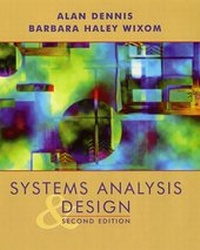
Systems Analysis and Design
2nd Edition
Published on 27. November 2002
Book
Hardback
544 pages
978-0-471-07322-2 (ISBN)
Description
Get the skills you need to do SAD! In a field as exciting and dynamic as System Analysis and Design (SAD), there will always be new techniques and approaches to develop systems more effectively and efficiently. But if you want to succeed in SAD, you'll need a solid foundation of skills you can rely on-no matter what the approach or methodology. That's why Alan Dennis and Barb Wixom's SYSTEMS ANALYSIS AND DESIGN focuses on the core set of skills that all analysis must possess-from gathering rewuirements and modeling business needs to creating blueprints for how the system should be built. Now updated and revised, the new edition features reorganized chapters, new topics, and expanded detail. FEATURES: Focus on doing SAD. This text encourages you to do SAD. After presenting the how and what of each major technique, the text guides you through practice problems and then invites you to use the technique in a project. New and expanded coverage. The Second Edition presents a new half chapter about the project selection process, as well as more detailed coverage of economic feasibility, process modeling, data modeling, and IT architecture. New real-life examples, cases, and skills.
The book includes a running case, which serves as a template that you can apply to your own work. Chapters also include "Concepts in Action" boxes, which describe how real companies succeeded (and failed) in performing the activities in that chapter. Object-oriented concepts and techniques. Object-oriented concepts are included throughout the book, and a final chapter focuses on the major elements of UML. Project-based approach. Topics are presented in the order in which an analyst would encounter them in a typical project. Tips from the pros. Interviews of seven CIOs on about project selection and management are integrated throughout the book. Student Web Site. Includes hands-on exercises, Word and RTF templates for project deliverables, PowerPoint slides, and relevant internet links.
The book includes a running case, which serves as a template that you can apply to your own work. Chapters also include "Concepts in Action" boxes, which describe how real companies succeeded (and failed) in performing the activities in that chapter. Object-oriented concepts and techniques. Object-oriented concepts are included throughout the book, and a final chapter focuses on the major elements of UML. Project-based approach. Topics are presented in the order in which an analyst would encounter them in a typical project. Tips from the pros. Interviews of seven CIOs on about project selection and management are integrated throughout the book. Student Web Site. Includes hands-on exercises, Word and RTF templates for project deliverables, PowerPoint slides, and relevant internet links.
More details
Edition
2nd Revised edition
Language
English
Place of publication
New York
United States
Publishing group
John Wiley and Sons Ltd
Target group
College/higher education
Edition type
Revised edition
Illustrations
Illustrations
Dimensions
Height: 263 mm
Width: 208 mm
Weight
1247 gr
ISBN-13
978-0-471-07322-2 (9780471073222)
Copyright in bibliographic data and cover images is held by Nielsen Book Services Limited or by the publishers or by their respective licensors: all rights reserved.
Schweitzer Classification
Other editions
New editions
Alan Dennis
Systems Analysis and Design
Book
09/2005
3rd Edition
Wiley
€54.90
Article exhausted; check for reprint

Book
10/2002
2nd Edition
Wiley
€54.90
Article is exhausted; no reprint
Previous edition
Book
01/2000
Wiley
€49.90
Article exhausted; check for reprint
Content
Preface.Introduction. PART I: PLANNING PHASE. Project Initiation. Project Management. PART II: ANALYSIS PHASE. Requirements Determination. Use--Case Analysis. Process Modeling. Data Modeling. PART III: DESIGN PHASE. System Design. Architecture Design. User Interface Design. Data Storage Design. Program Design. PART IV: IMPLEMENTATION PHASE. Construction. Installation. The Movement to Objects.Index.