

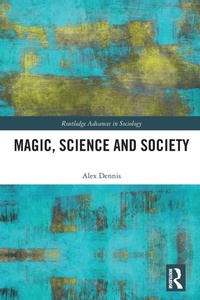
Magic, Science and Society
1st Edition
Published on 29. August 2025
Book
Paperback/Softback
134 pages
978-1-032-78758-9 (ISBN)
Description
Magic, Science and Society investigates the way the 'rationality debate' has developed over the last century, from E.E. Evans-Pritchard's study of Azande magic, through Peter Winch's argument that there can be no such thing as a social science, across the arguments about the proper status of science in the 1970s and 1980s, to the 'epistemological' and 'ontological' turns of the early twenty-first century.
Different people have different understandings of what is rational: some practise magic, some orientate to legal convention and tradition and others defer to science and logic. Starting with anthropological studies of witchcraft, and working through to contemporary debates about epistemology and ontology in social science, this book systematically examines the ways key questions about these issues have been framed and answered. These include:
Can 'magic' be real, either for members of the cultures that practise it or more generally?
How can we arbitrate between different types of rationality?
Is science a benchmark for studying other forms of rationality or just a cultural practice like any other?
What are the implications of these issues for the social sciences themselves?
This book will be of interest to anthropologists, sociologists, philosophers of the social sciences and science studies practitioners.
Different people have different understandings of what is rational: some practise magic, some orientate to legal convention and tradition and others defer to science and logic. Starting with anthropological studies of witchcraft, and working through to contemporary debates about epistemology and ontology in social science, this book systematically examines the ways key questions about these issues have been framed and answered. These include:
Can 'magic' be real, either for members of the cultures that practise it or more generally?
How can we arbitrate between different types of rationality?
Is science a benchmark for studying other forms of rationality or just a cultural practice like any other?
What are the implications of these issues for the social sciences themselves?
This book will be of interest to anthropologists, sociologists, philosophers of the social sciences and science studies practitioners.
More details
Series
Language
English
Place of publication
London
United Kingdom
Publishing group
Taylor & Francis Ltd
Target group
College/higher education
Postgraduate and Undergraduate
Dimensions
Height: 234 mm
Width: 156 mm
Thickness: 8 mm
Weight
228 gr
ISBN-13
978-1-032-78758-9 (9781032787589)
Copyright in bibliographic data and cover images is held by Nielsen Book Services Limited or by the publishers or by their respective licensors: all rights reserved.
Schweitzer Classification
Other editions
Additional editions
Alex Dennis
Magic, Science and Society
Book
06/2024
1st Edition
Routledge
€205.70
Shipment within 15-20 days
Alex Dennis
Magic, Science and Society
E-Book
06/2024
1st Edition
Routledge
€60.49
Available for download
Alex Dennis
Magic, Science and Society
E-Book
06/2024
1st Edition
Routledge
€60.49
Available for download
Person
Alex Dennis is Lecturer in Sociology at the University of Sheffield, UK, where he also leads the BA Sociology programme. His research explores theories of rationality, ethnomethodology and conversational analysis, ethnographic methodologies, workplace and organisational studies, sociologies of knowledge, social interaction and social order perspectives. He is the author of Making Decisions about People: The Organisational Contingencies of Illness (Routledge, 2001), co-author of Perspectives in Sociology (Sixth Edition, Routledge, 2015) and co-editor of Human Agents and Social Structures (2010).
Content
Introduction 1. Understanding magic 2. The implications of magic 3. A social science? 4. The 'rationality debate' 5. Redefining rationality 6. Is that what you want 'cause that's what'll happen Conclusion: Opportunities lost