

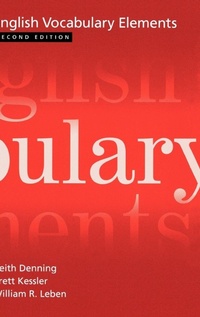
English Vocabulary Elements
2nd Edition
Published on 1. March 2007
Book
Hardback
336 pages
978-0-19-516802-0 (ISBN)
Description
Fascination with words-their meanings, origins, pronunciation, usages-is something most of us experience at some point. This book aims both to fuel and to satisfy that fascination.
The book is based on a course that each of the authors helped to develop at Stanford University over the past twenty years. The aim of the course was to help students master English vocabulary and to provide the fundamentals for pursuing an interest in English words. To this end, the book offers a detailed but introductory survey of the developments that have given English a uniquely rich vocabulary, taking into account both the changing structure of the language and the historical events that
shaped the language as a whole. Anyone who believes that changes in the language are robbing it of its elegance or expressive power will see this view challenged by the developments described here.
At the core of the book are a set of several hundred vocabulary elements that English borrowed, directly or indirectly, over the past fifteen hundred years, from Latin and Greek. These elements, introduced gradually chapter by chapter, provide a key to understanding the structure and meaning of much of the learned vocabulary of the language.
The chapters trace the history and structure of English words from the sixth century onward, laying out the major influences that are still observable in our vocabulary today. Each chapter ends with a large number of exercises. These offer many different types of practice with the material in the text, making it possible to tailor the work to different sets of needs and interests.
Upon finishing this textbook, students will be able to penetrate the structure of an enormous portion of the vocabulary of English, with or without the help of a dictionary, and to understand better how an individual word fits into the system of the language.
This second edition incorporates improved and refined text as well as examples and exercises, with thorough revision of pedagogy as a result of their significant classroom-based expertise. The new edition also updates cultural references, accounts for variations in pronunciation among students, and clarifies when historical details are important or peripheral.
The book is based on a course that each of the authors helped to develop at Stanford University over the past twenty years. The aim of the course was to help students master English vocabulary and to provide the fundamentals for pursuing an interest in English words. To this end, the book offers a detailed but introductory survey of the developments that have given English a uniquely rich vocabulary, taking into account both the changing structure of the language and the historical events that
shaped the language as a whole. Anyone who believes that changes in the language are robbing it of its elegance or expressive power will see this view challenged by the developments described here.
At the core of the book are a set of several hundred vocabulary elements that English borrowed, directly or indirectly, over the past fifteen hundred years, from Latin and Greek. These elements, introduced gradually chapter by chapter, provide a key to understanding the structure and meaning of much of the learned vocabulary of the language.
The chapters trace the history and structure of English words from the sixth century onward, laying out the major influences that are still observable in our vocabulary today. Each chapter ends with a large number of exercises. These offer many different types of practice with the material in the text, making it possible to tailor the work to different sets of needs and interests.
Upon finishing this textbook, students will be able to penetrate the structure of an enormous portion of the vocabulary of English, with or without the help of a dictionary, and to understand better how an individual word fits into the system of the language.
This second edition incorporates improved and refined text as well as examples and exercises, with thorough revision of pedagogy as a result of their significant classroom-based expertise. The new edition also updates cultural references, accounts for variations in pronunciation among students, and clarifies when historical details are important or peripheral.
More details
Edition
2nd Revised edition
Language
English
Place of publication
New York
United States
Target group
Adult education
Edition type
Revised edition
Product notice
Laminated cover
Illustrations
8 line illus.
Dimensions
Height: 234 mm
Width: 156 mm
Thickness: 21 mm
Weight
651 gr
ISBN-13
978-0-19-516802-0 (9780195168020)
Copyright in bibliographic data and cover images is held by Nielsen Book Services Limited or by the publishers or by their respective licensors: all rights reserved.
Schweitzer Classification
Other editions
Additional editions
Keith Denning | Brett Kessler | William R. Leben
English Vocabulary Elements
Book
03/2007
2nd Edition
Oxford University Press Inc
€25.40
Article exhausted; check different version
Keith Denning | Brett Kessler | William R. Leben
English Vocabulary Elements
E-Book
02/2007
2nd Edition
OUP USA
€19.99
Available for download
Persons
Keith Denning was Professor of Linguistics at Eastern Michigan University until his death in 1998.
Brett Kessler is Assistant Professor of Psychology and of PNP (Philosophy-Neuroscience-Psychology) at Washington University in St. Louis. William R. Leben is Emeritus Professor of Linguistics at Stanford University.
Brett Kessler is Assistant Professor of Psychology and of PNP (Philosophy-Neuroscience-Psychology) at Washington University in St. Louis. William R. Leben is Emeritus Professor of Linguistics at Stanford University.