

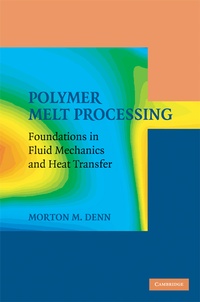
Polymer Melt Processing
Foundations in Fluid Mechanics and Heat Transfer
Published on 4. August 2008
Book
Hardback
264 pages
978-0-521-89969-7 (ISBN)
Description
Most of the shaping in the manufacture of polymeric objects is carried out in the melt state, as it is a substantial part of the physical property development. Melt processing involves an interplay between fluid mechanics and heat transfer in rheologically complex liquids, and taken as a whole it is a nice example of the importance of coupled transport processes. This book is on the underlying foundations of polymer melt processing, which can be derived from relatively straightforward ideas in fluid mechanics and heat transfer; the level is that of an advanced undergraduate or beginning graduate course, and the material can serve as the text for a course in polymer processing or for a second course in transport processes.
Reviews / Votes
'I have always admired Denn's ability to write authoritative and straightforward student texts on applied fluid mechanics ... I urge every research worker in polymer processing to have a copy to hand ...' Journal of Non-Newtonian Fluid Mechanics '... a pedagogical masterpiece ... It is highly recommended to all graduate students and researchers in polymer processing. It would also be useful to be read by process engineers working in industry, who are frequently confused and bewildered by the avalanche of equations found in the literature, which is mostly written by academics.' International Polymer Processing 'I highly recommend this book. It can be used as a textbook for a course in polymer processing for advanced undergraduate or beginning graduate students as well as a reference book for engineers and scientists who are interested in polymer processing. All readers will find it easy to read, interesting, authoritative, thoughtful and instructive.' AIChE JournalMore details
Series
Language
English
Place of publication
Cambridge
United Kingdom
Target group
Professional and scholarly
Dimensions
Height: 260 mm
Width: 183 mm
Thickness: 23 mm
Weight
810 gr
ISBN-13
978-0-521-89969-7 (9780521899697)
Copyright in bibliographic data and cover images is held by Nielsen Book Services Limited or by the publishers or by their respective licensors: all rights reserved.
Schweitzer Classification
Other editions
Additional editions
Book
07/2014
Cambridge University Press
€120.20
Shipment within 15-20 days
E-Book
08/2008
Cambridge University Press
€70.99
Available for download
Person
Morton M. Denn is the Albert Einstein Professor and Director of the Benjamin Levich Institute for Physico-Chemical Hydrodynamics at the City College of New York, CUNY. Prior to joining CCNY in 1999, he was Professor of Chemical Engineering at the University of California, Berkeley, where he served as Department Chair, as well as Program Leader in the Materials Sciences Division of the Lawrence Berkeley National Laboratory. He previously taught chemical engineering at the University of Delaware, where he was the Allan P. Colburn Professor. Professor Denn was Editor of AIChE Journal from 1985 to 1991 and Editor of the Journal of Rheology from 1995 to 2005. He is the recipient of a Guggenheim Fellowship; a Fulbright Lectureship; the Professional Progress, William H. Walker, Warren K. Lewis, and Institute Lectureship Awards of the American Institute of Chemical Engineers; the Chemical Engineering Lectureship of the American Society for Engineering Education; and the Bingham Medal and Distinguished Service Awards of the Society of Rheology. He is a member of the National Academy of Engineering and the American Academy of Arts and Sciences, and he received an honorary D.Sc. from the University of Minnesota. His previous books are Optimization by Variational Methods, Introduction to Chemical Engineering Analysis (as co-author), Stability of Reaction and Transport Processes, Process Fluid Mechanics, and Process Modeling.
Content
1. Polymer processing; 2. Fundamentals; 3. Extrusion; 4. Temperature and pressure effects in flow; 5. The thin gap approximation; 6. Quasi-steady analysis of mold filling; 7. Fiber spinning; 8. Numerical simulation; 9. Polymer melt rheology; 10. Viscoelasticity in processing flows; 11. Stability and sensitivity; 12. Wall slip and extrusion; 13. Structured fluids; 14. Mixing and dispersion.