

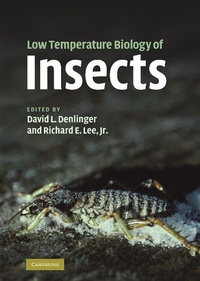
Low Temperature Biology of Insects
Published on 28. January 2010
Book
Hardback
406 pages
978-0-521-88635-2 (ISBN)
Description
Low temperature is a major environmental constraint impacting the geographic distribution and seasonal activity patterns of insects. Written for academic researchers in environmental physiology and entomology, this book explores the physiological and molecular mechanisms that enable insects to cope with a cold environment and places these findings into an evolutionary and ecological context. An introductory chapter provides a primer on insect cold tolerance and subsequent chapters in the first section discuss the organismal, cellular and molecular responses that allow insects to survive in the cold despite their, at best, limited ability to regulate their own body temperature. The second section, highlighting the evolutionary and macrophysiological responses to low temperature, is especially relevant for understanding the impact of global climate change on insect systems. A final section translates the knowledge gained from the rest of the book into practical applications including cryopreservation and the augmentation of pest management strategies.
More details
Language
English
Place of publication
Cambridge
United Kingdom
Target group
Professional and scholarly
Illustrations
16 Tabellen, 48 s/w Abbildungen
16 Tables, unspecified; 5 Halftones, unspecified; 43 Line drawings, unspecified
Dimensions
Height: 250 mm
Width: 175 mm
Thickness: 26 mm
Weight
877 gr
ISBN-13
978-0-521-88635-2 (9780521886352)
Copyright in bibliographic data and cover images is held by Nielsen Book Services Limited or by the publishers or by their respective licensors: all rights reserved.
Schweitzer Classification
Other editions
Additional editions
David L. Denlinger | Richard E. Lee, Jr
Low Temperature Biology of Insects
E-Book
04/2010
1st Edition
Cambridge University Press
€133.99
Available for download
David L. Denlinger
Low Temperature Biology of Insects
E-Book
01/2010
1st Edition
Cambridge University Press
€112.99
Available for download
Persons
David L. Denlinger is Distinguished University Professor at the Ohio State University. He is a recipient of the Recognition Award in Insect Physiology, Biochemistry and Toxicology from the Entomological Society of America and a member of the National Academy of Sciences. He is a Fellow of AAAS, the Entomological Society of America and the Royal Entomological Society. Richard E. Lee, Jr is Distinguished Professor of Zoology at Miami University, Oxford, Ohio. His honors include several teaching awards, the Benjamin Harrison Medallion from Miami University and election as a Fellow in AAAS, the Entomological Society of America and the Royal Entomological Society.
Content
Preface; Part I. Physiological and Molecular Responses: 1. A primer on insect cold tolerance Richard E. Lee, Jr,; 2. Rapid cold-hardening: ecological significance and underpinning mechanisms Richard E. Lee, Jr and David L. Denlinger; 3. Antifreeze and ice nucleator proteins John G. Duman, Kent R. Walters, Todd Sformo, Martin A. Carasco, Philip K. Nickell, Xia Lin and Brian M. Barnes; 4. Genomics, proteomics and metabolomics: finding the other players in insect cold tolerance M. Robert Michaud and David L. Denlinger; 5. Cell structural modifications in insects at low temperatures Vladimir Kostal; 6. Oxygen: stress and adaptation in cold hardy insects Kenneth B. Storey and Janet M. Storey; 7. Interactions between cold, desiccation and environmental toxins Martin Holmstrup, Mark Bayley, Sindre A. Pedersen and Karl Erik Zachariassen; Part II. Ecological and Evolutionary Responses: 8. The macrophysiology of insect cold hardiness Steven L. Chown and Brent J. Sinclair; 9. Evolutionary physiology of insect thermal adaptation to cold environments Raymond B. Huey; 10. Insects at not so low temperature: climate change in the temperate zone and its biotic consequences William E. Bradshaw and Christina M. Holzapfel; 11. Genetic variability and evolution of cold tolerance Johannes Overgaard, Jesper G. Sorensen and Volker Loeschcke; 12. Life history adaptations to polar and alpine environments Peter Convey; Part III. Practical Applications: 13. A template for insect cryopreservation Roger A. Leopold and Joseph P. Rinehart; 14. Implications of cold tolerance for pest management J. S. Bale; Index.