

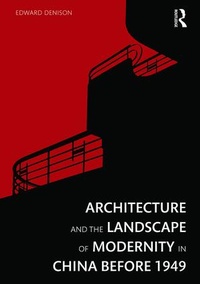
Architecture and the Landscape of Modernity in China before 1949
1st Edition
Published on 21. November 2018
Book
Paperback/Softback
390 pages
978-1-138-34218-7 (ISBN)
Description
This book explores China's encounter with architecture and modernity in the tumultuous epoch before Communism - an encounter that was mediated not by a singular notion of modernism emanating from the west, but that was uniquely multifarious, deriving from a variety of sources both from the west and, importantly, from the east. The heterogeneous origins of modernity in China are what make its experience distinctive and its architectural encounters exceptional.
These experiences are investigated through a re-evaluation of established knowledge of the subject within the wider landscape of modern art practices in China. The study draws on original archival and photographic material from different artistic genres and, architecturally, concentrates on China's engagement with the west through the treaty ports and leased territories, the emergence of architecture as a profession in China, and Japan's omnipresence, not least in Manchuria, which reached its apogee in the puppet state of Manchukuo.
The study's geographically, temporally, and architecturally inclusive approach framed by the concept of multiple modernities questions the application of conventional theories of modernity or post-colonialism to the Chinese situation. By challenging conventional modernist historiography that has marginalised the experiences of the west's other for much of the last century, this book proposes different ways of grappling with and comprehending the distinction and complexity of China's experiences and its encounter with architectural modernity.
These experiences are investigated through a re-evaluation of established knowledge of the subject within the wider landscape of modern art practices in China. The study draws on original archival and photographic material from different artistic genres and, architecturally, concentrates on China's engagement with the west through the treaty ports and leased territories, the emergence of architecture as a profession in China, and Japan's omnipresence, not least in Manchuria, which reached its apogee in the puppet state of Manchukuo.
The study's geographically, temporally, and architecturally inclusive approach framed by the concept of multiple modernities questions the application of conventional theories of modernity or post-colonialism to the Chinese situation. By challenging conventional modernist historiography that has marginalised the experiences of the west's other for much of the last century, this book proposes different ways of grappling with and comprehending the distinction and complexity of China's experiences and its encounter with architectural modernity.
More details
Language
English
Place of publication
London
United Kingdom
Publishing group
Taylor & Francis Ltd
Target group
College/higher education
Illustrations
101 s/w Photographien bzw. Rasterbilder, 44 Farbfotos bzw. farbige Rasterbilder
44 Halftones, color; 101 Halftones, black and white
Dimensions
Height: 246 mm
Width: 174 mm
Weight
720 gr
ISBN-13
978-1-138-34218-7 (9781138342187)
Copyright in bibliographic data and cover images is held by Nielsen Book Services Limited or by the publishers or by their respective licensors: all rights reserved.
Schweitzer Classification
Other editions
Additional editions
E-Book
02/2017
Routledge
€64.49
Available for download
E-Book
02/2017
Routledge
€64.49
Available for download
Edward Denison
Architecture and the Landscape of Modernity in China before 1949
Early to Mid 20th Century
Book
02/2017
1st Edition
Routledge
€237.50
Shipment within 10-20 days
Person
Edward Denison is an architectural historian and lecturer at the Bartlett School of Architecture, University College London. His previous publications include: Ultra-Modernism: Architecture and Modernity in Manchuria (2017), Luke Him Sau, Architect (2014), The Life of the British Home (2012), McMorran & Whitby (2009), Modernism in China (2008), Building Shanghai (2006), and Asmara: Africa's Secret Modernist City (2003).
Content
Part I: China and the Meaning of Modernity, 1. Introduction, 2. Intellectural Orientations: The Unavoidable Burden of Context, 3. China's Multiple Modernities, 4. Chinese Art and its Multiple Modernities, Part II: Architecture and Modernity, 5. The Advent of Architecture, 6. Foreign Settlements before 1912, 7. Modernism and Nationalism, 8. Japan: China's Mirror to Modernism, 9. Shanghai: Multiple Modernities' Exemplar, 10. China's Multiple Modernities - A Project Curtailed