

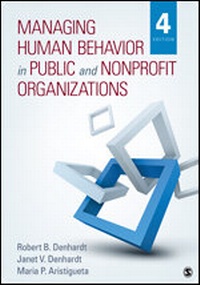
Managing Human Behavior in Public and Nonprofit Organizations
4th Edition
Published on 4. November 2015
Book
Paperback/Softback
504 pages
978-1-4833-5929-8 (ISBN)
Description
Managing Human Behavior in Public and Nonprofit Organizations helps you understand, manage, and influence the behaviour of others in the workplace. Taking an action-oriented approach the authors use real-world circumstances within public and non-profit organisations to illustrate key concepts. Important topics such as stress, decision making, motivation, leadership, communication, teams, and change give you a foundational understanding of the basic issues that affect human behaviour.
In addition to new cases and examples from the public and non-profit sectors, this edition features new material on leadership and organisational change, cultural diversity and generational diversity, and positive organisational behaviour.
NEW TO THIS EDITION:
New material on leadership and organisational change build your critical management and leadership skills, so you can act effectively and responsibly under real -world pressures
Expanded coverage of cultural diversity helps you understand, communicate with, and effectively interact with people across cultures, as well as work with varying cultural beliefs and schedules
Expanded coverage of positive organisational behaviour includes the latest research and findings that demonstrate the successful implementation of positive psychology in the workplace
New cases, examples, self-assessments, and exercises bring concepts to life with relevant ways to practice and improve your management skills.
A companion website will be available for lecturers at study.sagepub.com/denhardt4e featuring additional teaching resources.
In addition to new cases and examples from the public and non-profit sectors, this edition features new material on leadership and organisational change, cultural diversity and generational diversity, and positive organisational behaviour.
NEW TO THIS EDITION:
New material on leadership and organisational change build your critical management and leadership skills, so you can act effectively and responsibly under real -world pressures
Expanded coverage of cultural diversity helps you understand, communicate with, and effectively interact with people across cultures, as well as work with varying cultural beliefs and schedules
Expanded coverage of positive organisational behaviour includes the latest research and findings that demonstrate the successful implementation of positive psychology in the workplace
New cases, examples, self-assessments, and exercises bring concepts to life with relevant ways to practice and improve your management skills.
A companion website will be available for lecturers at study.sagepub.com/denhardt4e featuring additional teaching resources.
More details
Edition
4th Revised edition
Language
English
Place of publication
Thousand Oaks
United States
Target group
College/higher education
Edition type
Revised edition
Dimensions
Height: 254 mm
Width: 178 mm
Weight
784 gr
ISBN-13
978-1-4833-5929-8 (9781483359298)
Copyright in bibliographic data and cover images is held by Nielsen Book Services Limited or by the publishers or by their respective licensors: all rights reserved.
Schweitzer Classification
Other editions
New editions
Robert B. Denhardt | Janet V. Denhardt | Maria P. Aristigueta
Managing Human Behavior in Public and Nonprofit Organizations
Book
06/2021
5th Edition
CQ Press
€182.50
Shipment within 15-20 days
Persons
Robert B. Denhardt is Professor of Public Administration in the Price School of Public Policy at the University of Southern California. He was previously Regents Professor and Director of the School of Public Affairs at Arizona State University.
Dr. Denhardt is a past president of the American Society for Public Administration, a nationwide organization of academics and practitioners in the field of public administration at all levels of government. He is also a member of the prestigious National Academy of Public Administration, the field's equivalent of the National Academy of Science. He was the 2004 recipient of ASPA's Dwight Waldo Award, celebrating lifetime achievement in scholarship in public administration.
Dr. Denhardt has published a dozen books, including Just Plain Good Management, The Dance of Leadership, The New Public Service, Managing Human Behavior in Public and Nonprofit Organizations, The Pursuit of Significance, In the Shadow of Organization, Theories of Public Organiza-tion, and Public Administration: An Action Orientation.
Janet V. Denhardt is the Chester A. Newland Professor of Public Administration in the Price School at the University of Southern California. Dr. Denhardt is a member of the National Academy of Public Administration. She has published seven books, including The New Public Service, The Dance of Leadership, Organizational Behavior, and Street-Level Leadership, as well as numerous articles in such journals as Public Administration Review, Administration & Society, and the Journal of Public Administration Research and Theory. Her teaching and research interests focus on organizational behavior, leadership, and governance.
Maria P. Aristigueta is the president of the American Society for Public Administration, the Charles P. Messick Professor of Public Administration, the Associate Director of the School of Public Policy and Administra-tion, and the Senior Policy Fellow in the Institute of Public Administration at the University of Delaware. Her teaching and research interests are primarily in the areas of public sector management and include performance measurement, strategic planning, and organizational behavior. She has published numerous journal articles, book chapters, and books, including Managing for Results in State Government, Managing Human Behavior in Public and Nonprofit Organizations, Managing and Measuring Performance in Public and Nonprofit Organizations: An Integrated Approach, and Organizational Behavior, and she was coeditor of the International Handbook of Practice-Based Performance Management. Her doctorate is from the University of Southern California.
Dr. Denhardt is a past president of the American Society for Public Administration, a nationwide organization of academics and practitioners in the field of public administration at all levels of government. He is also a member of the prestigious National Academy of Public Administration, the field's equivalent of the National Academy of Science. He was the 2004 recipient of ASPA's Dwight Waldo Award, celebrating lifetime achievement in scholarship in public administration.
Dr. Denhardt has published a dozen books, including Just Plain Good Management, The Dance of Leadership, The New Public Service, Managing Human Behavior in Public and Nonprofit Organizations, The Pursuit of Significance, In the Shadow of Organization, Theories of Public Organiza-tion, and Public Administration: An Action Orientation.
Janet V. Denhardt is the Chester A. Newland Professor of Public Administration in the Price School at the University of Southern California. Dr. Denhardt is a member of the National Academy of Public Administration. She has published seven books, including The New Public Service, The Dance of Leadership, Organizational Behavior, and Street-Level Leadership, as well as numerous articles in such journals as Public Administration Review, Administration & Society, and the Journal of Public Administration Research and Theory. Her teaching and research interests focus on organizational behavior, leadership, and governance.
Maria P. Aristigueta is the president of the American Society for Public Administration, the Charles P. Messick Professor of Public Administration, the Associate Director of the School of Public Policy and Administra-tion, and the Senior Policy Fellow in the Institute of Public Administration at the University of Delaware. Her teaching and research interests are primarily in the areas of public sector management and include performance measurement, strategic planning, and organizational behavior. She has published numerous journal articles, book chapters, and books, including Managing for Results in State Government, Managing Human Behavior in Public and Nonprofit Organizations, Managing and Measuring Performance in Public and Nonprofit Organizations: An Integrated Approach, and Organizational Behavior, and she was coeditor of the International Handbook of Practice-Based Performance Management. Her doctorate is from the University of Southern California.
Content
Chapter 1: Organizational Behavior as a Way of Thinking and Acting
The Roots of Organizational Behavior
More Recent Developments
Does Good Management Make a Difference?
Themes and Purposes of This Book
Chapter 2: Knowing and Managing Yourself
Where Do We Begin?
Ways of Thinking
Ways of Acting
Thinking in Action
Appendix 2.A: Reddin's Personal Values Inventory
Appendix 2.B: Fundamental Interpersonal Relations Orientation-Behavior (FIRO)
Appendix 2.C: Locus of Control
Appendix 2.D: Career Orientation Inventory
Appendix 2.E: Emotional Intelligence
Chapter 3: Fostering Creativity and Innovation
Where Do We Begin?
Ways of Thinking
Ways of Acting
Thinking in Action
Chapter 4: Managing Stress
Where Do We Begin?
Ways of Thinking
Ways of Acting
Thinking in Action
Chapter 5: Decision-Making
Where Do We Begin?
Ways of Thinking
Ways of Acting
Thinking in Action
Chapter 6: Motivation and Engagement
Where Do We Begin?
Ways of Thinking
Ways of Acting
Thinking in Action
Chapter 7: Leadership in Public Organizations
Where Do We Begin?
Ways of Thinking
Ways of Acting
Thinking in Action
Chapter 8: Power and Organizational Politics
Where Do We Begin?
Ways of Thinking
Ways of Acting
Thinking in Action
Chapter 9: Communicating Effectively With Others
Where Do We Begin?
Ways of Thinking
Ways of Acting
Thinking in Action
Chapter 10: Working in Groups and Teams
Where Do We Begin?
Ways of Thinking
Ways of Acting
Thinking in Action
Chapter 11: Managing Conflict
Where Do We Begin?
Ways of Thinking
Ways of Acting
Thinking in Action
Chapter 12: Organizational Change
Where Do We Begin?
Ways of Thinking
Ways of Acting
Thinking in Action
Chapter 13: Representing the Organization "On the Outside"
Where Do We Begin?
Ways of Thinking
Ways of Acting
Thinking in Action
Chapter 14: Managing Behavior in the Public Interest
The New Public Service
Conclusion
The Roots of Organizational Behavior
More Recent Developments
Does Good Management Make a Difference?
Themes and Purposes of This Book
Chapter 2: Knowing and Managing Yourself
Where Do We Begin?
Ways of Thinking
Ways of Acting
Thinking in Action
Appendix 2.A: Reddin's Personal Values Inventory
Appendix 2.B: Fundamental Interpersonal Relations Orientation-Behavior (FIRO)
Appendix 2.C: Locus of Control
Appendix 2.D: Career Orientation Inventory
Appendix 2.E: Emotional Intelligence
Chapter 3: Fostering Creativity and Innovation
Where Do We Begin?
Ways of Thinking
Ways of Acting
Thinking in Action
Chapter 4: Managing Stress
Where Do We Begin?
Ways of Thinking
Ways of Acting
Thinking in Action
Chapter 5: Decision-Making
Where Do We Begin?
Ways of Thinking
Ways of Acting
Thinking in Action
Chapter 6: Motivation and Engagement
Where Do We Begin?
Ways of Thinking
Ways of Acting
Thinking in Action
Chapter 7: Leadership in Public Organizations
Where Do We Begin?
Ways of Thinking
Ways of Acting
Thinking in Action
Chapter 8: Power and Organizational Politics
Where Do We Begin?
Ways of Thinking
Ways of Acting
Thinking in Action
Chapter 9: Communicating Effectively With Others
Where Do We Begin?
Ways of Thinking
Ways of Acting
Thinking in Action
Chapter 10: Working in Groups and Teams
Where Do We Begin?
Ways of Thinking
Ways of Acting
Thinking in Action
Chapter 11: Managing Conflict
Where Do We Begin?
Ways of Thinking
Ways of Acting
Thinking in Action
Chapter 12: Organizational Change
Where Do We Begin?
Ways of Thinking
Ways of Acting
Thinking in Action
Chapter 13: Representing the Organization "On the Outside"
Where Do We Begin?
Ways of Thinking
Ways of Acting
Thinking in Action
Chapter 14: Managing Behavior in the Public Interest
The New Public Service
Conclusion