

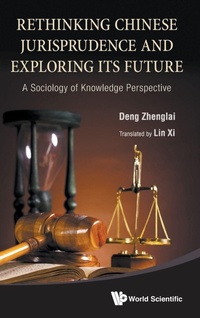
Rethinking Chinese Jurisprudence And Exploring Its Future: A Sociology Of Knowledge Perspective
Published on 19. June 2014
Book
Hardback
328 pages
978-981-4440-30-1 (ISBN)
Description
This book is an antecedent study on the task facing China's legal science, more strictly speaking - China's legal philosophy, in post-Cold War world structure. In broader terms, this is an academic study of China's own "identity" and future in the world structure. The author believes that from 1978 to 2004, in spite of its great achievements, China's legal science has at the same time had some of its grave problems being exposed. A fundamental problem is its failure to provide a "Chinese legal ideal picture" as the standard of and direction for evaluating, assessing and guiding China's law/legal development. This is an age of law without China's own ideal picture(s). However, why has China failed to have its own legal ideal picture(s)? Apparently this question in and of itself implies a question, both more directly and fundamentally, of China's legal science, namely why China's legal science has failed to provide China's own legal picture(s)? Or, as an internal critical approach may suggest (namely to critique China's legal science from the perspective of its promised objectives), where is China's legal science heading? Based on this, this book attempts to expound a standard to evaluate China's legal science through a theoretical discussion of this issue, and to further explore the possible direction for China's legal science beyond this age.
More details
Language
English
Place of publication
Singapore
Singapore
Target group
College/higher education
Dimensions
Height: 235 mm
Width: 157 mm
Thickness: 22 mm
Weight
627 gr
ISBN-13
978-981-4440-30-1 (9789814440301)
Copyright in bibliographic data and cover images is held by Nielsen Book Services Limited or by the publishers or by their respective licensors: all rights reserved.
Schweitzer Classification
Person
Content
Introduction; China's Legal Science and the "Paradigm of Modernisation"; A Critique and Reflection on the "Paradigm of Modernisation"; The Absence of "China" in China's Legal Scholarship; Further Examination of China's Legal Science (Part I): A Critique of Liang Zhiping's "Thesis of Legal Culture"; Further Examination of China's Legal Science (Part II): A Critique of Su Li's "Thesis of Indigenous Resources"; Tentative Conclusion.