

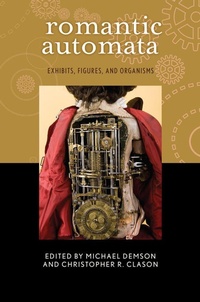
Romantic Automata
Exhibitions, Figures, Organisms
Published on 17. April 2020
Book
Paperback/Softback
264 pages
978-1-68448-176-7 (ISBN)
Description
For most of the eighteenth century, automata were deemed a celebration of human ingenuity, feats of science and reason. Among the Romantics, however, they prompted a contradictory apprehension about mechanization and contrivance: such science and engineering threatened the spiritual nature of life, the source of compassion in human society. A deep dread of puppets and the machinery that propels them consequently surfaced in late eighteenth and early nineteenth century literature. Romantic Automata is a collection of essays examining the rise of this cultural suspicion of mechanical imitations of life.
Recent scholarship in post-humanism, post-colonialism, disability studies, post-modern feminism, eco-criticism, and radical Orientalism has significantly affected the critical discourse on this topic. In engaging with the work and thought of Coleridge, Poe, Hoffmann, Mary Shelley, and other Romantic luminaries, the contributors to this collection open new methodological approaches to understanding human interaction with technology that strives to simulate, supplement, or supplant organic life.
Published by Bucknell University Press. Distributed worldwide by Rutgers University Press.
Recent scholarship in post-humanism, post-colonialism, disability studies, post-modern feminism, eco-criticism, and radical Orientalism has significantly affected the critical discourse on this topic. In engaging with the work and thought of Coleridge, Poe, Hoffmann, Mary Shelley, and other Romantic luminaries, the contributors to this collection open new methodological approaches to understanding human interaction with technology that strives to simulate, supplement, or supplant organic life.
Published by Bucknell University Press. Distributed worldwide by Rutgers University Press.
Reviews / Votes
"Romantic Automata is fascinating if idiosyncratic, and I enjoyed reading the essays immensely. Exploring literary representations of the relationship between the mechanical and the human or organic, this well-researched collection brings a range of theoretical approaches and primary sources to bear on an otherwise largely canonical debate. The readings are insightful and original, the arguments compelling and clear."- Ghislaine McDayter, author of Byromania and the Birth of Celebrity Culture"Romantic Automata is a strong collection of essays that engages a broad spectrum of European Romanticism. It fills a real need in the current scholarship of Romanticism as it connects the literary fascination with automata, dolls, and machines of the early nineteenth century with contemporary theoretical concerns with gender representation and the posthuman."- William Davis, author of Romanticism, Hellenism, and the Philosophy of Nature
"Romantic Automata is a strong collection of essays that engages a broad spectrum of European Romanticism. It fills a real need in the current scholarship of Romanticism as it connects the literary fascination with automata, dolls, and machines of the early nineteenth century with contemporary theoretical concerns with gender representation and the posthuman."- William Davis, author of Romanticism, Hellenism, and the Philosophy of Nature
"Romantic Automata is fascinating if idiosyncratic, and I enjoyed reading the essays immensely. Exploring literary representations of the relationship between the mechanical and the human or organic, this well-researched collection brings a range of theoretical approaches and primary sources to bear on an otherwise largely canonical debate. The readings are insightful and original, the arguments compelling and clear."- Ghislaine McDayter, author of Byromania and the Birth of Celebrity Culture
". . . a rich volume full of interesting topics and novel insights that makes a significant contribution to the study of the early history of posthumanism in the eighteenth and nineteenth centuries."- European Romantic Review
More details
Language
English
Place of publication
United States
Target group
Professional and scholarly
College/higher education
Product notice
Paperback (trade)
Unsewn / adhesive bound
Illustrations
9 B-W illustrations, 12 color illustrations
Dimensions
Height: 236 mm
Width: 154 mm
Thickness: 16 mm
Weight
390 gr
ISBN-13
978-1-68448-176-7 (9781684481767)
Copyright in bibliographic data and cover images is held by Nielsen Book Services Limited or by the publishers or by their respective licensors: all rights reserved.
Schweitzer Classification
Persons
Michael Demson is an associate professor at Sam Houston State University in Huntsville, Texas, where he teaches courses in Romanticism, literary theory, and world literature. He has published numerous scholarly articles, co-edited Commemorating Peterloo: Violence, Resilience and Claim-Making in the Romantic Era (2019) and a graphic novel, Masks of Anarchy (2013).
Christopher R. Clason is an emeritus professor of German language and literature at Oakland University in Rochester, Michigan. He has authored numerous articles in German medieval and Romantic literature. He is the editor of E.T.A. Hoffmann: Transgressive Romanticism (2018) and co-editor of several collections of essays.
Christopher R. Clason is an emeritus professor of German language and literature at Oakland University in Rochester, Michigan. He has authored numerous articles in German medieval and Romantic literature. He is the editor of E.T.A. Hoffmann: Transgressive Romanticism (2018) and co-editor of several collections of essays.
Content
List of Illustrations
Acknowledgements
Notes on Contributors and Co-editors
Introduction
Michael Demson and Christopher R. Clason
Chapters:
Section I: Exhibitions
1. The Uncanny Valley: E. T. A. Hoffmann, Sigmund Freud, Masahiro Mori
Frederick Burwick
2. The (Re-)Winding of Hoffmann's Automata: from Offenbach's 1881 Opera to Powell and Pressburger's 1951 Film
Ashley Shams
3. Wounded Bodies in the Lithographs of Theodore Gericault, 1818-1820
Peter Erickson
Section II: Figures
4. Romantic Tales of Pseudo Automata: The Chess-Playing Turk in Hoffmann, Poe, and Benjamin
Wendy Nielsen
5. On Toys, Violence, and Automated Gender
Erin Goss
6. Automatic for All: Mary Shelley's Posthuman Passion
Kate Singer
7. "A little earthly idol to contract your ideas": Global Hermeneutics in Phebe Gibbes's Zoriada, or, Village Annals (1786)
Kathryn Freeman
Section III: Organisms
8. Schelling's Uncanny Organism
Stefani Engelstein
9. "it [...] lives by dying": S. T. Coleridge's Mechanical Life and Colonial Necropolitics
Lenora Hanson
10. The Metaphysical Machinery of Mining in Novalis's Works
Christina M. Weiler
Bibliography
Index