

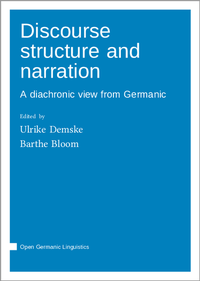
Discourse structure and narration
A diachronic view from Germanic
1st Edition
Published on 20. June 2025
Book
Hardback
364 pages
978-3-98554-149-2 (ISBN)
Description
The volume Discourse structure and narration: A diachronic view from Germanic deals with questions of information structuring at discourse level, focusing on narrative discourses. More precisely, it is about the contribution of grammatical devices to the organization of texts as well as their diagnostic potential for the narrative text type. Although it is well-known that information packaging had a much greater impact on the distribution of grammatical patterns in historical stages of a language than it does today, so far many studies on the relationship between information structure and grammatical patterns do not go beyond the sentence level, in other words, they do not take into account the possible influence of the text type on the manifestation of certain grammatical patterns. How and to which degree changes in grammatical patterns correlate or are affected by changes in either discourse and/or narrative structure, how the two layers interact with each other and affect each other, and how such issues can be operationalized are still understudied. This volume aims to shed more light on these issues by presenting eight papers, which address these questions more or less explicitly. As the research questions imply, the papers all take a historical or diachronic perspective. Another commonality between the studies is that they all focus on data from Germanic languages, as we assume that by comparing closely related languages, the relationships in question become more pronounced. Specifically, the languages in question are German, Dutch, English and Icelandic. Understandably, the contributions in this volume can only highlight some aspects of the complex relationship between grammar and narration(s). Addressing among others questions of narrative progression, temporal structure, reference tracking and discourse functions, the contributions discuss phenomena such as temporal adverbials at the left periphery as well as later in the clause, left dislocation structures, fronting of the finite verb in dependent and independent clauses, linguistic means to express aspectual and tense information, and the distribution of nominalization patterns across text types.
More details
Series
Edition
1. Auflage
Language
English
Place of publication
Berlin
Germany
Target group
Wissenschaft
Edition type
New edition
Product notice
sewn/stitched
Cloth over boards
Dimensions
Height: 246 mm
Width: 175 mm
Thickness: 28 mm
Weight
869 gr
ISBN-13
978-3-98554-149-2 (9783985541492)
DOI
10.5281/zenodo.15657267
Schweitzer Classification
Persons
Editor
Ulrike Demske is Professor of German Linguistics at the Universität Potsdam. Her research interests focus on morphosyntactic changes in the history of German. As a member of the Collaborative Research Center Limits of Variability in Language at the Universität Potsdam, Demske has recently been working on the interplay between grammatical processing and syntactic change, adressing the question of how processing ease affects syntactic change, given different dimensions of processing difficulties. A second focus of her current research is the impact of information and discourse structure on word order variation in prose narratives composed in the Early Modern Period of German. The creation of freely accessible research resources for investigating the historical syntax of this language period has always been a particular concern of hers (Baumbank.UP, Roko.UP, Potsdamer Zeitungskorpus - diachron).
Barthe Bloom is a postdoctoral researcher at the chair of English Linguistics at the Universität Erlangen-Nürnberg. Her previous position was in the DFG project Word Order and Discourse Structure in the Early Modern Period at the German department in Potsdam. Her work focuses on syntactic change in the Germanic languages, which she approaches from a usage-based, constructional perspective.