

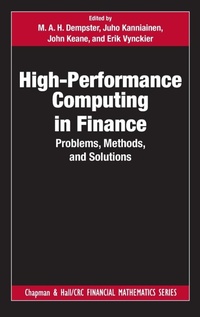
High-Performance Computing in Finance
Problems, Methods, and Solutions
1st Edition
Published on 12. March 2018
Book
Hardback
636 pages
978-1-4822-9966-3 (ISBN)
Description
High-Performance Computing (HPC) delivers higher computational performance to solve problems in science, engineering and finance. There are various HPC resources available for different needs, ranging from cloud computing- that can be used without much expertise and expense - to more tailored hardware, such as Field-Programmable Gate Arrays (FPGAs) or D-Wave's quantum computer systems. High-Performance Computing in Finance is the first book that provides a state-of-the-art introduction to HPC for finance, capturing both academically and practically relevant problems.
More details
Series
Language
English
Place of publication
Oxford
United States
Publishing group
Taylor & Francis Inc
Target group
Professional and scholarly
Illustrations
127 s/w Abbildungen, 53 s/w Tabellen
53 Tables, black and white; 127 Illustrations, black and white
Dimensions
Height: 240 mm
Width: 161 mm
Thickness: 38 mm
Weight
1112 gr
ISBN-13
978-1-4822-9966-3 (9781482299663)
Copyright in bibliographic data and cover images is held by Nielsen Book Services Limited or by the publishers or by their respective licensors: all rights reserved.
Schweitzer Classification
Other editions
Additional editions
M. A. H. Dempster | Juho Kanniainen | John Keane
High-Performance Computing in Finance
Problems, Methods, and Solutions
Book
09/2020
1st Edition
Chapman & Hall/CRC
€82.30
Shipment within 15-20 days
M. A. H. Dempster | Juho Kanniainen | John Keane
High-Performance Computing in Finance
Problems, Methods, and Solutions
E-Book
02/2018
1st Edition
Chapman & Hall/CRC
€73.49
Available for download
M. A. H. Dempster | Juho Kanniainen | John Keane
High-Performance Computing in Finance
Problems, Methods, and Solutions
E-Book
02/2018
Chapman & Hall/CRC
€73.49
Available for download
Persons
Michael Dempster is Professor Emeritus, Centre for Financial Research, University of Cambridge. He has held research and teaching appointments at leading universities globally and is founding Editor-in-Chief of Quantitative Finance. His numerous papers and books have won several awards and he is Honorary Fellow of the IFoA, Member of the Academia dei Lincei and Managing Director of Cambridge Systems Associates.
Juho Kanniainen is Professor of Financial Engineering at Tampere University of Technology, Finland. He has served as Coordinator of two international EU-programmes, HPC in Finance (www.hpcfinance.eu) and Big Data in Finance (www.bigdatafinance.eu). His research is broadly in quantitative finance focusing on computationally expensive problems and data-driven approaches.
John Keane is Professor of Data Engineering in the School of Computer Science at the University of Manchester, UK. As part of the UK Government's Foresight Project, The Future of Computer Trading in Financial Markets, he co-authored a commissioned economic impact assessment review. He has been involved in both the EU HPC in Finance and Big Data in Finance programmes. His wider research interests are data and decision analytics, and related performance aspects.
Erik Vynckier is board member of Foresters Friendly Society, partner of InsurTech Venture Partners and Chief Investment Officer of Eli Global, following a career in banking, insurance, asset management and petrochemical industry. He co-founded EU initiatives on high performance computing and big data in finance. Erik graduated as MBA at London Business School and as chemical engineer at Universiteit Gent.
Juho Kanniainen is Professor of Financial Engineering at Tampere University of Technology, Finland. He has served as Coordinator of two international EU-programmes, HPC in Finance (www.hpcfinance.eu) and Big Data in Finance (www.bigdatafinance.eu). His research is broadly in quantitative finance focusing on computationally expensive problems and data-driven approaches.
John Keane is Professor of Data Engineering in the School of Computer Science at the University of Manchester, UK. As part of the UK Government's Foresight Project, The Future of Computer Trading in Financial Markets, he co-authored a commissioned economic impact assessment review. He has been involved in both the EU HPC in Finance and Big Data in Finance programmes. His wider research interests are data and decision analytics, and related performance aspects.
Erik Vynckier is board member of Foresters Friendly Society, partner of InsurTech Venture Partners and Chief Investment Officer of Eli Global, following a career in banking, insurance, asset management and petrochemical industry. He co-founded EU initiatives on high performance computing and big data in finance. Erik graduated as MBA at London Business School and as chemical engineer at Universiteit Gent.
Content
Part I: Computationally Expensive Problems in the Financial Industry 1. Computationally Expensive Problems in Investment Banking 2. Using Market Sentiment to Enhance Second-Order Stochastic Dominance Trading Models 3. The Alpha Engine: Designing an Automated Trading Algorithm 4. Portfolio Liquidation and Ambiguity Aversion 5. Challenges in Scenario Generation: Modeling Market and Non-Market Risks in Insurance Part II: Numerical Methods in Financial High-Performance Computing (HPC) 6. Finite Difference Methods for Medium- and High-Dimensional Derivative Pricing PDEs 7. Multilevel Monte Carlo Methods for Applications in Finance 8. Fourier and Wavelet Option Pricing Methods 9. A Practical Robust Long-Term Yield Curve Model 10. Algorithmic Differentiation 11. Case Studies of Real-Time Risk Management via Adjoint Algorithmic Differentiation (AAD) 12. Tackling Reinsurance Contract Optimization by Means of Evolutionary Algorithms and HPC 13. Evaluating Blockchain Implementation of Clearing and Settlement at the IATA Clearing House Part III: HPC Systems: Hardware, Software, and Data with Financial Applications 14. Supercomputers 15. Multiscale Dataflow Computing in Finance 16. Manycore Parallel Computation 17. Practitioner's Guide on the Use of Cloud Computing in Finance 18. Blockchains and Distributed Ledgers in Retrospective and Perspective 19. Optimal Feature Selection Using a Quantum Annealer