


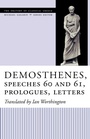
Demosthenes, Speeches 60 and 61, Prologues, Letters: Prologues, Letters
University of Texas Press
Published on 1. December 2006
Book
Hardback
178 pages
978-0-292-71331-4 (ISBN)
Description
This is the tenth volume in the Oratory of Classical Greece. This series presents all of the surviving speeches from the late fifth and fourth centuries BC in new translations prepared by classical scholars who are at the forefront of the discipline. These translations are especially designed for the needs and interests of today's undergraduates, Greekless scholars in other disciplines, and the general public. Classical oratory is an invaluable resource for the study of ancient Greek life and culture. The speeches offer evidence on Greek moral views, social and economic conditions, political and social ideology, law and legal procedure, and other aspects of Athenian culture that have recently been attracting particular interest: women and family life, slavery, and religion, to name just a few. Demosthenes is regarded as the greatest orator of classical antiquity.
This volume contains his Funeral Oration (Speech 60) for those who died in the Battle of Chaeronea in 338 BC, in which Philip of Macedonia secured his dominance over Greece, as well as the so-called Erotic Essay (Speech 61), a rhetorical exercise in which the speaker eulogizes the youth Epicrates for his looks and physical prowess and encourages him to study philosophy in order to become a virtuous and morally upright citizen. The volume also includes fifty-six prologues (the openings to political speeches to the Athenian Assembly) and six letters apparently written during the orator's exile from Athens. Because so little literature survives from the 330s and 320s BC, these works provide valuable insights into Athenian culture and politics of that era.
This volume contains his Funeral Oration (Speech 60) for those who died in the Battle of Chaeronea in 338 BC, in which Philip of Macedonia secured his dominance over Greece, as well as the so-called Erotic Essay (Speech 61), a rhetorical exercise in which the speaker eulogizes the youth Epicrates for his looks and physical prowess and encourages him to study philosophy in order to become a virtuous and morally upright citizen. The volume also includes fifty-six prologues (the openings to political speeches to the Athenian Assembly) and six letters apparently written during the orator's exile from Athens. Because so little literature survives from the 330s and 320s BC, these works provide valuable insights into Athenian culture and politics of that era.
More details
Series
Language
English
Place of publication
Austin, TX
United States
Target group
Professional and scholarly
Dimensions
Height: 216 mm
Width: 140 mm
Thickness: 12 mm
Weight
336 gr
ISBN-13
978-0-292-71331-4 (9780292713314)
Copyright in bibliographic data is held by Nielsen Book Services Limited or its licensors: all rights reserved.
Schweitzer Classification
Other editions
New editions
Book
12/2006
University of Texas Press
€25.20
Shipment within 10-20 days
Person
Ian Worthington is the Frederick A. Middlebush Professor of History at the University of Missouri-Columbia.
Content
Series Editor's Preface (Michael Gagarin) Translator's Acknowledgments (Ian Worthington) Speech Numbers and Titles Series Introduction (Michael Gagarin) Oratory in Classical Athens The Orators The Works of the Orators Government and Law in Classical Athens The Translation of Greek Oratory Abbreviations Note on Currency Bibliography of Works Cited Introduction to Demosthenes (Michael Gagarin) Life Works Style Significance Introduction to This Volume (Ian Worthington) The Works in This Volume Historical Background to the Funeral Oration and Letters The Prologues and the Erotic Essay Note on the Text DEMOSTHENES (Ian Worthington) 60. Funeral Oration 61. Erotic Essay Prologues Letters 1-6 Bibliography for This Volume Index