

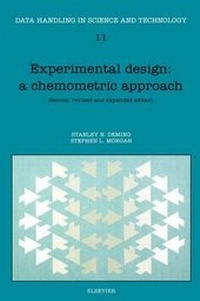
Experimental Design: A Chemometric Approach: Volume 11
2nd Edition
Published on 4. June 1993
Book
Hardback
436 pages
978-0-444-89111-2 (ISBN)
Description
Now available is the second edition of a book which has been described as "...an exceptionally lucid, easy-to-read presentation... would be an excellent addition to the collection of every analytical chemist. I recommend it with great enthusiasm." (Analytical Chemistry)
N.R. Draper reviewed the first edition in Publication of the International Statistical Institute "...discussion is careful, sensible, amicable, and modern and can be recommended for the intended readership."
The scope of the first edition has been revised, enlarged and expanded. Approximately 30% of the text is new. The book first introduces the reader to the fundamentals of experimental design. Systems theory, response surface concepts, and basic statistics serve as a basis for the further development of matrix least squares and hypothesis testing. The effects of different experimental designs and different models on the variance-covariance matrix and on the analysis of variance (ANOVA) are extensively discussed. Applications and advanced topics (such as confidence bands, rotatability, and confounding) complete the text. Numerous worked examples are presented.
The clear and practical approach adopted by the authors makes the book applicable to a wide audience. It will appeal particularly to those with a practical need (scientists, engineers, managers, research workers) who have completed their formal education but who still need to know efficient ways of carrying out experiments. It will also be an ideal text for advanced undergraduate and graduate students following courses in chemometrics, data acquisition and treatment, and design of experiments.
N.R. Draper reviewed the first edition in Publication of the International Statistical Institute "...discussion is careful, sensible, amicable, and modern and can be recommended for the intended readership."
The scope of the first edition has been revised, enlarged and expanded. Approximately 30% of the text is new. The book first introduces the reader to the fundamentals of experimental design. Systems theory, response surface concepts, and basic statistics serve as a basis for the further development of matrix least squares and hypothesis testing. The effects of different experimental designs and different models on the variance-covariance matrix and on the analysis of variance (ANOVA) are extensively discussed. Applications and advanced topics (such as confidence bands, rotatability, and confounding) complete the text. Numerous worked examples are presented.
The clear and practical approach adopted by the authors makes the book applicable to a wide audience. It will appeal particularly to those with a practical need (scientists, engineers, managers, research workers) who have completed their formal education but who still need to know efficient ways of carrying out experiments. It will also be an ideal text for advanced undergraduate and graduate students following courses in chemometrics, data acquisition and treatment, and design of experiments.
Reviews / Votes
"...is definitely an excellent summary of state-of-the-art ideas in experimental design. ...a welcome addition to the libraries of research-active chemometricians and represents new material of substantial interest to the specialist." --Analytica Chimica Acta"...it was difficult to see how it could be improved, but they have managed it! It would be wrong to think that this is a book just for college students. It is not - experienced experimenters, data analysts and statisticians can benefit from the perspectives of design taken by Deming and Morgan." --Trends in Analytical Chemistry
More details
Series
Edition
2nd edition
Language
English
Place of publication
Oxford
United Kingdom
Publishing group
Elsevier Science & Technology
Target group
Professional and scholarly
Edition type
New edition
Weight
840 gr
ISBN-13
978-0-444-89111-2 (9780444891112)
Copyright in bibliographic data and cover images is held by Nielsen Book Services Limited or by the publishers or by their respective licensors: all rights reserved.
Schweitzer Classification
Other editions
Additional editions
S. N. Deming | S. L. Morgan
Experimental Design: A Chemometric Approach
E-Book
06/1993
2nd Edition
Elsevier
€54.95
Available for download
Persons
Content
1. System Theory. 2. Response Surfaces. 3. Basic Statistics. 4. One Experiment. 5. Two Experiments. 6. Hypothesis Testing. 7. The Variance-Covariance Matrix. 8. Three Experiments. 9. Analysis of Variance (ANOVA) for Linear Models. 10. An Example of Regression Analysis on Existing Data. 11. A Ten-Experiment Example. 12. Approximating a Region of a Multifactor Response Surface. 13. Confidence Intervals for Full Second-Order Polynomial Models. 14. Factorial-Based Designs. 15. Additional Multifactor Concepts and Experimental Designs. Appendix A. Matrix Algebra. Appendix B. Critical Values of t. Appendix C. Critical Values of F, &agr;=0.05. Subject Index.