

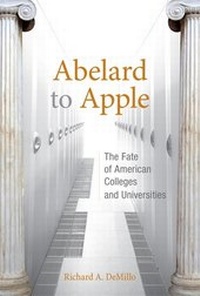
Abelard to Apple
The Fate of American Colleges and Universities
Published on 26. August 2011
Book
Hardback
344 pages
978-0-262-01580-6 (ISBN)
Description
The vast majority of American college students attend two thousand or so private and
public institutions that might be described as the Middle--reputable educational institutions, but
not considered equal to the elite and entrenched upper echelon of the Ivy League and other
prestigious schools. Richard DeMillo has a warning for these colleges and universities in the
Middle: If you do not change, you are heading for irrelevance and marginalization. In
Abelard to Apple, DeMillo argues that these institutions, clinging precariously
to a centuries-old model of higher education, are ignoring the social, historical, and economic
forces at work in today's world. In the age of iTunes, open source software, and for-profit online
universities, there are new rules for higher education.DeMillo, who has spent
years in both academia andin industry, explains how higher education arrived at its current parlous
state and offers a road map for the twenty-first century. He describes the evolving model for higher
education, from European universities based on a medieval model to American land-grant colleges to
Apple's iTunes U and MIT's OpenCourseWare. He offers ten rules to help colleges reinvent themselves
(including "Don't romanticize your weaknesses") and argues for a focus on teaching
undergraduates. DeMillo's message--for colleges and universities, students,
alumni, parents, employers, and politicians--is that any college or university can change course if
it defines a compelling value proposition (one not based in "institutional envy" of
Harvard and Berkeley) and imagines an institution that delivers it.
public institutions that might be described as the Middle--reputable educational institutions, but
not considered equal to the elite and entrenched upper echelon of the Ivy League and other
prestigious schools. Richard DeMillo has a warning for these colleges and universities in the
Middle: If you do not change, you are heading for irrelevance and marginalization. In
Abelard to Apple, DeMillo argues that these institutions, clinging precariously
to a centuries-old model of higher education, are ignoring the social, historical, and economic
forces at work in today's world. In the age of iTunes, open source software, and for-profit online
universities, there are new rules for higher education.DeMillo, who has spent
years in both academia andin industry, explains how higher education arrived at its current parlous
state and offers a road map for the twenty-first century. He describes the evolving model for higher
education, from European universities based on a medieval model to American land-grant colleges to
Apple's iTunes U and MIT's OpenCourseWare. He offers ten rules to help colleges reinvent themselves
(including "Don't romanticize your weaknesses") and argues for a focus on teaching
undergraduates. DeMillo's message--for colleges and universities, students,
alumni, parents, employers, and politicians--is that any college or university can change course if
it defines a compelling value proposition (one not based in "institutional envy" of
Harvard and Berkeley) and imagines an institution that delivers it.
More details
Language
English
Place of publication
Cambridge, Mass.
United States
Publishing group
MIT Press Ltd
Target group
Professional and scholarly
US School Grade: College Graduate Student and over
Illustrations
14 s/w Abbildungen
14 b&w illus.
Dimensions
Height: 229 mm
Width: 152 mm
Thickness: 0 mm
Weight
454 gr
ISBN-13
978-0-262-01580-6 (9780262015806)
Copyright in bibliographic data and cover images is held by Nielsen Book Services Limited or by the publishers or by their respective licensors: all rights reserved.
Schweitzer Classification
Other editions
Additional editions
E-Book
08/2011
MIT Press
€18.49
Available for download
Person
Richard A. DeMillo is Distinguished Professor of Computing and Professor of Management, former John P. Imlay Dean of Computing, and Director of the Center for 21st Century Universities at Georgia Institute of Technology. Author of over 100 articles, books, and patents, he has held academic positions at Purdue University, the University of Wisconsin, and the University of Padua. He directed the Computer and Computation Research Division of the National Science Foundation and was Hewlett-Packard's first Chief Technology Officer.