

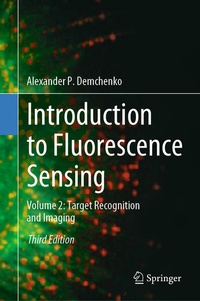
Introduction to Fluorescence Sensing
Volume 2: Target Recognition and Imaging
3rd Edition
Published on 16. February 2023
Book
Hardback
XXI, 761 pages
978-3-031-19088-9 (ISBN)
Description
Fluorescence is the most popular technique in chemical and biological sensing because of its ultimate sensitivity, high temporal and spatial resolution and versatility that enables imaging within the living cells. It develops rapidly in the directions of constructing new molecular recognition units, new fluorescence reporters and in improving sensitivity of response up to detection of single molecules. Its application areas range from control of industrial processes to environment monitoring and clinical diagnostics. This book provides systematic knowledge of basic principles in design of fluorescence sensing and imaging techniques together with critical analysis of recent developments. Being a guide for students and young researchers, it also addresses professionals involved in active basic and applied research. Making a strong link between education, research and product development, this book discusses prospects for future progress.
More details
Edition
Third Edition 2023
Language
English
Place of publication
Cham
Switzerland
Publishing group
Springer International Publishing
Target group
Professional and scholarly
Edition type
Revised edition
Illustrations
30 s/w Abbildungen, 260 farbige Abbildungen
XXI, 761 p. 290 illus., 260 illus. in color.
Dimensions
Height: 241 mm
Width: 160 mm
Thickness: 45 mm
Weight
1468 gr
ISBN-13
978-3-031-19088-9 (9783031190889)
DOI
10.1007/978-3-031-19089-6
Schweitzer Classification
Other editions
Additional editions
Book
02/2024
3rd Edition
Springer
€171.19
Shipment within 15-20 days
E-Book
02/2023
3rd Edition
Springer
€160.49
Available for download
Content
1. Principles of molecular recognition.- 2. Theoretical Aspects.- 3. Molecular Recognition Units in Sensor Constructions.- 4. Binding blocks and Interfaces Designed for Sensing.- 5. Probing the properties of continuous media and interfaces.- 6. Detection of Ions and Low-molecular Targets.- 7. Detection of Biological Macromolecules and Recognition of harmful microbes.- 8. Sensing Inside the Living Cells.- 9. Ex-vivo Clinical Diagnostics.- 10. Imaging in vivo.- 11. Theranostics: Combining Targeting, Imaging and Therapy.- 12. Opening new horizons.