

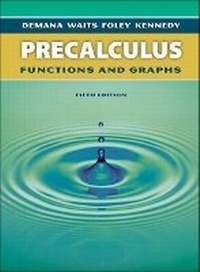
Precalculus
Functions and Graphs
5th Edition
Published on 22. May 2003
Book
Hardback
1056 pages
978-0-321-13196-6 (ISBN)
Description
This text, intended for a graphing calculator required precalculus course, shows students when and how to use concepts, and promotes real understanding not just rote memorization. In addition, the graphing calculator is used as a tool to help explain ideas rather than merely to find answers. The book reflects AMATYC, MAA, and NCTM guidelines, and makes use of real world data in presenting a balanced algebraic and graphical approach to understanding precalculus concepts. The result is a thorough preparation for the calculus course.
More details
Edition
5th edition
Language
English
Place of publication
United States
Publishing group
Pearson Education (US)
Target group
Professional and scholarly
Dimensions
Height: 262 mm
Width: 207 mm
Thickness: 37 mm
Weight
2022 gr
ISBN-13
978-0-321-13196-6 (9780321131966)
Copyright in bibliographic data and cover images is held by Nielsen Book Services Limited or by the publishers or by their respective licensors: all rights reserved.
Schweitzer Classification
Other editions
New editions
Book
03/2006
7th Edition
Pearson
€76.74
Article exhausted; check for reprint
Previous edition
Book
10/2000
4th Edition
Pearson
€53.22
Article exhausted; check for reprint
Content
P. Prerequisites.
Real Numbers.
Cartesian Coordinate System.
Linear Equations and Inequalities.
Lines in the Plane.
Solving Equations Graphically, Numerically and Algebraically.
Solving Inequalities Algebraically and Graphically.
1. Functions and Graphs.
Modeling and Equation Solving.
Functions and Their Properties.
Twelve Basic Functions.
Building Functions from Functions.
Graphical Transformations.
Modeling with Functions.
2. Polynomial, Power and Rational Functions.
Linear and Quadratic Functions with Modeling.
Power Functions with Modeling.
Polynomial Functions of Higher Degree with Modeling.
Real Zeros of Polynomial Functions.
Complex Numbers.
Complex Zeros and the Fundamental Theorem of Algebra.
Graphs of Rational Functions.
Solving Equations in One Variable.
Solving Inequalities in One Variable.
3. Exponential, Logistic and Logarithmic Functions.
Exponential and Logistic Functions.
Exponential and Logistic Modeling.
Logarithmic Functions and Their Graphs.
Properties of Logarithmic Functions.
Equation Solving and Modeling.
Mathematics of Finance.
4. Trigonometric Functions.
Angles and Their Measures.
Trigonometric Functions of Acute Angles.
Trigonometry Extended: The Circular Functions.
Graphs of Sine and Cosine: Sinusoids.
Graphs of Tangent, Cotangent, Secant, and Cosecant.
Graphs of Composite Trigonometric Functions.
Inverse Trigonometric Functions.
Solving Problems with Trigonometry.
5. Analytic Trigonometry.
Fundamental Identities.
Proving Trigonometric Identities.
Sum and Difference Identities.
Multiple-Angle Identities.
Law of Sines.
Law of Cosines.
6. Vectors, Parametric Equations, and Polar Equations.
Vectors in the Plane.
Dot Products of Vectors.
Parametric Equations and Motion.
Polar Coordinates.
Graphs of Polar Equations.
De Moivre's Theorem and nth Roots.
7. Systems and Matrices.
Solving Systems of Two Equations.
Matrix Algebra.
Multivariate Linear Systems and Row Operations.
Partial Fractions.
Systems of Inequalities in Two Variables.
8. Analytic Geometry in Two and Three Dimensions.
Conic Sections and Parabolas.
Ellipses.
Hyperbolas.
Translations and Rotations of Axes.
Polar Equations of Conics.
Three Dimensional Cartesian Coordinate System.
9. Discrete Mathematics.
Basic Combinatorics.
The Binomial Theorem.
Probability.
Sequences and Series.
Mathematical Induction.
Statistics and Data (Graphical).
Statistics and Data (Algebraic).
10. An Introduction to Calculus: Limits, Derivatives, and Integrals.
Limits and Motion: The Tangent Problem.
Limits and Motion: The Area Problem.
More on Limits.
Numerical Derivatives and Integrals.
Appendix A Algebra Review.
A.1 Radicals and Rational Exponents.
A.2 Polynomials and Factoring.
A.3 Fractional Expressions.
Real Numbers.
Cartesian Coordinate System.
Linear Equations and Inequalities.
Lines in the Plane.
Solving Equations Graphically, Numerically and Algebraically.
Solving Inequalities Algebraically and Graphically.
1. Functions and Graphs.
Modeling and Equation Solving.
Functions and Their Properties.
Twelve Basic Functions.
Building Functions from Functions.
Graphical Transformations.
Modeling with Functions.
2. Polynomial, Power and Rational Functions.
Linear and Quadratic Functions with Modeling.
Power Functions with Modeling.
Polynomial Functions of Higher Degree with Modeling.
Real Zeros of Polynomial Functions.
Complex Numbers.
Complex Zeros and the Fundamental Theorem of Algebra.
Graphs of Rational Functions.
Solving Equations in One Variable.
Solving Inequalities in One Variable.
3. Exponential, Logistic and Logarithmic Functions.
Exponential and Logistic Functions.
Exponential and Logistic Modeling.
Logarithmic Functions and Their Graphs.
Properties of Logarithmic Functions.
Equation Solving and Modeling.
Mathematics of Finance.
4. Trigonometric Functions.
Angles and Their Measures.
Trigonometric Functions of Acute Angles.
Trigonometry Extended: The Circular Functions.
Graphs of Sine and Cosine: Sinusoids.
Graphs of Tangent, Cotangent, Secant, and Cosecant.
Graphs of Composite Trigonometric Functions.
Inverse Trigonometric Functions.
Solving Problems with Trigonometry.
5. Analytic Trigonometry.
Fundamental Identities.
Proving Trigonometric Identities.
Sum and Difference Identities.
Multiple-Angle Identities.
Law of Sines.
Law of Cosines.
6. Vectors, Parametric Equations, and Polar Equations.
Vectors in the Plane.
Dot Products of Vectors.
Parametric Equations and Motion.
Polar Coordinates.
Graphs of Polar Equations.
De Moivre's Theorem and nth Roots.
7. Systems and Matrices.
Solving Systems of Two Equations.
Matrix Algebra.
Multivariate Linear Systems and Row Operations.
Partial Fractions.
Systems of Inequalities in Two Variables.
8. Analytic Geometry in Two and Three Dimensions.
Conic Sections and Parabolas.
Ellipses.
Hyperbolas.
Translations and Rotations of Axes.
Polar Equations of Conics.
Three Dimensional Cartesian Coordinate System.
9. Discrete Mathematics.
Basic Combinatorics.
The Binomial Theorem.
Probability.
Sequences and Series.
Mathematical Induction.
Statistics and Data (Graphical).
Statistics and Data (Algebraic).
10. An Introduction to Calculus: Limits, Derivatives, and Integrals.
Limits and Motion: The Tangent Problem.
Limits and Motion: The Area Problem.
More on Limits.
Numerical Derivatives and Integrals.
Appendix A Algebra Review.
A.1 Radicals and Rational Exponents.
A.2 Polynomials and Factoring.
A.3 Fractional Expressions.