

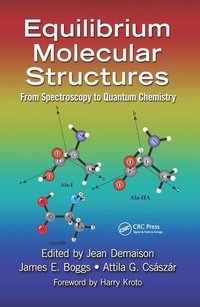
Equilibrium Molecular Structures
From Spectroscopy to Quantum Chemistry
1st Edition
Published on 2. December 2010
Book
Hardback
302 pages
978-1-4398-1132-0 (ISBN)
Description
Molecular structure is the most basic information about a substance, determining most of its properties. Determination of accurate structures is hampered in that every method applies its own definition of "structure" and thus results from different sources can yield significantly different results. Sophisticated protocols exist to account for these differences, but until now, no textbook has been written to discuss such topics in a widely accessible manner.
Balancing quantum theory with practical experiments, Equilibrium Molecular Structures focuses on the theory involved in determining and converting measured and computed data sets into accurate and well-defined equilibrium structures.
This textbook begins with a discussion of quantum chemistry and the concept of potential energy surfaces, quantum chemical computation of structures and anharmonic force fields. The reader is next introduced to the method of least squares and the problem of ill-conditioning, leverage points, perturbation theory, computational aspects of determining semi-experimental equilibrium structures, the determination of moments of inertia from spectra, and the treatment of resonances. The textbook also examines the determination of diatomic molecular potentials using semiclassical and quantum mechanical methods as well as position and distance averages.
From basic elements to the latest advances and current best practices, Equilibrium Molecular Structures contains abundant references, examples, and exercises. Additional examples are also available as downloadable support material on the publishers website. These features make the book ideal for class instruction but also user-friendly for self-instruction. It is recommended for newcomers to the field and also for experienced spectroscopists who want to expand their area of knowledge.
Balancing quantum theory with practical experiments, Equilibrium Molecular Structures focuses on the theory involved in determining and converting measured and computed data sets into accurate and well-defined equilibrium structures.
This textbook begins with a discussion of quantum chemistry and the concept of potential energy surfaces, quantum chemical computation of structures and anharmonic force fields. The reader is next introduced to the method of least squares and the problem of ill-conditioning, leverage points, perturbation theory, computational aspects of determining semi-experimental equilibrium structures, the determination of moments of inertia from spectra, and the treatment of resonances. The textbook also examines the determination of diatomic molecular potentials using semiclassical and quantum mechanical methods as well as position and distance averages.
From basic elements to the latest advances and current best practices, Equilibrium Molecular Structures contains abundant references, examples, and exercises. Additional examples are also available as downloadable support material on the publishers website. These features make the book ideal for class instruction but also user-friendly for self-instruction. It is recommended for newcomers to the field and also for experienced spectroscopists who want to expand their area of knowledge.
Reviews / Votes
"... well written by practicing experts in the field ... excellent lists of references to well-known introductory texts and current, advanced journal articles ... Recommended."- M. Coplan, Institute for Physical Science and Technology in CHOICE Magazine, December 2011
"The book contains many references, examples, and exercises and includes a CD with additional examples which make the book ideal for class instruction as well as for reader self-instruction. The book will be useful for newcomers to the field and also for experienced spectroscopists who want to expand their area of knowledge."
-Dr. James G. Speight in Petroleum and Science Technology, June 2011
More details
Language
English
Place of publication
Bosa Roca
United States
Publishing group
Taylor & Francis Inc
Target group
College/higher education
Illustrations
63 s/w Abbildungen, 26 s/w Tabellen
26 Tables, black and white; 63 Illustrations, black and white
Dimensions
Height: 234 mm
Width: 156 mm
Weight
657 gr
ISBN-13
978-1-4398-1132-0 (9781439811320)
Copyright in bibliographic data and cover images is held by Nielsen Book Services Limited or by the publishers or by their respective licensors: all rights reserved.
Schweitzer Classification
Other editions
Additional editions
Jean Demaison | James E. Boggs | Attila G. Csaszar
Equilibrium Molecular Structures
From Spectroscopy to Quantum Chemistry
E-Book
04/2016
1st Edition
CRC Press
€224.99
Available for download
Jean Demaison | James E. Boggs | Attila G. Csaszar
Equilibrium Molecular Structures
From Spectroscopy to Quantum Chemistry
E-Book
04/2016
CRC Press
€225.99
Available for download
Persons
Jean Demaison is a former Research Director at CNRS, University of Lille I. The research for his PhD, which he received in 1972, was performed in Freiburg and Nancy in the field of microwave spectroscopy. He was invited to be a Professor at the Universities of Ulm, Louvain-La-Neuve, and Brussels. In 2008, he received the International Barbara Mez-Starck prize for outstanding contribution in the field of structural chemistry. He has published over 300 papers in research journals and contributed to 17 books. Professor Attila G. Csaszar is the head of the Laboratory of Molecular Spectroscopy at Eoetvoes University of Budapest, Hungary. He received his PhD in 1985 in theoretical chemistry at the same place. His research interests include computational molecular spectroscopy, structure determinations of small molecules, ab initio thermochemistry, and electronic structure theory. He has published more than 150 papers in these fields, mostly in leading international journals. James E. Boggs is Professor Emeritus at the University of Texas at Austin. His PhD was received from the University of Michigan after working on the Manhattan District Project. He has spent sabbaticals at Harvard, Berkeley, and the University of Oslo. Dr. Boggs has published over 325 papers, mostly on microwave spectroscopy and applications of quantum theory. He organized the first 23 biennial meetings of the Austin Symposium on Molecular Structure. In 2010, he received the International Barbara Mez-Starck prize for outstanding contributions in structural chemistry. He has been chosen as a Fellow of the American Chemical Society.
Content
Quantum Theory of Equilibrium Molecular Structures. The Method of Least Squares.Semiexperimental Equilibrium Structures: Computational Aspects. Spectroscopy of Polyatomic Molecules: Determination of the Rotational Constants. Determination of the Structural Parameters from the Inertial Moments. Determining Equilibrium Structures and Potential Energy Functions for Diatomic Molecules. Other Spectroscopic Sources of Molecular Properties: Intermolecular Complexes as Examples. Structures Averaged over Nuclear Motions. Appendix A: Bibliographies of Equilibrium Structures. Appendix B: Sources for Fundamental Constants, Conversion Factors, and Atomic and Nuclear Masses. Index.