

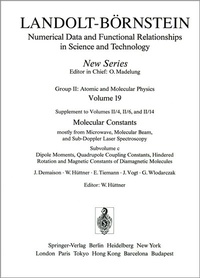
Dipole Moments, Quadrupole Coupling Constants, Hindered Rotation and Magnetic Constants of Diamagnetic Molecules/ Dipolmomente, Quadrupolkopplungskonstanten, gehinderte Rotation und magnetische Konstanten diamagnetischer Molekeln
Published on 18. August 1992
Book
Hardback
XII, 295 pages
978-3-540-54893-5 (ISBN)
Description
Volume II/19
Molecular Constants mostly from Microwave,
Molecular Beam and Sub-Doppler Laser Spectroscopy
is a supplement to the earlier volumes II/4, II/6, and II/14. The slight change in the title reflects current trends in the applications of spectroscopic methods. Together, the four volumes collect all the critically evaluated data published up to 1989/90 on constants of free molecules obtained by classical and modern spectroscopy.
Volume II/19
is divided into four parts to record the growing number of investigations, especially in the microwave and millimeter wave regions, where modern techniques like Fourier Transform Microwave Spectroscopy have made new objects of interest such as molecular complexes and clusters accessible to study.
Subvolume II/19a
contains a general introduction and tables of rotational and centrifugal distortion constants of diamagnetic, diatomic, linear and symmetric top molecules, which specify the frequences of the rotational transitions of these types of rotor.
Subvolume II/19b
contains corresponding data on diamagnetic asymmetric top molecules.
Subvolume II/19c
contains tables for diamagnetic molecules giving further spectroscopic parameters: quadrupole coupling constants, potential barriers, and data from Stark and Zeeman effect measurements.
Subvolume II/19d
presents high resolution spectroscopic results for freely rotating paramagnetic and ionic molecular species. The basic organization and arrangement of the tables is the same as in the previous volumes so that readers familiar with previous volumes may have easy access to desired information. The order of molecules within each table, however, has been changed to agree with the system introduced by Hill in 1900. Except for the special cases of C and H, this is based on an alphabetical listing of the atoms in the molecular sum formula, as explained in the introduction. This ordering, based on Hill's system, reduces the importance of the global index of substances, an indispensable part of all previous volumes. For completeness, an index of substances is included at the end of Subvolume II/19d.
More details
Series
Edition
1992 ed.
Language
English
Place of publication
Berlin
Germany
Publishing group
Springer Berlin
Target group
College/higher education
Professional and scholarly
Research
Illustrations
8 s/w Abbildungen
XII, 295 p. 8 illus.
Dimensions
Height: 27 cm
Width: 19.3 cm
Weight
1145 gr
ISBN-13
978-3-540-54893-5 (9783540548935)
DOI
10.1007/b44435
Schweitzer Classification