

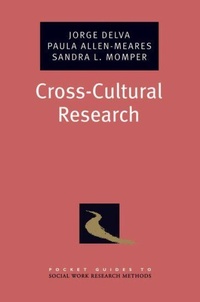
Cross-Cultural Research
Published on 27. May 2010
Book
Paperback/Softback
176 pages
978-0-19-538250-1 (ISBN)
Description
This pocket guide offers researchers a framework for conducting research in a culturally sensitive manner with individuals, families, and communities in diverse settings. This unique framework focuses on a process, rather than a typology of behaviors, attitudes, values, and beliefs. All too frequently, cross-cultural research improperly attributes behaviors, beliefs, and values entirely to culture, when a closer examination would reveal the shared influences of gender, socioeconomic status, immigration status, and racial and ethnic backgrounds that interact in complex ways. By encouraging practitioners to incorporate an intersectionality lens into their work, this pocket guide helps researchers reveal stories that are more than the sum of particular identities.
Sharing their extensive research experience with diverse populations around the world, the authors present a range of fluid and dynamic cross-cultural research practices that readers can easily adapt to their unique circumstances. At the intersection of culture and research methods, chapters illustrate the application of the model to three broad areas of inquiry: describing the nature of a problem; understanding the etiology of the problem; and evaluating the interventions designed to ameliorate the problem. Each area is illustrated with examples of research projects that incorporate multiple epistemologies and methodologies in order to better understand and respond to a population's needs.
This guide offers a complete roadmap for developing cross-cultural projects that truly engage communities, and will be a trusted resource for students and seasoned researchers alike.
Sharing their extensive research experience with diverse populations around the world, the authors present a range of fluid and dynamic cross-cultural research practices that readers can easily adapt to their unique circumstances. At the intersection of culture and research methods, chapters illustrate the application of the model to three broad areas of inquiry: describing the nature of a problem; understanding the etiology of the problem; and evaluating the interventions designed to ameliorate the problem. Each area is illustrated with examples of research projects that incorporate multiple epistemologies and methodologies in order to better understand and respond to a population's needs.
This guide offers a complete roadmap for developing cross-cultural projects that truly engage communities, and will be a trusted resource for students and seasoned researchers alike.
Reviews / Votes
".. this book provides a very rich discussion and poignant, detailed examples of how researchers can be culturally sensitive and at the same time conduct meaningful and useful projects with individuals and communities as collaborators rather than as passive or disillusioned observers." --PsycCRITIQUESMore details
Series
Language
English
Place of publication
New York
United States
Target group
College/higher education
Professional and scholarly
Product notice
Paperback (trade)
Unsewn / adhesive bound
Illustrations
1 half-tone and 6 line-cuts
Dimensions
Height: 206 mm
Width: 137 mm
Thickness: 10 mm
Weight
204 gr
ISBN-13
978-0-19-538250-1 (9780195382501)
Copyright in bibliographic data and cover images is held by Nielsen Book Services Limited or by the publishers or by their respective licensors: all rights reserved.
Schweitzer Classification
Persons
Jorge Delva, Ph.D., is Professor of Social Work and Co-Director of the Vivian A. and James L. Curtis School of Social Work Research and Training Center at the University of Michigan.
Paula Allen-Meares, Ph.D., is Chancellor and the John Corbally Presidential Professor at the University of Illinois, Chicago.
Sandra L. Momper, Ph.D., is Assistant Professor of Social Work at the University of Michigan.
Paula Allen-Meares, Ph.D., is Chancellor and the John Corbally Presidential Professor at the University of Illinois, Chicago.
Sandra L. Momper, Ph.D., is Assistant Professor of Social Work at the University of Michigan.
Author
ProfessorProfessor, School of Social Work, University of Michigan, Ann Arbor, MI
Chancellor and ProfessorChancellor and Professor, University of Illinois, Chicago, Chicago, IL
Assistant Professor of Social WorkAssistant Professor of Social Work, School of Social Work, University of Michigan, Ann Arbor, MI
Content
1. Introduction
2. Conducting Mixed-Methods Research: An Illustration with American Indians in the United States
3. Conducting Large-Scale Population-Based Survey Research
4. Conducting Longitudinal Studies
5. Use of experimental designs in community settings
6. Conducting Community-Based Participatory Research
7. Discussion
Glossary
Notes
References
Index
2. Conducting Mixed-Methods Research: An Illustration with American Indians in the United States
3. Conducting Large-Scale Population-Based Survey Research
4. Conducting Longitudinal Studies
5. Use of experimental designs in community settings
6. Conducting Community-Based Participatory Research
7. Discussion
Glossary
Notes
References
Index