

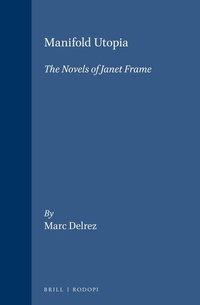
Manifold Utopia
The Novels of Janet Frame
Published on 1. January 2002
Book
Paperback/Softback
264 pages
978-90-420-1508-1 (ISBN)
Description
This study of Janet Frame's fiction addresses with unusual directness the Utopian momentum that underpins her concern with fundamental social issues, traditionally highlighted in existing criticism of her work. The idea behind this book is that Frame's critique of society, while it is offered for its own sake on one level, should not lead us to neglect the author's more speculative interest in an alternative conception of the human person. Her engagement in a species of experimental portraiture proves elusive, though, owing to an indirectness of approach that usually takes the form of thematic circumscription, rather than explicit representation. For example, the figure of the mute child, recurrent in her work, may well testify to a concern with the plight of the mentally ill; but on another level it also points to an envelope of intractable experience which it is the artist's task to penetrate and explain.
Such aspiration is inseparable from the search for a new medium of expression, felt to be necessary if one is to meet the challenge of apprehending the scope of pioneering knowledge. This close reading of the novels reveals that the alternative dimension of experience to be found in Frame's novels is characterized by an intact capacity for remembering, or for imaginatively re-creating, eclipsed aspects of the present. Frame's view of Utopia thus turns out to be manifold: it is existential and ontological, linguistic and epistemological, but also historical and political. An unravelling of these intertwined strains then serves to clarify the complex question of Frame's post-colonial sensibility, which cannot be said to rely on a sense of rigid identity, whether national or otherwise.
Such aspiration is inseparable from the search for a new medium of expression, felt to be necessary if one is to meet the challenge of apprehending the scope of pioneering knowledge. This close reading of the novels reveals that the alternative dimension of experience to be found in Frame's novels is characterized by an intact capacity for remembering, or for imaginatively re-creating, eclipsed aspects of the present. Frame's view of Utopia thus turns out to be manifold: it is existential and ontological, linguistic and epistemological, but also historical and political. An unravelling of these intertwined strains then serves to clarify the complex question of Frame's post-colonial sensibility, which cannot be said to rely on a sense of rigid identity, whether national or otherwise.
Reviews / Votes
"...a series of judicious and elegant close readings..." - in: New Zealand Books, Vol. 13, No. 3 (August 2003), p. 14"...cogent and often illuminating..." - in: Utopian Studies, Vol. 14, No. 1 (2003), pp.183-4
More details
Series
Language
English
Place of publication
Leiden
Netherlands
Publishing group
Brill
Target group
Professional and scholarly
Product notice
Paperback (trade)
Unsewn / adhesive bound
Dimensions
Height: 230 mm
Width: 155 mm
Thickness: 25 mm
Weight
472 gr
ISBN-13
978-90-420-1508-1 (9789042015081)
Copyright in bibliographic data and cover images is held by Nielsen Book Services Limited or by the publishers or by their respective licensors: all rights reserved.
Schweitzer Classification
Other editions
Additional editions
Book
01/2002
Rodopi
€150.50
Shipment within 10-20 days
Content
Author's Note
Introduction
1 Travel Writing
2 "Imaginative Recognitions"
3 "Archeological Metafiction"
4 "A Writer's Remembering"
5 Plural Personality
6 "Universal Belonging"
7 Interstitial Time
8 Amputations of History
Conclusion
Select Bibliography
Introduction
1 Travel Writing
2 "Imaginative Recognitions"
3 "Archeological Metafiction"
4 "A Writer's Remembering"
5 Plural Personality
6 "Universal Belonging"
7 Interstitial Time
8 Amputations of History
Conclusion
Select Bibliography