

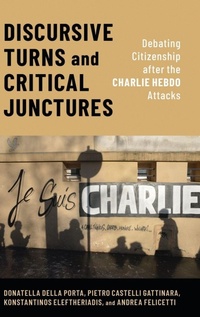
Discursive Turns and Critical Junctures
Debating Citizenship after the Charlie Hebdo Attacks
Published on 29. June 2020
Book
Hardback
276 pages
978-0-19-009743-1 (ISBN)
Description
Among the violent acts perpetrated by radical Islamist groups in Europe, the Charlie Hebdo massacre in Paris has been one of those that has challenged established categories of public debate the most.
Through a multifaceted and detailed analysis of the public discourse around the Charlie Hebdo episode in France, Germany, Italy, and the UK, Discursive Turns and Critical Junctures offers an in-depth analysis of how political groups and religious organizations have reacted to the event, which claims they have made in the public sphere, and how they have justified such claims. Drawing on newspaper sources and discourse analysis, the authors navigate the complexities caused by political violence. They develop a threefold comparison that considers how the debate differs across countries; how it evolved over time; and how it varies when one looks at mainstream media compared to social movement arenas. Based on a triangulation of quantitative and qualitative analyses, the volume pays particular attention to radical left, radical right and religious actors and to issues related to migration and integration, secularism and cultural diversity, security and civil rights. In particular, they focus on the way in which transformative events act as critical junctures within different public spheres.
Starting from the nefarious attacks on January 2015, this highly relevant, theoretically compelling, and methodologically sophisticated study of public debates in Europe adds substantially to the growing body of research into critical junctures as discursive turning points and gives insights into into a number of debates ranging including citizenship and political violence.
Through a multifaceted and detailed analysis of the public discourse around the Charlie Hebdo episode in France, Germany, Italy, and the UK, Discursive Turns and Critical Junctures offers an in-depth analysis of how political groups and religious organizations have reacted to the event, which claims they have made in the public sphere, and how they have justified such claims. Drawing on newspaper sources and discourse analysis, the authors navigate the complexities caused by political violence. They develop a threefold comparison that considers how the debate differs across countries; how it evolved over time; and how it varies when one looks at mainstream media compared to social movement arenas. Based on a triangulation of quantitative and qualitative analyses, the volume pays particular attention to radical left, radical right and religious actors and to issues related to migration and integration, secularism and cultural diversity, security and civil rights. In particular, they focus on the way in which transformative events act as critical junctures within different public spheres.
Starting from the nefarious attacks on January 2015, this highly relevant, theoretically compelling, and methodologically sophisticated study of public debates in Europe adds substantially to the growing body of research into critical junctures as discursive turning points and gives insights into into a number of debates ranging including citizenship and political violence.
Reviews / Votes
"With subtlety and skill, Della Porta and her colleagues show exactly how violent attacks can disrupt the public sphere. Their analysis matters enormously, as the ensuing symbolic struggles help determine the contours of contemporary politics. Essential reading for anyone who cares about the wellbeing of the world's democracies." -John S. Dryzek, Australian Research Council Laureate Fellow and Centenary Professor, University of Canberra"This is an impressive and important book. It analyzes one of the most important transformative events of the recent years: the attacks on Charlie Hebdo. It does so in a superb way by showing differences and similarities within the left, the right, and among religious organisations across four countries: France, Italy, Germany, and the UK. This is cutting edge research, both empirically and theoretically." -Jan Willem Duyvendak, Distinguished
Research Professor of Sociology, University of Amsterdam
"Discursive Turns and Critical Junctures is an ambitious and innovative book that brings together several approaches to social movements in order to analyse how European publics responded to the Charlie Hebdo attacks in 2015. It is based on rich and original data that has been collected specifically for the project and analyses whether the events triggered a discursive juncture and a turning point in European political cultures." -Florence
Faucher, Professor of Political Science, Sciences Po, Centre d'etudes Europeennes et de politique comparee, Paris
More details
Series
Language
English
Place of publication
New York
United States
Target group
Professional and scholarly
Dimensions
Height: 240 mm
Width: 161 mm
Thickness: 20 mm
Weight
584 gr
ISBN-13
978-0-19-009743-1 (9780190097431)
Copyright in bibliographic data and cover images is held by Nielsen Book Services Limited or by the publishers or by their respective licensors: all rights reserved.
Schweitzer Classification
Other editions
Additional editions
Donatella Della Porta | Pietro Castelli Gattinara | Konstantinos Eleftheriadis
Discursive Turns and Critical Junctures
Debating Citizenship after the Charlie Hebdo Attacks
E-Book
05/2020
OUP eBook
€36.49
Available for download
Donatella Della Porta | Pietro Castelli Gattinara | Konstantinos Eleftheriadis
Discursive Turns and Critical Junctures
Debating Citizenship after the Charlie Hebdo Attacks
E-Book
05/2020
OUP eBook
€46.99
Available for download
Persons
Donatella Della Porta is Professor of Political Science, Dean of the Department of Political and Social Sciences, and Director of the PhD program in Political Science and Sociology at the Scuola Normale Superiore in Florence, where she also leads the Center on Social Movement Studies (Cosmos).
Pietro Castelli Gattinara is Assistant Professor in the Centre for Research on Extremism at the University of Oslo. His research focuses on comparative politics, the far right and international migration to Europe. He is the author of The Politics of Migration in Italy (2016).
Andrea Felicetti is a Postdoctoral Researcher at the Centre for Political Research at KU Leuven. He is the author of Deliberative Democracy and Social Movements.
Konstantinos Eleftheriadis is Lecturer at the University of London-Institute in Paris (ULIP) and Research Associate at the Center for the Study of Social Movements at the School for Advanced Studies in the Social Sciences (EHESS-Paris). His
research focuses on the politics of gender and sexuality and the role of mobilization for combatting discriminations. He is the author of Queer Festivals: Challenging Collective Identities in a Transnational Europe.
Pietro Castelli Gattinara is Assistant Professor in the Centre for Research on Extremism at the University of Oslo. His research focuses on comparative politics, the far right and international migration to Europe. He is the author of The Politics of Migration in Italy (2016).
Andrea Felicetti is a Postdoctoral Researcher at the Centre for Political Research at KU Leuven. He is the author of Deliberative Democracy and Social Movements.
Konstantinos Eleftheriadis is Lecturer at the University of London-Institute in Paris (ULIP) and Research Associate at the Center for the Study of Social Movements at the School for Advanced Studies in the Social Sciences (EHESS-Paris). His
research focuses on the politics of gender and sexuality and the role of mobilization for combatting discriminations. He is the author of Queer Festivals: Challenging Collective Identities in a Transnational Europe.
Author
Professor of Political ScienceProfessor of Political Science, Scuola Normale Superiore
Assistant Professor in the Centre for Research on ExtremismAssistant Professor in the Centre for Research on Extremism, University of Oslo
LecturerLecturer, University of London-Institute in Paris (ULIP)
Postdoctoral ResearcherPostdoctoral Researcher, Centre for Political Research at KU Leuven
Content
Acknowledgments
List of Tables
List of Figures
Chapter 1. Discursive turns and critical junctures: An introduction
Chapter 2. Comparing mass media debates in the European public sphere
Chapter 3. The evolution of the debate: Polarization and deliberation over time
Chapter 4. The deliberative qualities of the debates from a comparative perspective
Chapter 5. Left-wing movements facing dilemmas
Chapter 6. Multiculturalism backlash and anti-establishment politics: The far right
Chapter 7. Religious organizations: Strategies and framing
Chapter 8. Justifications in the debates on citizenship: Whose common good?
Chapter 9. Discursive turns and critical junctures: some conclusions
Technical Appendix
References
Index
List of Tables
List of Figures
Chapter 1. Discursive turns and critical junctures: An introduction
Chapter 2. Comparing mass media debates in the European public sphere
Chapter 3. The evolution of the debate: Polarization and deliberation over time
Chapter 4. The deliberative qualities of the debates from a comparative perspective
Chapter 5. Left-wing movements facing dilemmas
Chapter 6. Multiculturalism backlash and anti-establishment politics: The far right
Chapter 7. Religious organizations: Strategies and framing
Chapter 8. Justifications in the debates on citizenship: Whose common good?
Chapter 9. Discursive turns and critical junctures: some conclusions
Technical Appendix
References
Index