

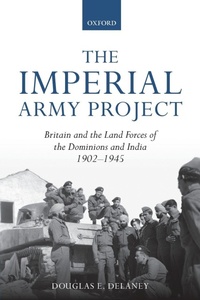
The Imperial Army Project
Britain and the Land Forces of the Dominions and India, 1902-1945
Published on 3. March 2020
Book
Paperback/Softback
376 pages
978-0-19-884580-5 (ISBN)
Description
How did British authorities manage to secure the commitment of large dominion and Indian armies that could plan, fight, shoot, communicate, and sustain themselves, in concert with the British Army and with each other, during the era of the two world wars? What did the British want from the dominion and Indian armies and how did they go about trying to get it? Douglas E Delaney seeks to answer these questions to understand whether the imperial army project was successful.
Answering these questions requires a long-term perspective - one that begins with efforts to fix the armies of the British Empire in the aftermath of their desultory performance in South Africa (1899-1903) and follows through to the high point of imperial military cooperation during the Second World War. Based on multi-archival research conducted in six different countries, on four continents, Delaney argues that the military compatibility of the British Empire armies was the product of a deliberate and enduring imperial army project, one that aimed at standardizing and piecing together the armies of the empire, while, at the same time, accommodating the burgeoning autonomy of the dominions and even India. At its core, this book is really about how a military coalition worked.
Answering these questions requires a long-term perspective - one that begins with efforts to fix the armies of the British Empire in the aftermath of their desultory performance in South Africa (1899-1903) and follows through to the high point of imperial military cooperation during the Second World War. Based on multi-archival research conducted in six different countries, on four continents, Delaney argues that the military compatibility of the British Empire armies was the product of a deliberate and enduring imperial army project, one that aimed at standardizing and piecing together the armies of the empire, while, at the same time, accommodating the burgeoning autonomy of the dominions and even India. At its core, this book is really about how a military coalition worked.
Reviews / Votes
This work is valuable to academics and graduate students alike who study the British Empire's military effort in the twentieth century. * Brad St. Croix, Canadian Military History * Review from previous edition Douglas Delaney's masterly book shows that the creation of a series of interoperable armies across the British Empire was no accident. Rather it was the result of a highly successful imperial project which contributed significantly to the victories won in 1918 and 1945. This book is an important contribution to both military and imperial history. * Gary Sheffield, Author of The Chief: Douglas Haig and the British Army and Forgotten Victory: The First World War: Myths and Realities * This is a hugely ambitious and successful book. In explaining how the British imperial military coalition worked, Delaney also explains how it was that the people of a small island off the north-west coast of Europe were able for so long to defend an empire that spanned the globe. It should be compulsory reading for anyone interested in the history of the British Empire in the era of the two world wars. * David French, Author of Raising Churchill's Army: the British Army and the War against Germany, 1919-1945. * How did the Imperial General Staff manage to secure the cooperation of the sometimes fractious and increasingly autonomous Dominions and India in standardizing the ways in which they could operate together in war almost seamlessly? Delaney's beautifully written study is based on extraordinarily thorough research that clearly explains how the Imperial Army Project succeeded in moulding Empire-Commonwealth armies that could and did fight as one through two world wars. * J.L. Granatstein, Author of Canada's Army: Waging War and Keeping the Peace. * Delaney's depth of knowledge and acute comparative analysis are on full display with The Imperial Army Project. He pivots easily from one national army to another, each with its own peculiarities, and then returns to the British, who tied it all together. This is a masterpiece of scholarship that adds exhaustive archival research to the existing literature and creates something completely new. * Tim Cook, Author of Shock Troops: Canadians Fighting the Great War, 1917-1918 and Fight to the Finish: Canadians in the Second World War, 1944-1945 . * The Imperial Army Project is a masterful study. Douglas E. Delaney skilfully shows how the armies of Britain, Canada, Australia, New Zealand, the Union of South Africa and India spent four decades developing national armies that were compatible across the British Empire. This interoperability allowed for the efficient combination of military forces during the two world wars. Britain did not, and need not, stand alone. The empire stood together. Indeed, it this comparative approach that makes Delaney's a must-read work. * Dr Karl James, Head of the Military History Section, Australian War Memorial *More details
Language
English
Place of publication
Oxford
United Kingdom
Target group
College/higher education
Illustrations
46 black and white images, figures, and maps
Dimensions
Height: 234 mm
Width: 156 mm
Thickness: 20 mm
Weight
567 gr
ISBN-13
978-0-19-884580-5 (9780198845805)
Copyright in bibliographic data and cover images is held by Nielsen Book Services Limited or by the publishers or by their respective licensors: all rights reserved.
Schweitzer Classification
Other editions
Additional editions
Douglas E. Delaney
The Imperial Army Project
Britain and the Land Forces of the Dominions and India, 1902-1945
E-Book
01/2018
1st Edition
OUP eBook
€23.99
Available for download
Douglas E. Delaney
The Imperial Army Project
Britain and the Land Forces of the Dominions and India, 1902-1945
Book
01/2018
Oxford University Press
€185.70
Shipment within 15-20 days
Person
Douglas E. Delaney holds the Canada Research Chair in War Studies at the Royal Military College of Canada. He is the author of The Soldiers' General: Bert Hoffmeister at War (2005), which won the 2007 C.P. Stacey Prize for Canadian Military History, and Corps Commanders: Five British and Canadian Generals at War, 1939-1945 (2011). He is also co-editor of Capturing Hill 70: Canada's Forgotten Battle of the First World War (2016) and Turning Point 1917: The British Empire at War (2017). Professor Delaney is a retired lieutenant-colonel who served with the First and Third Battalions, Princess Patricia's Canadian Light Infantry, and the Canadian Airborne Regiment.
Content
Introduction 1: Frameworks: Elgin, Esher, Haldane and the Idea of an Imperial Army, 1902-1909 2: The Imperial General Staff, Military Education, Army Apostles, and the Land Forces of the Dominions and India, 1904-1914 3: Growing, Controlling, and Fighting Imperial Armies, 1914-1918 4: The Strands of Cooperation, 1919-1933 5: Imperial Armies in the Period of Rearmament and Appeasement, 1933-1939 6: The Last Great Imperial War Effort, 1939-1945 Conclusion Appendices Bibliography