

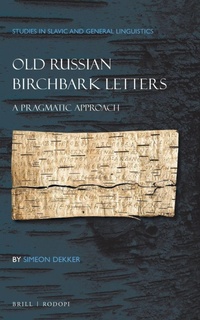
Old Russian Birchbark Letters
A Pragmatic Approach
Published on 22. February 2018
Book
Hardback
219 pages
978-90-04-36238-3 (ISBN)
Description
This study is devoted to a corpus of Old Russian letters, written on pieces of birchbark. These unique texts from Novgorod and surroundings give us an exceptional impression of everyday life in medieval Russian society. In this study, the birchbark letters are addressed from a pragmatic angle. Linguistic parameters are identified that shed light on the degree to which literacy had gained ground in communicative processes. It is demonstrated that the birchbark letters occupy an intermediate position between orality and literacy. On the one hand, oral habits of communication persisted, as reflected in how the birchbark letters are phrased; on the other hand, literate modes of expression emerged, as seen in the development of normative conventions and literate formulae.
Reviews / Votes
"Dekker?s book is a very welcome contribution to the field of historical pragmatics and an important step towards a comprehensive account of the pragmatics of the Old Russian birchbark letters."-Imke Mendoza, Paris-Lodron-Universitaet Salzburg in Journal of Historical Sociolinguistics, 2019
More details
Series
Edition
XIX, 196 pp., index
Language
English
Place of publication
Leiden
Netherlands
Target group
Professional and scholarly
Product notice
sewn/stitched
Cloth over boards
Illustrations
8 s/w Tabellen, 6 farbige Abbildungen
8 Tables, black and white; 6 Illustrations, color
Dimensions
Height: 236 mm
Width: 157 mm
Thickness: 23 mm
Weight
476 gr
ISBN-13
978-90-04-36238-3 (9789004362383)
Copyright in bibliographic data and cover images is held by Nielsen Book Services Limited or by the publishers or by their respective licensors: all rights reserved.
Schweitzer Classification
Person
Simeon Dekker, Ph.D. (Leiden University, 2016) is a researcher in Slavic philology. His main focus of research concerns the pragmatics of medieval texts.
Content
Preface
List of Abbreviations
List of Tables
List of Figures
Index of Birchbark Letters
1 The Field of Study: Berestology
?1.1?Introduction
?1.2?Excavations
?1.3?Dating and Chronology
?1.4?Users and Uses of the Birchbark Letters
?1.5?The Language: Old Novgorodian
?1.6?Other Sources: Parchment Documents
?1.7?Concluding Remarks
2 The Background: Communicatively Heterogeneous Letters
?2.1?Introduction
?2.2?The Problem
?2.3?Communicative Heterogeneity
?2.4?The Oral Component
?2.5?Evaluating Gippius (2004)
?2.6?Subsequent Research
?2.7?Discussion
3 Research Question
?3.1?Introduction
?3.2?Research Question
?3.3?The Choice of Case Studies
?3.4?Concluding Remarks
4 Theory and Methodology
?4.1?Introduction
?4.2?Philology
?4.3?Pragmatics
?4.4?Pragmaphilology
?4.5?Orality
?4.6?Use of the Corpus
?4.7?Illustration of the Pragmaphilological Approach: One Case Study
5 Case Study I: Imperative Subjects
?5.1?Introduction
?5.2?Imperative Subjects
?5.3?The Imperative Subject as a Cohesive Device
?5.4?The Oral Component
?5.5?Concluding Remarks
6 Case Study II: Speech Reporting
?6.1?Introduction
?6.2?Speech Reporting Strategies
?6.3?Some Terminological Considerations
?6.4?The Data on Birchbark
?6.5?Diachronic Considerations
?6.6?Speech Reporting Strategies on a Scale
?6.7?Complexity and Context
?6.8?Functional Considerations
?6.9?Free Direct Speech Revisited
?6.10?More Elements of Orality: Dictation and Performatives Type
?6.11?Concluding Remarks
7 Case Study III: Epistolary Past Tense
?7.1?Introduction
?7.2?Birchbark Data and Discussion
?7.3?Epistolary Past Tense in Other Languages
?7.4?The Data on Birchbark Revisited
?7.5?Deixis
?7.6?Performatives
?7.7?Ancient Greek Revisited
?7.8?Concluding Remarks
8 Case Study IV: Assertive Declarations
?8.1?Introduction
?8.2?Theoretical Considerations
?8.3?The Data on Birchbark
?8.4?Other Languages
?8.5?Discussion
?8.6?Concluding Remarks
9 Conclusions
?9.1?Introduction
?9.2?General Lines Connecting the Case Studies
?9.3?A Transitional Period of Verschriftlichung
?9.4?Final Remarks
References
Index
List of Abbreviations
List of Tables
List of Figures
Index of Birchbark Letters
1 The Field of Study: Berestology
?1.1?Introduction
?1.2?Excavations
?1.3?Dating and Chronology
?1.4?Users and Uses of the Birchbark Letters
?1.5?The Language: Old Novgorodian
?1.6?Other Sources: Parchment Documents
?1.7?Concluding Remarks
2 The Background: Communicatively Heterogeneous Letters
?2.1?Introduction
?2.2?The Problem
?2.3?Communicative Heterogeneity
?2.4?The Oral Component
?2.5?Evaluating Gippius (2004)
?2.6?Subsequent Research
?2.7?Discussion
3 Research Question
?3.1?Introduction
?3.2?Research Question
?3.3?The Choice of Case Studies
?3.4?Concluding Remarks
4 Theory and Methodology
?4.1?Introduction
?4.2?Philology
?4.3?Pragmatics
?4.4?Pragmaphilology
?4.5?Orality
?4.6?Use of the Corpus
?4.7?Illustration of the Pragmaphilological Approach: One Case Study
5 Case Study I: Imperative Subjects
?5.1?Introduction
?5.2?Imperative Subjects
?5.3?The Imperative Subject as a Cohesive Device
?5.4?The Oral Component
?5.5?Concluding Remarks
6 Case Study II: Speech Reporting
?6.1?Introduction
?6.2?Speech Reporting Strategies
?6.3?Some Terminological Considerations
?6.4?The Data on Birchbark
?6.5?Diachronic Considerations
?6.6?Speech Reporting Strategies on a Scale
?6.7?Complexity and Context
?6.8?Functional Considerations
?6.9?Free Direct Speech Revisited
?6.10?More Elements of Orality: Dictation and Performatives Type
?6.11?Concluding Remarks
7 Case Study III: Epistolary Past Tense
?7.1?Introduction
?7.2?Birchbark Data and Discussion
?7.3?Epistolary Past Tense in Other Languages
?7.4?The Data on Birchbark Revisited
?7.5?Deixis
?7.6?Performatives
?7.7?Ancient Greek Revisited
?7.8?Concluding Remarks
8 Case Study IV: Assertive Declarations
?8.1?Introduction
?8.2?Theoretical Considerations
?8.3?The Data on Birchbark
?8.4?Other Languages
?8.5?Discussion
?8.6?Concluding Remarks
9 Conclusions
?9.1?Introduction
?9.2?General Lines Connecting the Case Studies
?9.3?A Transitional Period of Verschriftlichung
?9.4?Final Remarks
References
Index