

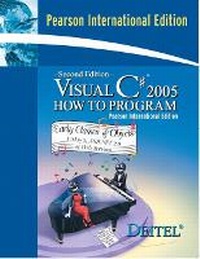
Visual C# 2005 How to Program
International Edition
2nd Edition
Published on 23. January 2006
Book
Paperback/Softback
1648 pages
978-0-13-204361-8 (ISBN)
Description
For courses on C# programming found in departments of Computer Science, CIS, MIS, IT, Business, Engineering and Continuing Education. An exciting addition to the How to Program series, C# How to Program provides a comprehensive introduction to Microsoft's new object-oriented language. C# builds on the skills already mastered by countless C++ and Java programmers, enabling them to create powerful Web applications and components-ranging from XML-based Web services on Microsoft's .NET platform to middle-tier business objects and system-level applications. C# How to Program gives students the strong foundation in introductory and intermediate programming principles they'll need in industry. Mastering C# will allow them to create complex systems-using fewer lines of code and reducing the chance for error. The end result is faster development at a decreased cost-and optimum adaptability that makes it easy to keep up with the evolving Web.
More details
Edition
2nd edition
Language
English
Place of publication
United States
Publishing group
Pearson Education (US)
Target group
Professional and scholarly
Dimensions
Height: 233 mm
Width: 179 mm
Thickness: 49 mm
Weight
2252 gr
ISBN-13
978-0-13-204361-8 (9780132043618)
Copyright in bibliographic data and cover images is held by Nielsen Book Services Limited or by the publishers or by their respective licensors: all rights reserved.
Schweitzer Classification
Other editions
New editions
Book
11/2008
3rd Edition
Pearson
€60.82
Article exhausted; check for reprint
Previous edition

Book
Pearson
Unfortunately, price unknown
Available (delivery time upon request)
Content
Preface
Before You Begin
1. Introduction to Computers, the Internet and C#
2. Introduction to the Visual C# 2005 Express IDE
3. Introduction to Visual C# Programming
4. Introduction to Early Classes and Objects
5. Control Statements Part 1
6. Control Statements Part 2
7. Methods: A Deeper Look
8. Arrays
9 Classes and Objects: A Deeper Look
10 Object-Oriented Programming: Inheritance
11 Object-Oriented Programming: Polymorphism
12 Exception Handling
13. Graphical User Interface Concepts: Part 1
14. Graphical User Interface Concepts: Part 2
15. Multithreading
16. Strings, Characters and Regular Expressions
17. Graphics and Multimedia
18. Files and Streams
19. XML
20. Database, SQL and ADO.NET
21. ASP.NET, Web Forms and Web Controls
22. Web Services
23. Networking: Stream-Based Sockets
24. Searching and Sorting
25. Data Structures
26. Generics
27. Collections
A. Operator Precedence Chart
B. Number Systems
C. Visual Studio .NET Debugger
D. ASCII Character Set
E. UnicodeR
F. Introduction to XHTML: Part1
G. Introduction to XHTML: Part 2
H. HTML/XHTML Special Characters
I. HTML Colors
J. ATM Case Study Code
K. UML Diagrams
L. Simple Types
Before You Begin
1. Introduction to Computers, the Internet and C#
2. Introduction to the Visual C# 2005 Express IDE
3. Introduction to Visual C# Programming
4. Introduction to Early Classes and Objects
5. Control Statements Part 1
6. Control Statements Part 2
7. Methods: A Deeper Look
8. Arrays
9 Classes and Objects: A Deeper Look
10 Object-Oriented Programming: Inheritance
11 Object-Oriented Programming: Polymorphism
12 Exception Handling
13. Graphical User Interface Concepts: Part 1
14. Graphical User Interface Concepts: Part 2
15. Multithreading
16. Strings, Characters and Regular Expressions
17. Graphics and Multimedia
18. Files and Streams
19. XML
20. Database, SQL and ADO.NET
21. ASP.NET, Web Forms and Web Controls
22. Web Services
23. Networking: Stream-Based Sockets
24. Searching and Sorting
25. Data Structures
26. Generics
27. Collections
A. Operator Precedence Chart
B. Number Systems
C. Visual Studio .NET Debugger
D. ASCII Character Set
E. UnicodeR
F. Introduction to XHTML: Part1
G. Introduction to XHTML: Part 2
H. HTML/XHTML Special Characters
I. HTML Colors
J. ATM Case Study Code
K. UML Diagrams
L. Simple Types