

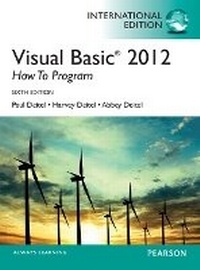
Visual Basic 2012 How to Program
International Edition
6th Edition
Published on 13. June 2013
Book
Paperback/Softback
688 pages
978-0-273-79328-1 (ISBN)
Description
Appropriate for all basic-to-intermediate level courses in Visual Basic 2012 programming.
Created by world-renowned programming instructors Paul and Harvey Deitel, Visual Basic 2012 How to Program introduces all facets of the Visual Basic 2012 language through a hands-on approach with hundreds of working programs. This book reflects the major innovations Microsoft has incorporated in Visual Basic 2012; all discussions and sample code have been carefully audited against the newest Visual Basic language specification. The 6th Edition is updated to Visual Studio 2012 and includes new chapters on Windows 8 UI app development, Windows 8 graphics/multimedia, Windows Phone 8 app development and Windows Azure.
Students begin by getting comfortable with the free Visual Basic Express 2012 IDE and basic VB syntax. Next, they build their skills one step at a time, mastering control structures, classes, objects, methods, variables, arrays, and the core techniques of object-oriented programming. With this strong foundation in place, the Deitels introduce more sophisticated techniques, including inheritance, polymorphism, exception handling, strings, GUI's, data structures, generics, and collections. Throughout, the authors show developers how to make the most of Microsoft's Visual Studio tools. A series of appendices provide essential programming reference material on various topics.
Created by world-renowned programming instructors Paul and Harvey Deitel, Visual Basic 2012 How to Program introduces all facets of the Visual Basic 2012 language through a hands-on approach with hundreds of working programs. This book reflects the major innovations Microsoft has incorporated in Visual Basic 2012; all discussions and sample code have been carefully audited against the newest Visual Basic language specification. The 6th Edition is updated to Visual Studio 2012 and includes new chapters on Windows 8 UI app development, Windows 8 graphics/multimedia, Windows Phone 8 app development and Windows Azure.
Students begin by getting comfortable with the free Visual Basic Express 2012 IDE and basic VB syntax. Next, they build their skills one step at a time, mastering control structures, classes, objects, methods, variables, arrays, and the core techniques of object-oriented programming. With this strong foundation in place, the Deitels introduce more sophisticated techniques, including inheritance, polymorphism, exception handling, strings, GUI's, data structures, generics, and collections. Throughout, the authors show developers how to make the most of Microsoft's Visual Studio tools. A series of appendices provide essential programming reference material on various topics.
More details
Other editions
Additional editions
E-Book
09/2014
6th Edition
Pearson Higher Education;Pearson
€59.49
Available for download
Previous edition

Paul Deitel | Harvey Deitel
Visual Basic 2010 How to Program: Pearson New International Edition
Book
08/2013
5th Edition
Pearson Education Limited
€73.03
Article exhausted; check for reprint
Content
1 Introduction to Computers, the Internet and Visual Basic
2 Dive Into (R) Visual Studio Express 2012 for Windows Desktop
3 Introduction to Visual Basic Programming
4 Introduction to Problem Solving and Control Statements: Part 1
5 Problem Solving and Control Statements: Part 2
6 Methods
7 Arrays
8 Files
9 Object-Oriented Programming: Classes and Objects
10 Object-Oriented Programming: Inheritance and Polymorphism
11 Introduction to LINQ
12 Databases and LINQ
13 Web App Development with ASP.NET
14 Windows Forms GUI: A Deeper Look
15 Graphics and Multimedia
A Operator Precedence Chart
B Primitive Types
C Number Systems
D ASCII Character Set
E Unicode (R)
Index