

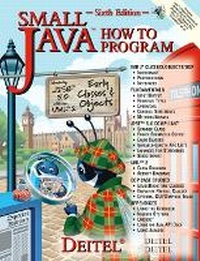
Small Java How to Program
6th Edition
Published on 21. December 2004
Book
Mixed media product
624 pages
978-0-13-148660-7 (ISBN)
Description
For courses in Java/Visual J++, and Java - Introduction to Programming. This special edition of Java How to Program is ideal for one- semester, introductory Java courses and is up-to-date with the Java 2 Platform Standard Edition 5.0. The text covers fundamental programming topics and provides several extra chapters so professors can customize courses to meet their needs. Many of the chapters have been trimmed from Java How to Program, Sixth Edition so they include only information likely to be presented in a one- semester, introductory course. Coverage of graphical user interfaces, applets and graphics is designed to be optional in Small Java How to Program.
More details
Edition
6th edition
Language
English
Place of publication
United States
Publishing group
Pearson Education (US)
Target group
College/higher education
Dimensions
Height: 178 mm
Width: 232 mm
Thickness: 19 mm
Weight
896 gr
ISBN-13
978-0-13-148660-7 (9780131486607)
Copyright in bibliographic data and cover images is held by Nielsen Book Services Limited or by the publishers or by their respective licensors: all rights reserved.
Schweitzer Classification
Other editions
Previous edition
Harvey M. Deitel | Paul J. Deitel
Small Java How to Program and CD Version One Package
Book
11/2004
6th Edition
Pearson
€71.64
Article exhausted; check for reprint
Persons
Dr. Harvey Deitel is one of the world's leading computer science instructors and seminar presenters, and author of more than a dozen books. He worked on the pioneering operating system teams in industry and academia that developed many of the techniques at the heart of operating systems like UNIX (R), Windows NT (TM) and OS/2 (TM).
Paul Deitel has taught Visual Basic, Java, C and C++ at numerous hardware and software companies, including Sun Microsystems, Digital Equipment Corporation, IBM, Open Environment Corporation, Adra Systems, and Cambridge Technology Partners, and is himself an expert developer.
The Deitels are principals of Deitel & Associates, Inc., an international training organization specializing in Visual Basic, Java, C and C++, and object technologies.
Paul Deitel has taught Visual Basic, Java, C and C++ at numerous hardware and software companies, including Sun Microsystems, Digital Equipment Corporation, IBM, Open Environment Corporation, Adra Systems, and Cambridge Technology Partners, and is himself an expert developer.
The Deitels are principals of Deitel & Associates, Inc., an international training organization specializing in Visual Basic, Java, C and C++, and object technologies.
Content
(subject to change)
1. Introduction to Computers, the Internet and the Web
2. Introduction to Java Applications
3. Introduction to Classes and Objects
4. Control Statements: Part 1
5. Control Statements: Part 2
6. Methods: A Deeper Look
7. Arrays
8. Classes and Objects: A Deeper Look
9. Object-Oriented Programming: Inheritance
10. Object-Oriented Programming: Polymorphism
Appendix A. Operator Precedence Chart
Appendix B. ASCII Character Set
Appendix C. Keywords and Reserved Words
Appendix D. Primitive Types
Appendix E. Number Systems
Appendix F. Unicode
Appendix G. Using the Java API Documentation
Appendix H. Creating Documentation with javadoc
Appendix I. Labeled break and continue Statements
Appendix J. Using the Debugger
Bibliography
Index
1. Introduction to Computers, the Internet and the Web
2. Introduction to Java Applications
3. Introduction to Classes and Objects
4. Control Statements: Part 1
5. Control Statements: Part 2
6. Methods: A Deeper Look
7. Arrays
8. Classes and Objects: A Deeper Look
9. Object-Oriented Programming: Inheritance
10. Object-Oriented Programming: Polymorphism
Appendix A. Operator Precedence Chart
Appendix B. ASCII Character Set
Appendix C. Keywords and Reserved Words
Appendix D. Primitive Types
Appendix E. Number Systems
Appendix F. Unicode
Appendix G. Using the Java API Documentation
Appendix H. Creating Documentation with javadoc
Appendix I. Labeled break and continue Statements
Appendix J. Using the Debugger
Bibliography
Index