

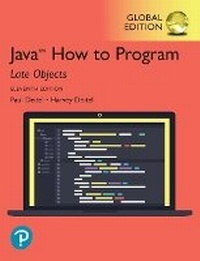
Java How to Program, Late Objects, Global Edition
11th Edition
Published on 18. September 2019
Book
Paperback/Softback
1248 pages
978-1-292-27373-0 (ISBN)
Description
The Deitels' groundbreaking How to Program series offers unparalleled breadth and depth of programming fundamentals, object-oriented programming concepts and intermediate-level topics for further study.
Java How to Program, Late Objects, 11th Edition, presents leading-edge computing technologies using the Deitel signature live-code approach, which demonstrates concepts in hundreds of complete working programs. The 11th Edition presents updated coverage of Java SE 8 and new Java SE 9 capabilities, including JShell, the Java Module System, and other key Java 9 topics.
Java How to Program, Late Objects, 11th Edition, presents leading-edge computing technologies using the Deitel signature live-code approach, which demonstrates concepts in hundreds of complete working programs. The 11th Edition presents updated coverage of Java SE 8 and new Java SE 9 capabilities, including JShell, the Java Module System, and other key Java 9 topics.
More details
Edition
11th edition
Language
English
Place of publication
Harlow
United Kingdom
Target group
College/higher education
Dimensions
Height: 231 mm
Width: 178 mm
Thickness: 41 mm
Weight
1671 gr
ISBN-13
978-1-292-27373-0 (9781292273730)
Copyright in bibliographic data and cover images is held by Nielsen Book Services Limited or by the publishers or by their respective licensors: all rights reserved.
Schweitzer Classification
Other editions
Additional editions
E-Book
08/2019
11th Edition
Pearson
from
€54.39
Available for download
Previous edition
Harvey Deitel | Paul Deitel
Java: How to Program (Late Objects), Global Edition
Book
07/2014
10th Edition
Pearson Education Limited
€89.32
Article exhausted; check for reprint
Content
1. Introduction to Computers, the Internet and Java
2. Introduction to Java Applications; Input/Output and Operators
3. Control Statements: Part 1; Assignment, ++ and -- Operators
4. Control Statements: Part 2; Logical Operators
5. Methods
6. Arrays and ArrayLists
7. Introduction to Classes and Objects
8. Classes and Objects: A Deeper Look
9. Object-Oriented Programming: Inheritance
10. Object-Oriented Programming: Polymorphism and Interfaces
11. Exception Handling: A Deeper Look
12. JavaFX Graphical User Interfaces: Part 1
13. JavaFX GUI: Part 2
14. Strings, Characters, and Regular Expressions
15. Files, Input/Output Streams, NIO and XML Serialization
16. Generic Collections
17. Lambdas and Streams
18. Recursion
19. Searching, Sorting and Big O
20. Generic Classes and Methods: A Deeper Look
21. Custom Generic Data Structures
22. JavaFX Graphics and Multimedia
23. Concurrency
24. Accessing Databases with JDBC
25. Introduction to JShell: Java 9's REPL
Chapters on the Web
A. Operator Precedence Chart
B. ASCII Character Set
C. Keywords and Reserved Words
D. Primitive Types
E. Using the Debugger
Appendices on the Web
Index
Online Chapters and Appendices
26. Swing GUI Components: Part 1
27. Graphics and Java 2D
28. Networking
29. Java Persistence API (JPA)
30. JavaServer (TM) Faces Web Apps: Part 1
31. JavaServer (TM) Faces Web Apps: Part 2
32. REST-Based Web Services
33. (Optional) ATM Case Study, Part 1: Object-Oriented Design with the UML
34. (Optional) ATM Case Study, Part 2: Implementing an Object-Oriented Design
35. Swing GUI Components: Part 2
36. Java Module System and Other Java 9 Features
F. Using the Java API Documentation
G. Creating Documentation with javadoc
H. Unicode (R)
I. Formatted Output
J. Number Systems
K. Bit Manipulation
L. Labeled break and continue Statements
M. UML 2: Additional Diagram Types
N. Design Patterns
2. Introduction to Java Applications; Input/Output and Operators
3. Control Statements: Part 1; Assignment, ++ and -- Operators
4. Control Statements: Part 2; Logical Operators
5. Methods
6. Arrays and ArrayLists
7. Introduction to Classes and Objects
8. Classes and Objects: A Deeper Look
9. Object-Oriented Programming: Inheritance
10. Object-Oriented Programming: Polymorphism and Interfaces
11. Exception Handling: A Deeper Look
12. JavaFX Graphical User Interfaces: Part 1
13. JavaFX GUI: Part 2
14. Strings, Characters, and Regular Expressions
15. Files, Input/Output Streams, NIO and XML Serialization
16. Generic Collections
17. Lambdas and Streams
18. Recursion
19. Searching, Sorting and Big O
20. Generic Classes and Methods: A Deeper Look
21. Custom Generic Data Structures
22. JavaFX Graphics and Multimedia
23. Concurrency
24. Accessing Databases with JDBC
25. Introduction to JShell: Java 9's REPL
Chapters on the Web
A. Operator Precedence Chart
B. ASCII Character Set
C. Keywords and Reserved Words
D. Primitive Types
E. Using the Debugger
Appendices on the Web
Index
Online Chapters and Appendices
26. Swing GUI Components: Part 1
27. Graphics and Java 2D
28. Networking
29. Java Persistence API (JPA)
30. JavaServer (TM) Faces Web Apps: Part 1
31. JavaServer (TM) Faces Web Apps: Part 2
32. REST-Based Web Services
33. (Optional) ATM Case Study, Part 1: Object-Oriented Design with the UML
34. (Optional) ATM Case Study, Part 2: Implementing an Object-Oriented Design
35. Swing GUI Components: Part 2
36. Java Module System and Other Java 9 Features
F. Using the Java API Documentation
G. Creating Documentation with javadoc
H. Unicode (R)
I. Formatted Output
J. Number Systems
K. Bit Manipulation
L. Labeled break and continue Statements
M. UML 2: Additional Diagram Types
N. Design Patterns