

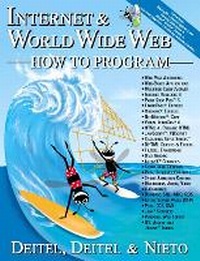
Internet & World Wide Web How to Program
Published on 29. February 2000
Book
Mixed media product
1156 pages
978-0-13-016143-7 (ISBN)
Description
This innovative new book in the Deitel's How to Program series offers an alternative to traditional introductory programming courses. The fundamentals of programming no longer have to be taught in languages like C, C++, and Java. With Internet/Web markup languages (such as HTML, Dynamic HTML, and XML) and scripting languages (such as JavaScript (R) and VBScript (R)), one can teach the fundamentals of programming "wrapped in the Web page metaphor." The book offers a thorough treatment of programming concepts, with programs that yield visible or audible results in Web pages and Web-based applications. The book discusses effective Web page design, server- and client-side scripting, ActiveX (R) controls, and the essentials of electronic commerce.
More details
Language
English
Place of publication
United States
Publishing group
Pearson Education (US)
Target group
College/higher education
Dimensions
Width: 232 mm
Thickness: 35 mm
Weight
1689 gr
ISBN-13
978-0-13-016143-7 (9780130161437)
Copyright in bibliographic data and cover images is held by Nielsen Book Services Limited or by the publishers or by their respective licensors: all rights reserved.
Schweitzer Classification
Other editions
New editions
Harvey M. Deitel | Paul J. Deitel | Tem R. Nieto
Internet & World Wide Web How to Program
United States Edition
Book
09/2001
2nd Edition
Pearson
€68.24
Article exhausted; check for reprint
Persons
Harvey M. Deitel is one of the world's leading computer science instructors and seminar presenters, and author of twelve books. Paul J. Deitel has taught programming at many of the world's leading companies. Together, the Deitels have written seven books, including C++ How to Program. Together, they are principals of Deitel & Associates, a leading international training firm. Tem R. Nieto is an instructor for Deitel & Associates, and has taught programming at many of the world's leading companies.
Content
(subject to change): I. INTRODUCTION 1. Introduction to Computers 2. Introduction to the Internet and the World Wide Web II. CLIENT-SIDE PROGRAMMING 3. HyperText Markup Language (HTML) 4. Scripting with JavaScript: Control Structures 5. Scripting with JavaScript: Functions 6. Scripting with JavaScript: Arrays 7. Object-based Programming and the Scripting Object Model 8. Dynamic HTML (DHTML), the Event Model and the Document Object Model 9. Cascading Style Sheets 10. Microsoft Script Debugger 11. Introduction to COM, DCOM and ActiveX 12. ActiveX Controls, Scripting and Documents 13. Multimedia and ActiveX: Images, Animation, Audio and Video 14. Microsoft Frontpage and Microsoft Visual InterDev; III. SERVER-SIDE PROGRAMMING 15. VBScript (Visual Basic Script) 16. Database, SQL and ADO 17. Active Server Pages 18. CGI (Common Gateway Interface) and Perl 19. Case Study: Three-Tier Client/Server Application 20. Chat Clients/Servers 21. Electronic Commerce, Security and Authenticode 22. Java Servlets ADVANCED TOPICS XML (Extensible Markup Language) and Web Commerce. Appendix A. Effective Web Page Design Appendix B. Operator Precedence Chart Appendix C. Character Set Appendix D. HTML Color Table Appendix E. Number Systems Appendix F. Internet and World Wide Web Resources