

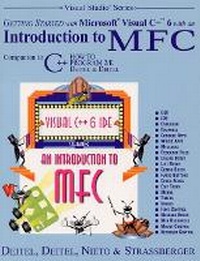
Getting Started with Microsoft Visual C++ 6 with an Introduction to MFC
2nd Edition
Published on 2. August 2000
Book
Mixed media product
163 pages
978-0-13-013249-9 (ISBN)
Description
This companion to C++ How to Program, Second Edition -- the world's most widely used C++ textbook -- carefully explains how to use Microsoft's Visual Studio 6 integrated development environment (IDE) and Visual C++ 6 to create Windows programs using the Microsoft Foundation Classes (MFC). Key topics include: Win32 and console applications; online documentation and Web resources; GUI controls; dialog boxes; graphics; message handling; the resource definition language; and the debugger. The book includes 15 "live-code" Visual C++/MFC programs with screen captures; dozens of tips, recommended practices and cautions; and exercises accompanying every chapter. This book is part of a family of resources for teaching and learning C++, including a Web site with the book's code examples, an optional interactive CD-ROM (C & C++ Multimedia Cyberclassroom), and more.
More details
Edition
2nd edition
Language
English
Place of publication
United States
Publishing group
Pearson Education (US)
Target group
College/higher education
Dimensions
Height: 179 mm
Width: 231 mm
Thickness: 19 mm
Weight
485 gr
ISBN-13
978-0-13-013249-9 (9780130132499)
Copyright in bibliographic data and cover images is held by Nielsen Book Services Limited or by the publishers or by their respective licensors: all rights reserved.
Schweitzer Classification
Other editions
Previous edition
Harvey M. Deitel | Paul J. Deitel | Tem R. Nieto
Getting Started with Visual C++ 6 with An Introduction to MFC
Book
01/2000
2nd Edition
Pearson
€29.70
Article exhausted; check for reprint
Persons
Harvey Deitel and Paul Deitel are principals of Deitel & Associates, Inc., a leader in programming training; and authors of C++ How to Program and Java How to Program -- each the #1 book in its market. They have taught 500,000 programmers.
T.R. Nieto, an MIT graduate, is senior lecturer at Deitel & Associates.
Edward T. Strassberger is the owner of Strassberger Software Training, Inc.
T.R. Nieto, an MIT graduate, is senior lecturer at Deitel & Associates.
Edward T. Strassberger is the owner of Strassberger Software Training, Inc.
Content
1. Visual Studio 6 Integrated Development Environment.
Introduction. Integrated Development Environment Overview: Visual C++. Online Visual C++ Documentation. Creating and Executing a C++ Application. Debugger.
2. MFC Programming: Part 1.
Introduction. MFC Classes. Messages. MFC Resources. Hungarian Notation. Win32 Application Projects. Creating Simple C++ with MFC. Menus. Dialog Boxes.
3. MFC Programming: Part 2.
Introduction. Password Protection. Processing Mouse Messages. Processing Keyboard Input Messages. Text Output.
4. MFC Graphical User Interface Controls.
Introduction. Multiline Edit Text Control. Check Boxes. Radio Button. List Boxes. Combo Boxes.
5. MFC Graphics.
Introduction. Coordinate Systems. Colors. Drawing Functions. Drawing Properties. Shapes and Lines. Timers. Images. Fonts. Closing Remarks.
Appendix: MFC Resources.
Introduction. Resources. Tutorials. FAQs. Products. Newsletters and Publications. Newsgroups.
Bibliography.
Introduction. Integrated Development Environment Overview: Visual C++. Online Visual C++ Documentation. Creating and Executing a C++ Application. Debugger.
2. MFC Programming: Part 1.
Introduction. MFC Classes. Messages. MFC Resources. Hungarian Notation. Win32 Application Projects. Creating Simple C++ with MFC. Menus. Dialog Boxes.
3. MFC Programming: Part 2.
Introduction. Password Protection. Processing Mouse Messages. Processing Keyboard Input Messages. Text Output.
4. MFC Graphical User Interface Controls.
Introduction. Multiline Edit Text Control. Check Boxes. Radio Button. List Boxes. Combo Boxes.
5. MFC Graphics.
Introduction. Coordinate Systems. Colors. Drawing Functions. Drawing Properties. Shapes and Lines. Timers. Images. Fonts. Closing Remarks.
Appendix: MFC Resources.
Introduction. Resources. Tutorials. FAQs. Products. Newsletters and Publications. Newsgroups.
Bibliography.