

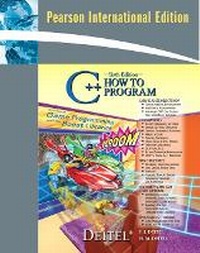
C++ How to Program
International Edition
6th Edition
Published on 28. March 2008
Book
Mixed media product
1504 pages
978-0-13-242701-2 (ISBN)
Description
For Introduction to Programming (CS1) and other more intermediate courses covering programming in C++. Also appropriate as a supplement for upper-level courses where the instructor uses a book as a reference for the C++ language.
This best-selling comprehensive text is aimed at readers with little or no programming experience. It teaches programming by presenting the concepts in the context of full working programs and takes and early objects approach. The text has an emphasis on achieving program clarity through structured and object-oriented programming, software reuse and component-oriented software construction. The Sixth Edition reflects the suggested improvements of a distinguished team of industry professionals and academics.
This best-selling comprehensive text is aimed at readers with little or no programming experience. It teaches programming by presenting the concepts in the context of full working programs and takes and early objects approach. The text has an emphasis on achieving program clarity through structured and object-oriented programming, software reuse and component-oriented software construction. The Sixth Edition reflects the suggested improvements of a distinguished team of industry professionals and academics.
More details
Edition
6th edition
Language
English
Place of publication
United States
Publishing group
Pearson Education (US)
Target group
College/higher education
Dimensions
Height: 235 mm
Width: 178 mm
ISBN-13
978-0-13-242701-2 (9780132427012)
Copyright in bibliographic data is held by Nielsen Book Services Limited or its licensors: all rights reserved.
Schweitzer Classification
Other editions
New editions
Book
07/2008
6th Edition
Pearson
€66.84
Article exhausted; check for reprint
Previous edition

Harvey M. Deitel | Paul J. Deitel
C++ How to Program
Book
02/2005
Prentice-Hall
€56.94
Article exhausted; check for reprint
Person
Paul J. Deitel, CEO and Chief Technical Officer of Deitel & Associates, Inc., is a graduate of MIT's Sloan School of Management, where he studied Information Technology. He holds the Java Certified Programmer and Java Certified Developer certifications, and has been designated by Sun Microsystems as a Java Champion. Through Deitel & Associates, Inc., he has delivered Java, C, C++, C# and Visual Basic courses to industry clients, including IBM, Sun Microsystems, Dell, Lucent Technologies, Fidelity, NASA at the Kennedy Space Center, the National Severe Storm Laboratory, White Sands Missile Range, Rogue Wave Software, Boeing, Stratus, Cambridge Technology Partners, Open Environment Corporation, One Wave, Hyperion Software, Adra Systems, Entergy, CableData Systems, Nortel Networks, Puma, iRobot, Invensys and many more. He has also lectured on Java and C++ for the Boston Chapter of the Association for Computing Machinery. He and his father, Dr. Harvey M. Deitel, are the world's best-selling programming language textbook authors.
Dr. Harvey M. Deitel, Chairman and Chief Strategy Officer of Deitel & Associates, Inc., has 45 years of academic and industry experience in the computer field. Dr. Deitel earned B.S. and M.S. degrees from the MIT and a Ph.D. from Boston University. He has 20 years of college teaching experience, including earning tenure and serving as the Chairman of the Computer Science Department at Boston College before founding Deitel & Associates, Inc., with his son, Paul J. Deitel. He and Paul are the co-authors of several dozen books and multimedia packages and they are writing many more. With translations published in Japanese, German, Russian, Spanish, Traditional Chinese, Simplified Chinese, Korean, French, Polish, Italian, Portuguese, Greek, Urdu and Turkish, the Deitels' texts have earned international recognition. Dr. Deitel has delivered hundreds of professional seminars to major corporations, academic institutions, government organizations and the military.
Dr. Harvey M. Deitel, Chairman and Chief Strategy Officer of Deitel & Associates, Inc., has 45 years of academic and industry experience in the computer field. Dr. Deitel earned B.S. and M.S. degrees from the MIT and a Ph.D. from Boston University. He has 20 years of college teaching experience, including earning tenure and serving as the Chairman of the Computer Science Department at Boston College before founding Deitel & Associates, Inc., with his son, Paul J. Deitel. He and Paul are the co-authors of several dozen books and multimedia packages and they are writing many more. With translations published in Japanese, German, Russian, Spanish, Traditional Chinese, Simplified Chinese, Korean, French, Polish, Italian, Portuguese, Greek, Urdu and Turkish, the Deitels' texts have earned international recognition. Dr. Deitel has delivered hundreds of professional seminars to major corporations, academic institutions, government organizations and the military.
Content
1. Introduction to Computers, the Internet and World Wide Web
2. Introduction to C++ Programming
3. Introduction to Classes and Objects
4. Control Statements: Part 1
5. Control Statements: Part 2
6. Functions and an Introduction to Recursion
7. Arrays and Vectors
8. Pointers and Pointer-Based Strings
9. Classes: A Deeper Look, Part I
10. Classes: A Deeper Look, Part II
11. Operator Overloading: String and Array Objects
12. Object-Oriented Programming: Inheritance
13. Object-Oriented Programming: Polymorphism
14. Templates
15. Stream Input/Output
16. Exception Handling
17. File Processing
18. Class string and String Stream Processing
19. Searching and Sorting
20. Data Structures
21. Bits, Characters, Strings and Structures
22. Standard Template Library (STL)
23. Other Topics24. Game Programming with OGRE and Open AL
Appendices
A. Operator Precedence and Associativity Chart
B. ASCII Character Set
C. Fundamental Types
D. Number Systems
E. C Legacy Code Topics
F. Preprocessor
G. ATM Case Study Code
H. UML 2: Additional Diagram Types
I. Using the Visual Studio (R) 2005 DebuggerJ. Using the GNU C++ Debugger
K. Boost C++ Libraries:
L. What's New in C++ Ox
Bibliography
Index
2. Introduction to C++ Programming
3. Introduction to Classes and Objects
4. Control Statements: Part 1
5. Control Statements: Part 2
6. Functions and an Introduction to Recursion
7. Arrays and Vectors
8. Pointers and Pointer-Based Strings
9. Classes: A Deeper Look, Part I
10. Classes: A Deeper Look, Part II
11. Operator Overloading: String and Array Objects
12. Object-Oriented Programming: Inheritance
13. Object-Oriented Programming: Polymorphism
14. Templates
15. Stream Input/Output
16. Exception Handling
17. File Processing
18. Class string and String Stream Processing
19. Searching and Sorting
20. Data Structures
21. Bits, Characters, Strings and Structures
22. Standard Template Library (STL)
23. Other Topics24. Game Programming with OGRE and Open AL
Appendices
A. Operator Precedence and Associativity Chart
B. ASCII Character Set
C. Fundamental Types
D. Number Systems
E. C Legacy Code Topics
F. Preprocessor
G. ATM Case Study Code
H. UML 2: Additional Diagram Types
I. Using the Visual Studio (R) 2005 DebuggerJ. Using the GNU C++ Debugger
K. Boost C++ Libraries:
L. What's New in C++ Ox
Bibliography
Index