

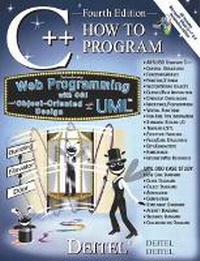
C++ How To Program & C++ in the Lab, Lab Manual
International Edition
4th Edition
Published on 7. August 2003
Book
Mixed media product
978-0-13-120156-9 (ISBN)
Description
For Introduction to Programming (CS1) and other more intermediate courses covering programming in C++. Also appropriate as a supplement for upper-level courses where the instructor uses a book as a reference for the C++ language.
This best-selling comprehensive text is aimed at readers with little or no programming experience. It teaches programming by presenting the concepts in the context of full working programs. The text has an emphasis on achieving program clarity through structured and object-oriented programming, software reuse and component-oriented software construction. The Fourth Edition reflects the suggested improvements of a distinguished team of industry professionals and academics
This best-selling comprehensive text is aimed at readers with little or no programming experience. It teaches programming by presenting the concepts in the context of full working programs. The text has an emphasis on achieving program clarity through structured and object-oriented programming, software reuse and component-oriented software construction. The Fourth Edition reflects the suggested improvements of a distinguished team of industry professionals and academics
More details
Edition
4th edition
Language
English
Place of publication
United States
Publishing group
Pearson Education (US)
Target group
Professional and scholarly
Dimensions
Height: 280 mm
Width: 214 mm
Thickness: 74 mm
Weight
3440 gr
ISBN-13
978-0-13-120156-9 (9780131201569)
Copyright in bibliographic data and cover images is held by Nielsen Book Services Limited or by the publishers or by their respective licensors: all rights reserved.
Schweitzer Classification
Other editions
New editions
Book
02/2005
5th Edition
Pearson
€61.89
Article exhausted; check for reprint
Previous edition
Book
10/2002
4th Edition
Pearson
€39.60
Article exhausted; check for reprint
Content
(NOTE: Each chapter begins with Objectives, an Outline, and an Introduction and ends with a Summary, Terminology, Self-Review Exercises, Self-Review Exercise Answers, and Exercises.)
1. Introduction to Computers and C++ Programming.
2. Control Structures.
3. Functions.
4. Arrays.
5. Pointers and Strings.
6. Classes and Data Abstraction.
7. Classes: Part II.
8. Operator Overloading.
9. Inheritance.
10. Virtual Functions and Polymorphism.
11. C++ Stream Input/Output.
12. Templates.
13. Exception Handling.
14. File Processing.
15. Data Structures.
16. Bits, Characters, Strings and Structures.
17. The Preprocessor.
18. C Legacy Code Topics.
19. Class String and String Stream Processing.
20. Standard Template Library (STL).
21. Standard C++ Language Additions.
Appendix A: Operator Precedence Chart.
Appendix B: ASCII Character Set.
Appendix C: Number Systems.
Appendix D: C++ Internet and Web Resources.
Bibliography.
Index.
1. Introduction to Computers and C++ Programming.
2. Control Structures.
3. Functions.
4. Arrays.
5. Pointers and Strings.
6. Classes and Data Abstraction.
7. Classes: Part II.
8. Operator Overloading.
9. Inheritance.
10. Virtual Functions and Polymorphism.
11. C++ Stream Input/Output.
12. Templates.
13. Exception Handling.
14. File Processing.
15. Data Structures.
16. Bits, Characters, Strings and Structures.
17. The Preprocessor.
18. C Legacy Code Topics.
19. Class String and String Stream Processing.
20. Standard Template Library (STL).
21. Standard C++ Language Additions.
Appendix A: Operator Precedence Chart.
Appendix B: ASCII Character Set.
Appendix C: Number Systems.
Appendix D: C++ Internet and Web Resources.
Bibliography.
Index.