

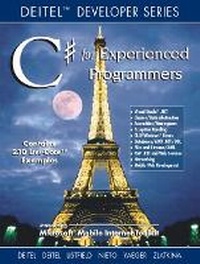
C# For Experienced Programmers
Published on 7. August 2002
Book
Paperback/Softback
1456 pages
978-0-13-046133-9 (ISBN)
Description
Appropriate for all courses in C# for students with experience in at least one high-level programming language.
Written for students with backgrounds in any high-level language, C# for Experienced Programmers applies the proven Deitel LIVE-CODE (TM) approach to an in-depth exploration of Microsofts C# language. The authors present key C# concepts in the context of fully-tested programs, complete with syntax highlighting, detailed line-by-line descriptions, and program outputs. The book features 230 LIVE-CODE (TM) programs containing 26,000 lines of proven C# program code, along with 402 programming tips for building applications that are portable, reusable, and optimized for performance. Students begin with concise discussions of the Visual Studio (R) .NET IDE, control structures, procedures, and arrays; then move rapidly to more advanced topics, including Windows (R) Forms, ADO.NET, ASP .NET, ASP .NET Web services, network programming and XML processing. The book also presents an authoritative, easy-to-understand introduction to objects and object-oriented programming. By the time students are finished, they will understand everything necessary to build next-generation Windows applications, Web applications and XML Web services. Includes selected content from C# How to Program. Second Edition.
Written for students with backgrounds in any high-level language, C# for Experienced Programmers applies the proven Deitel LIVE-CODE (TM) approach to an in-depth exploration of Microsofts C# language. The authors present key C# concepts in the context of fully-tested programs, complete with syntax highlighting, detailed line-by-line descriptions, and program outputs. The book features 230 LIVE-CODE (TM) programs containing 26,000 lines of proven C# program code, along with 402 programming tips for building applications that are portable, reusable, and optimized for performance. Students begin with concise discussions of the Visual Studio (R) .NET IDE, control structures, procedures, and arrays; then move rapidly to more advanced topics, including Windows (R) Forms, ADO.NET, ASP .NET, ASP .NET Web services, network programming and XML processing. The book also presents an authoritative, easy-to-understand introduction to objects and object-oriented programming. By the time students are finished, they will understand everything necessary to build next-generation Windows applications, Web applications and XML Web services. Includes selected content from C# How to Program. Second Edition.
More details
Language
English
Place of publication
Upper Saddle River
United States
Publishing group
Pearson Education (US)
Target group
College/higher education
Dimensions
Height: 230 mm
Width: 177 mm
Thickness: 63 mm
Weight
1972 gr
ISBN-13
978-0-13-046133-9 (9780130461339)
Copyright in bibliographic data and cover images is held by Nielsen Book Services Limited or by the publishers or by their respective licensors: all rights reserved.
Schweitzer Classification
Other editions
New editions
Harvey M. Deitel | Paul J. Deitel
C# for Programmers
Book
12/2005
2nd Edition
Prentice Hall
€53.22
Article is exhausted; no reprint
Persons
Harvey M. Deitel is one of the world's leading computer science instructors and seminar presenters, and author of twelve books. Paul J. Deitel has taught programming at many of the world's leading companies. Together, they have written numerous books, and are principals of Deitel & Associates, a leading global training firm. Their C# How to Program was the world's first C# college textbook.
Content
Preface.
1. Introduction to .NET and C#.
2. Introduction to the Visual Studio .NET IDE and C# Programming.
3. Control Structures.
4. Methods and Arrays.
5. Object-Based Programming.
6. Object-Oriented Programming: Inheritance.
7. Object-Oriented Programming: Polymorphism.
8. Exception Handling.
9. Graphical User Interface Concepts: Part 1.
10. Graphical User Interface Concepts: Part 2.
11. Multithreading.
12. Strings, Characters and Regular Expressions.
13. Graphics and Multimedia.
14. Files and Streams.
15. Extensible Markup Language (XML).
16. Database, SQL and ADO .NET.
17. ASP .NET, Web Forms and Web Controls.
18. ASP .NET and Web Services.
19. Networking: Streams-Based Sockets and Datagrams.
20. Data Structures and Collections.
21. Accessibility.
22. Mobile Internet Toolkit.
Appendix A. Operator Precedence Chart.
Appendix B. Number Systems.
Appendix C. Career Opportunities.
Appendix D. Visual Studio .NET Debugger.
Appendix E. Generating Documentation in Visual Studio .NET.
Appendix F. ASCII Character Set.
Appendix G. Unicode (R).
Appendix H. COM Integration.
Appendix I. Introduction to HyperText Markup Language 4: Part 1.
Appendix J. Introduction to HyperText Markup Language 4: Part 2.
Appendix K. Introduction to XHTML: Part 1.
Appendix L. Introduction to XHTML: Part 2.
Appendix M. HTML/XHTML Special Characters.
Appendix N. HTML/XHTML Colors.
Appendix O. Bit Manipulation.
Appendix P. Crystal Reports (R) for Visual Studio .NET.
Bibliography.
Index.
1. Introduction to .NET and C#.
2. Introduction to the Visual Studio .NET IDE and C# Programming.
3. Control Structures.
4. Methods and Arrays.
5. Object-Based Programming.
6. Object-Oriented Programming: Inheritance.
7. Object-Oriented Programming: Polymorphism.
8. Exception Handling.
9. Graphical User Interface Concepts: Part 1.
10. Graphical User Interface Concepts: Part 2.
11. Multithreading.
12. Strings, Characters and Regular Expressions.
13. Graphics and Multimedia.
14. Files and Streams.
15. Extensible Markup Language (XML).
16. Database, SQL and ADO .NET.
17. ASP .NET, Web Forms and Web Controls.
18. ASP .NET and Web Services.
19. Networking: Streams-Based Sockets and Datagrams.
20. Data Structures and Collections.
21. Accessibility.
22. Mobile Internet Toolkit.
Appendix A. Operator Precedence Chart.
Appendix B. Number Systems.
Appendix C. Career Opportunities.
Appendix D. Visual Studio .NET Debugger.
Appendix E. Generating Documentation in Visual Studio .NET.
Appendix F. ASCII Character Set.
Appendix G. Unicode (R).
Appendix H. COM Integration.
Appendix I. Introduction to HyperText Markup Language 4: Part 1.
Appendix J. Introduction to HyperText Markup Language 4: Part 2.
Appendix K. Introduction to XHTML: Part 1.
Appendix L. Introduction to XHTML: Part 2.
Appendix M. HTML/XHTML Special Characters.
Appendix N. HTML/XHTML Colors.
Appendix O. Bit Manipulation.
Appendix P. Crystal Reports (R) for Visual Studio .NET.
Bibliography.
Index.