

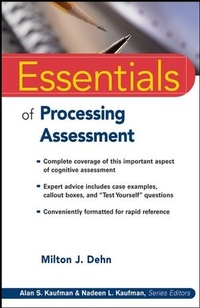
Essentials of Processing Assessment
1st Edition
Published on 1. December 2005
Book
Paperback/Softback
306 pages
978-0-471-71925-0 (ISBN)
Description
Provides step-by-step guidelines for organizing a processing assessment, selecting appropriate instruments, interpreting results, and identifying processing deficits
Understanding how the brain processes information is vital to identifying a child's strengths and weaknesses with regard to learning and formulating appropriate interventions for specific learning difficulties. Essentials of Processing Assessment, the latest addition to the popular Essentials of Psychological Assessment series, provides critical information about this important aspect of cognitive functioning. This handy resource provides students and practitioners with the tools they need to accurately and efficiently assess an individual's ability to process information.
As part of the Essentials of Psychological Assessment series, this book provides information mental health professionals need to practice knowledgeably, efficiently, and ethically in today's behavioral healthcare environment. Each concise chapter features numerous callout boxes highlighting key concepts, bulleted points, and extensive illustrative material, as well as "Test Yourself" questions that help you gauge and reinforce your grasp of the information covered.
The author first presents a model of cognitive processing and learning accompanied by a snapshot of interventions that address various processing deficits, especially those linked to problems with reading, writing, and arithmetic. Next, he outlines a cross-battery approach to selecting appropriate assessment measures and reviews key instruments, such as the WISC(r)-IV, KABC-II, Stanford-Binet 5, WJ III(r), CAS, NEPSY(r), and others. Finally, he provides indispensable guidelines on how to organize a processing assessment and how to interpret results. The book includes a detailed chart categorizing the scales and subtests used in processing assessments and a valuable worksheet for analyzing results.
Closely following IDEA Reauthorization requirements, Essentials of Processing Assessment offers the best one-stop source of information for students and practitioners to identify processing strengths and weaknesses, and plan appropriate interventions.
Other titles in the Essentials of Psychological Assessment series:
Essentials of Stanford-Binet (SB5) Assessment
Essentials of WISC(r)-IV Assessment
Essentials of WIAT(r)-II and KTEA-II Assessment
Essentials of Assessment Report Writing
Essentials of WJ III(r) Cognitive Abilities Assessment
Essentials of WJ III(r) Achievement Assessment
Essentials of WPPSI-III Assessment
Essentials of Cross-Battery Assessment
Essentials of KABC-II Assessment
Essentials of NEPSY(r) Assessment
Essentials of CAS Assessment
Essentials of WMS(r)-III Assessment
Reviews / Votes
"...one of the clearest expositions of the assessment process that I've ever seen." (Essentials of Processing Assessment, April 2007)More details
Other editions
New editions
Milton J. Dehn
Essentials of Processing Assessment
Book
05/2014
2nd Edition
Wiley
€57.90
Article exhausted; check for reprint
Person
MILTON J. DEHN, EdD, is an Associate Professor of Psychology and former director of the School Psychology program at the University of Wisconsin-LaCrosse. He is also program director for Schoolhouse Educational Services, an agency that provides tutoring and remedial education to children with processing and learning problems, in addition to providing continuing education to psychologists and educators.
Content
Series Preface.
Acknowledgments.
One: Introduction and Overview.
Two: Processing and Learning.
Three: Strategies for Assessing Processing.
Four: How to Interpret Processing Assessment Results.
Five: Assessing Processing with Traditional Intelligence Scales.
Six: Assessing Processing with Cognitive Scales.
Seven: Assessing Memory.
Eight: Using Scales Designed to Assess Processing.
Nine: Illustrative Case Reports.
Appendix A: Selective Testing Table for Processes Measured by Cognitive Tests.
Appendix B: Processing Assessment Organizer.
Appendix C: Processing Analysis Worksheet.
Appendix D: Conversion Table: Scaled Scores to Standard Scores.
Appendix E: Supplemental Processing Analysis Worksheet for All Wechsler Scales.
Appendix F: Calculation of WISC-IV Integrated Clinical Processing Factor Scores and Pairwise Comparisons.
Appendix G: Processes Measured by Standardized Tests.
References.
Annotated Bibliography.
Index.
About the Author.