

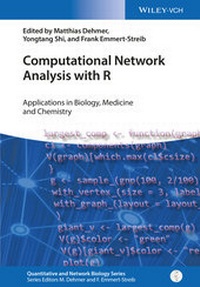
Computational Network Analysis with R
Applications in Biology, Medicine and Chemistry
1st Edition
Published on 15. September 2016
Book
Hardback
XVIII, 343 pages
978-3-527-33958-7 (ISBN)
Description
This new title in the well-established "Quantitative Network Biology" series includes innovative and existing methods for analyzing network data in such areas as network biology and chemoinformatics.
With its easy-to-follow introduction to the theoretical background and application-oriented chapters, the book demonstrates that R is a powerful language for statistically analyzing networks and for solving such large-scale phenomena as network sampling and bootstrapping.
Written by editors and authors with an excellent track record in the field, this is the ultimate reference for R in Network Analysis.
With its easy-to-follow introduction to the theoretical background and application-oriented chapters, the book demonstrates that R is a powerful language for statistically analyzing networks and for solving such large-scale phenomena as network sampling and bootstrapping.
Written by editors and authors with an excellent track record in the field, this is the ultimate reference for R in Network Analysis.
More details
Series
Edition
1. Auflage
Language
English
Place of publication
Berlin
Germany
Target group
Professional and scholarly
Illustrations
32
71 farbige Abbildungen, 32 s/w Abbildungen
Dimensions
Height: 24.4 cm
Width: 17 cm
Thickness: 2.4 cm
Weight
938 gr
ISBN-13
978-3-527-33958-7 (9783527339587)
Schweitzer Classification
Other editions
Additional editions
Matthias Dehmer | Yongtang Shi | Frank Emmert-Streib
Computational Network Analysis with R
Applications in Biology, Medicine and Chemistry
E-Book
08/2016
1st Edition
Wiley-VCH
€151.99
Available for download
Matthias Dehmer | Yongtang Shi | Frank Emmert-Streib
Computational Network Analysis with R
Applications in Biology, Medicine and Chemistry
E-Book
07/2016
1st Edition
Wiley-VCH
€151.99
Available for download
Persons
Matthias Dehmer studied mathematics at the University of Siegen (Germany) and received his Ph.D. in computer science from the Technical University of Darmstadt (Germany). Afterwards, he was a research fellow at Vienna Bio Center (Austria), Vienna University of Technology, and University of Coimbra (Portugal). He obtained his habilitation in applied discrete mathematics from the Vienna University of Technology. Currently, he is Professor at UMIT - The Health and Life Sciences University (Austria) and also holds a position at the Universität der Bundeswehr München. His research interests are in applied mathematics, bioinformatics, systems biology, graph theory, complexity and information theory. He has written over 180 publications in his research areas.
Yongtang Shi studied mathematics at Northwest University (Xi'an, China) and received his Ph.D in applied mathematics from Nankai University (Tianjin, China). He visited Technische Universität Bergakademie Freiberg (Germany), UMIT (Austria) and Simon Fraser University (Canada). Currently, he is an associate professor at the Center for Combinatorics of Nankai University. His research interests are in graph theory and its applications, especially the applications of graph theory in mathematical chemistry, computer science and information theory. He has written over 40 publications in graph theory and its applications.
Frank Emmert-Streib studied physics at the University of Siegen (Germany) gaining his PhD in theoretical physics from the University of Bremen (Germany). He received postdoctoral training from the Stowers Institute for Medical Research (Kansas City, USA) and the University of Washington (Seattle, USA). Currently, he is associate professor for Computational Biology at Tampere University of Technology (Finland). His main research interests are in the field of computational medicine, network biology and statistical genomics.
Yongtang Shi studied mathematics at Northwest University (Xi'an, China) and received his Ph.D in applied mathematics from Nankai University (Tianjin, China). He visited Technische Universität Bergakademie Freiberg (Germany), UMIT (Austria) and Simon Fraser University (Canada). Currently, he is an associate professor at the Center for Combinatorics of Nankai University. His research interests are in graph theory and its applications, especially the applications of graph theory in mathematical chemistry, computer science and information theory. He has written over 40 publications in graph theory and its applications.
Frank Emmert-Streib studied physics at the University of Siegen (Germany) gaining his PhD in theoretical physics from the University of Bremen (Germany). He received postdoctoral training from the Stowers Institute for Medical Research (Kansas City, USA) and the University of Washington (Seattle, USA). Currently, he is associate professor for Computational Biology at Tampere University of Technology (Finland). His main research interests are in the field of computational medicine, network biology and statistical genomics.
Content
Differential correlation technique to analyze biological networks: DiffCorr
Challenges of computational network analysis with R
Software and practices for visualizing network data in biology and medicine
Efficient anomaly detection in dynamic, attributed graphs by using R
Chemical informatics functionality in R
Biological network comparison
Degradation analysis in R using uDEMO
Penalized methods in high-dimensional Gaussian graphical models
Challenges of computational network analysis with R
Software and practices for visualizing network data in biology and medicine
Efficient anomaly detection in dynamic, attributed graphs by using R
Chemical informatics functionality in R
Biological network comparison
Degradation analysis in R using uDEMO
Penalized methods in high-dimensional Gaussian graphical models