

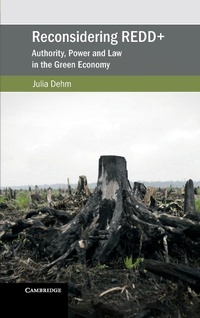
Reconsidering REDD+
Authority, Power and Law in the Green Economy
Published on 3. June 2021
Book
Hardback
440 pages
978-1-108-42376-2 (ISBN)
Description
In Reconsidering REDD+: Authority, Power and Law in the Green Economy, Julia Dehm provides a critical analysis of how the Reducing Emissions from Deforestation and Forest Degradation (REDD+) scheme operates to reorganise social relations and to establish new forms of global authority over forests in the Global South, in ways that benefit the interests of some actors while further marginalising others. In accessible prose that draws on interdisciplinary insights, Dehm demonstrates how, through the creation of new legal relations, including property rights and contractual obligations, new forms of transnational authority over forested areas in the Global South are being constituted. This important work should be read by anyone interested in a critical analysis of international climate law and policy that offers insights into questions of political economy, power, and unequal authority.
Reviews / Votes
'Dehm's authoritative and beautifully written book traces emergent relations of law, power and authority in the green economy. Set against the background of climate crisis as a socio-ecological bio-crisis, Dehm's skilful, multi-layered analysis strips back the surface of REDD+ to expose the global management of forests as a troubling new site of capitalist accumulation. I highly recommend this timely and necessary book.' Anna Grear, Cardiff University 'An original and thought-provoking critique of REDD+ that also sheds light on fundamental shortcomings of the climate change regime and of international environmental law and policy more generally. This is the very best kind of critical scholarship, that not only reveals the limitations of current frameworks but also inspires the reader to look past them to possible alternatives.' Karin Mickelson, University of British ColumbiaMore details
Series
Language
English
Place of publication
Cambridge
United Kingdom
Target group
Professional and scholarly
Illustrations
Worked examples or Exercises
Dimensions
Height: 235 mm
Width: 157 mm
Thickness: 28 mm
Weight
784 gr
ISBN-13
978-1-108-42376-2 (9781108423762)
Copyright in bibliographic data and cover images is held by Nielsen Book Services Limited or by the publishers or by their respective licensors: all rights reserved.
Schweitzer Classification
Other editions
Additional editions
Book
07/2022
Cambridge University Press
€50.10
Shipment within 15-20 days
E-Book
06/2021
Cambridge University Press
€83.99
Available for download
E-Book
05/2021
Cambridge University Press
€28.99
Available for download
Person
Julia Dehm is a Senior Lecturer at the School of Law, La Trobe University, Victoria. Her research addresses international climate change law and regulation, transnational carbon markets and the governance of natural resources, as well as the relationship between human rights and economic inequality. She is the Co-Editor in Chief of the Journal of Human Rights and the Environment. Previously she was a Postdoctoral Fellow at the Rapoport Center for Human Rights and Justice at the University of Texas at Austin and a Resident Fellow at the Institute for Global Law and Policy, Harvard Law School. Her work has been widely published in journals such as the Leiden Journal of International Law, Humanity: An International Journal of Human Rights, Humanitarianism, and Development, and the Journal of Human Rights and the Environment.
Content
Introduction: Reconsidering REDD+; 1. Background to REDD+; 2. Asserting global authority over the carbon sequestration potential of forests; 3. Actualising authority through public and private law: REDD+ through the lens of property and contract; 4. Responsibility and capacity: recasting north-south difference; 5. Scale, multilevel governance and the disaggregation of property rights in REDD+; 6. REDD+ at the 'local' level: between rights and responsibilisation; 7. Conclusion: Possibilities for climate justice and planetary co-habitation.