

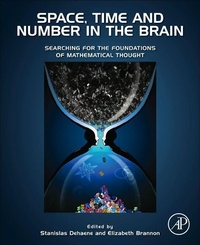
Space, Time and Number in the Brain
Searching for the Foundations of Mathematical Thought
Published on 13. July 2011
Book
Hardback
374 pages
978-0-12-385948-8 (ISBN)
Description
The study of mathematical cognition and the ways in which the ideas of space, time and number are encoded in brain circuitry has become a fundamental issue for neuroscience. How such encoding differs across cultures and educational level is of further interest in education and neuropsychology. This rapidly expanding field of research is overdue for an interdisciplinary volume such as this, which deals with the neurological and psychological foundations of human numeric capacity. A uniquely integrative work, this volume provides a much needed compilation of primary source material to researchers from basic neuroscience, psychology, developmental science, neuroimaging, neuropsychology and theoretical biology.
More details
Language
English
Place of publication
San Diego
United States
Publishing group
Elsevier Science Publishing Co Inc
Target group
College/higher education
Professional and scholarly
Attention and performance researchers from a variety of disciplines - basic neuroscience to psychology, developmental science, neuroimaging, neuropsychology and theoretical biology
Product notice
Unsewn / adhesive bound
Paper over boards
Dimensions
Height: 245 mm
Width: 200 mm
Thickness: 27 mm
Weight
1056 gr
ISBN-13
978-0-12-385948-8 (9780123859488)
Copyright in bibliographic data and cover images is held by Nielsen Book Services Limited or by the publishers or by their respective licensors: all rights reserved.
Schweitzer Classification
Other editions
Additional editions

Stanislas Dehaene | Elizabeth Brannon
Space, Time and Number in the Brain
Searching for the Foundations of Mathematical Thought
Book
10/2018
Academic Press
€79.22
The article will not be published
Stanislas Dehaene | Elizabeth Brannon
Space, Time and Number in the Brain
Searching for the Foundations of Mathematical Thought
E-Book
07/2011
Academic Press
€75.95
Available for download
Persons
Content
Section I Mental Magnitudes and their Transformations
1. Mental Magnitudes
2. Objects, Sets, and Ensembles
3. Attention Mechanisms for Counting in Stabilized and in Dynamic Displays
Section II Neural Codes for Space, Time and Number
4. A Manifold of Spatial Maps in the Brain
5. Temporal Neuronal Oscillations can Produce Spatial Phase Codes
6. Population Clocks
7. Discrete Neuroanatomical Substrates for Generating and Updating Temporal Expectations
8. The Neural Code for Number
Section III Shared Mechanisms for Space, Time and Number?
9. Synesthesia
10. How is Number Associated with Space? The Role of Working Memory
11. Neglect "Around the Clock?
12. Saccades Compress Space, Time, and Number*
Section IV Origins of Proto-Mathematical Intuitions
13. Origins of Spatial, Temporal, and Numerical Cognition
14. Evolutionary Foundations of the Approximate Number System
15. Origins and Development of Generalized Magnitude Representation
Section V Representational Change and Education
16. Foundational Numerical Capacities and the Origins of Dyscalculia
17. Neurocognitive Start-Up Tools for Symbolic Number Representations
18. Natural Number and Natural Geometry
19. Geometry as a Universal Mental Construction
20. How Languages Construct Time
21. Improving Low-Income Children's Number Sense
1. Mental Magnitudes
2. Objects, Sets, and Ensembles
3. Attention Mechanisms for Counting in Stabilized and in Dynamic Displays
Section II Neural Codes for Space, Time and Number
4. A Manifold of Spatial Maps in the Brain
5. Temporal Neuronal Oscillations can Produce Spatial Phase Codes
6. Population Clocks
7. Discrete Neuroanatomical Substrates for Generating and Updating Temporal Expectations
8. The Neural Code for Number
Section III Shared Mechanisms for Space, Time and Number?
9. Synesthesia
10. How is Number Associated with Space? The Role of Working Memory
11. Neglect "Around the Clock?
12. Saccades Compress Space, Time, and Number*
Section IV Origins of Proto-Mathematical Intuitions
13. Origins of Spatial, Temporal, and Numerical Cognition
14. Evolutionary Foundations of the Approximate Number System
15. Origins and Development of Generalized Magnitude Representation
Section V Representational Change and Education
16. Foundational Numerical Capacities and the Origins of Dyscalculia
17. Neurocognitive Start-Up Tools for Symbolic Number Representations
18. Natural Number and Natural Geometry
19. Geometry as a Universal Mental Construction
20. How Languages Construct Time
21. Improving Low-Income Children's Number Sense