

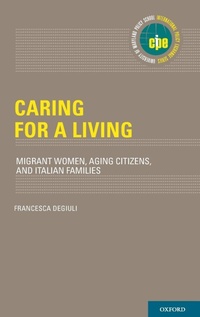
Caring for a Living
Migrant Women, Aging Citizens, and Italian Families
Published on 23. June 2016
Book
Hardback
216 pages
978-0-19-998901-0 (ISBN)
Description
Today's world is aging at a great speed, and although increased longevity represents one of the greatest achievements of the last century, the extension of life expectancy does not necessarily correspond to an extension of healthy lives. Aging populations, particularly those with a high percentage of the oldest old, are often burdened with chronic conditions that require extended long-term care. Deciding who provides said care, and in what forms, are key problems that will soon affect a growing number of post-industrial high- and mid-income countries. ^iCaring for a Living^r contributes to this debate by exploring the organization of long-term care in Italy, a country already in the midst of an eldercare crisis. There, the answer to this problem has taken the shape of home eldercare assistance, an arrangement whereby long-term care services are bought in the market in the form of private and individualized assistance by families sometimes with economic support provided by the State. The providers of these services, commonly known as "badanti" (minders), are, for the most part, im/migrant women coming from different areas of the world.
^iCaring for a Living^r analyzes the emergence and development of this arrangement and the role that the state, Italian families, and workers themselves play in shaping and in defining it. The author provides timely insights on: the nature of long-term care and its requirements; the specific needs of families facing this issue; the changing role of the neoliberal State; and the ways in which global political and economic processes influence and shape an apparently individually based solution to long-term care. This book is ideal for graduate courses in sociology and anthropology, specifically in courses related to gender and migration, work and women, social inequality, and immigration studies.
^iCaring for a Living^r analyzes the emergence and development of this arrangement and the role that the state, Italian families, and workers themselves play in shaping and in defining it. The author provides timely insights on: the nature of long-term care and its requirements; the specific needs of families facing this issue; the changing role of the neoliberal State; and the ways in which global political and economic processes influence and shape an apparently individually based solution to long-term care. This book is ideal for graduate courses in sociology and anthropology, specifically in courses related to gender and migration, work and women, social inequality, and immigration studies.
Reviews / Votes
Shaped by global forces of economic restructuring, im/migration, and demographic change, eldercare emerges in this stunning ethnography as a distinct form of labor in which keeping company and attentive intimacy separates the job from other kinds of household work. The Italian case highlights the ways that state policy maintains familial relations of care through fictive kinship while sustaining traditional gender burdens and reinforcing neoliberal responses to human need. Caring for a Living is a must-read for policy makers and scholars alike. * Eileen Boris, PhD, MA, Hull Professor of Feminist Studies, University of California, Santa Barbara; co-author, Caring for America: Home Health Workers in the Shadow of the Welfare State * Care drain is an emerging dimension of immigrant's flows, and aging populations in developed societies foster the demand of care workers coming from abroad. The thorough analysis provided by Francesca Degiuli intersects migration regime, care regime, and employment regime, highlighting a crucial process in the restructuring of Welfare States in contemporary societies. Even if her focus is on Italian society, the author's analysis goes well beyond, providing a comprehensive glance on relations between the elderly, households, States, and migrant workers. I highly recommend this book to every scholar who wants to understand why, where, and how migrants are necessary and the terms in which receiving societies make use of them. * Maurizio Ambrosini, PhD, Professor of Sociology of Migrations, University of Milan, Department of Social and Political Sciences *More details
Series
Language
English
Place of publication
New York
United States
Target group
College/higher education
Professional and scholarly
Dimensions
Height: 240 mm
Width: 161 mm
Thickness: 16 mm
Weight
493 gr
ISBN-13
978-0-19-998901-0 (9780199989010)
Copyright in bibliographic data and cover images is held by Nielsen Book Services Limited or by the publishers or by their respective licensors: all rights reserved.
Schweitzer Classification
Other editions
Additional editions
E-Book
05/2016
1st Edition
OUP eBook
€39.49
Available for download
E-Book
05/2016
1st Edition
OUP eBook
€30.49
Available for download
Person
Francesca Degiuli, PhD, is Assistant Professor of Sociology at Fairleigh Dickinson University and a Visiting Fellow in the Center for European and Mediterranean Studies at NYU. Dr. Degiuli's research interests lie at the intersection of aging, gender, immigration, and globalization. Specifically, she is interested in highlighting the complex interactions between political economy and culture in shaping everyday life.
Content
Chapter 1: The Changing Landscape of Eldercare
Chapter 2: The New Faces of Eldercare
Chapter 3: The Italian Case
Chapter 4: The Burden of Long-Term Care: Its Cultural, Economic and Social Aspects.
Chapter 5: The Shaping of New Subjects
Chapter 6: Skilling the Unskilled: The Multiple Dimensions of Eldercare
Chapter 7: The Bonds of Labor
Chapter 8: Concluding Thoughts
Appendix 1: Interviews with current or former home eldercare assistants
Appendix 2: Table 3.7 Interviews with Family Caregivers who care for disabled elders.
Appendix 3: Interviews with im/migrant women at Tierra and with cultural
References
Index
Chapter 2: The New Faces of Eldercare
Chapter 3: The Italian Case
Chapter 4: The Burden of Long-Term Care: Its Cultural, Economic and Social Aspects.
Chapter 5: The Shaping of New Subjects
Chapter 6: Skilling the Unskilled: The Multiple Dimensions of Eldercare
Chapter 7: The Bonds of Labor
Chapter 8: Concluding Thoughts
Appendix 1: Interviews with current or former home eldercare assistants
Appendix 2: Table 3.7 Interviews with Family Caregivers who care for disabled elders.
Appendix 3: Interviews with im/migrant women at Tierra and with cultural
References
Index