

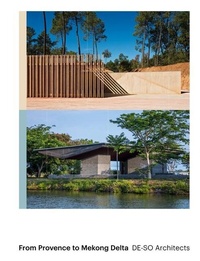
From Provence to Mekong Delta
DE-SO Architects
Published on 1. January 2022
Book
Hardback
200 pages
978-1-946226-47-1 (ISBN)
Description
The visitor centers in Can Gio, south Vietnam and Bruoux en Provence in the south of France are designed by the architectural firm DE-SO and DE-SO Asia. Both buildings integrate into their respective landscape and climate. The Bruoux en Provence building was built in 2010 and Can Gio in 2020 - 10 years later.
Slightly elevated above natural ground level, the Can Gio pavilion reception areas benefit from the cool sea breeze - a naturally ventilated gazebo that overlooks the mangrove swamp.
Built into a hillside, the Bruoux en Provence mines visitor center concourse benefits from thermal inertia and the freshness of the ground, burying into the earth to create a shaded "cool" space for visitors that overlooks the ocher cliffs paved square.
Each building is built from local materials - a constructive choice that favors short supply circuits of the natural materials - laterite stone in the sandy mangroves of the Saigon River, timber and concrete from a site in Provence. The Can Gio building is the grey color of the mangrove silt, and Bruoux the orange the color of the ocher in Provence.
Both buildings express a special strong attachment with the ground. Their abstraction and the landscape views are key to the design of these two projects. In its own way, each frames views of the natural landscape. Views that are like abstract paintings composed of colors strongly imbued with the air moisture or sunlight intensity. At night, the moucharabiehs - clad in solid laterite stone bricks at Can Gio and in vertical pine screen at the Mines de Bruoux visitor center - create subtle, magnetic lanterns whose light changes in accordance with visitor movement within. An angular geometry composes the layout of both projects in contrast with the flowing lines of the surrounding topography. As since the beginning of architecture - geometry and geography intertwine to accentuate their expression.
Slightly elevated above natural ground level, the Can Gio pavilion reception areas benefit from the cool sea breeze - a naturally ventilated gazebo that overlooks the mangrove swamp.
Built into a hillside, the Bruoux en Provence mines visitor center concourse benefits from thermal inertia and the freshness of the ground, burying into the earth to create a shaded "cool" space for visitors that overlooks the ocher cliffs paved square.
Each building is built from local materials - a constructive choice that favors short supply circuits of the natural materials - laterite stone in the sandy mangroves of the Saigon River, timber and concrete from a site in Provence. The Can Gio building is the grey color of the mangrove silt, and Bruoux the orange the color of the ocher in Provence.
Both buildings express a special strong attachment with the ground. Their abstraction and the landscape views are key to the design of these two projects. In its own way, each frames views of the natural landscape. Views that are like abstract paintings composed of colors strongly imbued with the air moisture or sunlight intensity. At night, the moucharabiehs - clad in solid laterite stone bricks at Can Gio and in vertical pine screen at the Mines de Bruoux visitor center - create subtle, magnetic lanterns whose light changes in accordance with visitor movement within. An angular geometry composes the layout of both projects in contrast with the flowing lines of the surrounding topography. As since the beginning of architecture - geometry and geography intertwine to accentuate their expression.
More details
Series
Language
English
Place of publication
United States
Product notice
sewn/stitched
Cloth over boards
Illustrations
62 Illustrations, color
Dimensions
Height: 282 mm
Width: 224 mm
Thickness: 25 mm
Weight
1293 gr
ISBN-13
978-1-946226-47-1 (9781946226471)
Copyright in bibliographic data and cover images is held by Nielsen Book Services Limited or by the publishers or by their respective licensors: all rights reserved.
Schweitzer Classification
Persons
Francois Defrain founded the world reknown DE-SO Architects, with Olivier Souquet, in 2005. Herve Abbadie was born in Rennes (France) in 1962 and is an internationally recognised photographer who specialises in graphic and subtle work on the urban landscape. He work is emplyed by many of the top contemporary architects.