

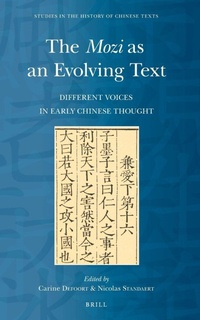
The Mozi as an Evolving Text
Different Voices in Early Chinese Thought
Published on 1. March 2013
Book
Hardback
302 pages
978-90-04-23434-5 (ISBN)
Description
Mozi (ca. 479-381), known as the first outspoken critic of Confucius, is an important but neglected figure in early Chinese philosophy. The book Mozi, named after master Mo, was compiled in the course of the fifth - third centuries BCE. The seven studies included in the The Mozi as an Evolving Text take a fresh look at the Core Chapters, Dialogues, and Opening Chapters of the book Mozi. Rather than presenting a unified vision of Mohist thought, the contributions search for different voices in the text and for evolutions or tensions between its chapters. By analysing the Mozi as an evolving text, these studies not only contribute to the rejuvenation of Mozi studies, but also to the methodology of studying ancient Chinese texts.
More details
Series
Language
English
Place of publication
Leiden
Netherlands
Target group
All those interested in the major texts of early Chinese philosophy, especially Mozi, and anyone concerned with the textual history of ancient Chinese texts.
Product notice
Laminated cover
Dimensions
Height: 235 mm
Width: 155 mm
Thickness: 18 mm
Weight
602 gr
ISBN-13
978-90-04-23434-5 (9789004234345)
Copyright in bibliographic data and cover images is held by Nielsen Book Services Limited or by the publishers or by their respective licensors: all rights reserved.
Schweitzer Classification
Persons
Carine Defoort is Professor of Sinology at the University of Leuven (Belgium), specialising in early Chinese philosophy and its modern reception. She is editor of Contemporary Chinese Thought and leads the Mozi research at the Sinology department in Leuven.
Nicolas Standaert is Professor of Sinology at the University of Leuven (Belgium), specialising in the cultural contacts between China and Europe in the seventeenth and eighteenth centuries.
Nicolas Standaert is Professor of Sinology at the University of Leuven (Belgium), specialising in the cultural contacts between China and Europe in the seventeenth and eighteenth centuries.