

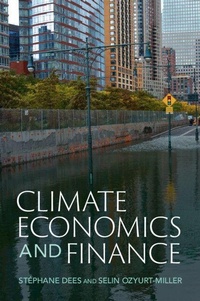
Climate Economics and Finance
Will be published approx. on 31. December 2025
Book
Paperback/Softback
340 pages
978-1-009-62863-1 (ISBN)
Description
Climate change and its mitigation has become one of the most pressing challenges facing our societies. Shocks and phenomena related to climate change cause important economic losses due to damages to property infrastructure, disruptions to supply chains, lower productivity, and migration. Climate Economics and Finance offers a comprehensive analysis of how climate change impacts the economy and financial systems. Focusing on the monetary and financial implications of climate change, it addresses critical yet often overlooked areas such as greenflation, public and private financing of the transition process, and the challenges faced by central banks and supervisors in preventing and managing associated risks. It delves into the challenges that emerging and developing economies face in accessing climate finance, highlighting innovative financial and de-risking solutions. Synthesizing state-of-the-art research and ongoing policy discussions, this book offers a clear and accessible entry point into the intersection of climate and finance.
Reviews / Votes
'This book by Stephane Dees and Selin Ozyurt-Miller is an excellent overview of the state of knowledge on climate change economics, the importance of financing the climate transition, and the role of central banks. This is essential reading for scholars and policymakers. It is particularly useful for understanding how central banks are thinking about the climate transition and the potential impacts on central bank policy.' Warwick McKibbin, Australian National University, and The Peterson Institute for International Economics, Washington, DC 'This book provides an excellent and very comprehensive overview of the economic and financial consequences of climate change and the concepts, tools, and policies developed to address those consequences. It is a great source for policymakers, financial professionals, and academics who want to dig into the current policy debate.' Frank Smets, Bank for International Settlements 'In this new book, Stephane Dees and Selin Ozyurt-Miller tackle an enormous - but vitally crucial - issue of how global climate change influences economics and finance, in an impressively comprehensive and yet understandable way. Without shying away from discussing the intricacies of statistical and economic models, the authors cover the implications of climate change, as well as the costs and benefits of the various means of addressing the challenges that have arisen. I'll certainly refer to this text when I teach my macroeconomics courses.' Menzie D. Chinn, University of Wisconsin-MadisonMore details
Language
English
Place of publication
Cambridge
United Kingdom
Target group
College/higher education
Professional and scholarly
Illustrations
Worked examples or Exercises
Dimensions
Height: 229 mm
Width: 152 mm
Thickness: 19 mm
Weight
485 gr
ISBN-13
978-1-009-62863-1 (9781009628631)
Copyright in bibliographic data and cover images is held by Nielsen Book Services Limited or by the publishers or by their respective licensors: all rights reserved.
Schweitzer Classification
Other editions
Additional editions
Stephane Dees | Selin Ozyurt
Climate Economics and Finance
Book
approx. 12/2025
Cambridge University Press
€112.30
Not yet published
Persons
Stéphane Dees is Head of the Climate Economics Unit at the Banque de France and Associate Professor at the Bordeaux School of Economics. He spent a majority of his career at the European Central Bank. His research, which has been published in top academic journals, covers various topics in financial and international macroeconomics, financial stability and climate change.
Content
1. Climate change and its economic impacts; 2. The economics of climate change mitigation; 3. The macroeconomic effects of mitigation policies; 4. Introduction to climate finance and main instruments; 5. Central banks and climate change - risks to price stability; 6. Risks to financial stability and prudential policy; 7. Main Climate Finance Challenges in EMDEs and Ways to Overcome Them.