

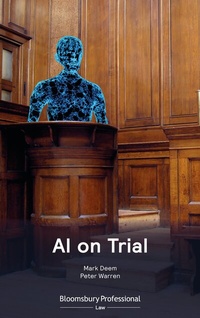
AI on Trial
Published on 16. June 2022
Book
Paperback/Softback
352 pages
978-1-5265-1355-7 (ISBN)
Description
AI on Trial follows the same process as a High Court trial, and in so doing it takes an innovative approach to the most innovative of technological areas.
Addressing the current state of artificial intelligence and the law, the book identifies why the technology should be 'placed on trial' and presents relevant evidence, before passing 'judgment' and proposing a Manifesto for Responsible AI and a blueprint for an ethical, legal and regulatory framework.
The 'trial' examines such questions as:
-Should AI, a computer technology, have rights and responsibilities?
-What are the legal and ethical issues created by the implicit bias of coders and data sets?
-Is AI racist?
-Do we need a Hippocratic Oath in AI?
-Could AI lead to a data war to end all wars?
-Can we trust AI?
Readers will benefit from understanding the necessary considerations in formulating any legal framework and will come to recognise the role of any such framework, not only in preventing harm, but in supporting growth and technological advancement.
Written from the viewpoint of practitioners, academics and journalists, this is an essential title for all information and technology law practitioners, in-house counsel, data protection officers, company directors, finance directors, academics and students. Technologists, regulators, legislators and journalists interested in getting to grips with the issues presented by AI will also benefit.
This title is included in Bloomsbury Professional's Cyber Law online service.
Addressing the current state of artificial intelligence and the law, the book identifies why the technology should be 'placed on trial' and presents relevant evidence, before passing 'judgment' and proposing a Manifesto for Responsible AI and a blueprint for an ethical, legal and regulatory framework.
The 'trial' examines such questions as:
-Should AI, a computer technology, have rights and responsibilities?
-What are the legal and ethical issues created by the implicit bias of coders and data sets?
-Is AI racist?
-Do we need a Hippocratic Oath in AI?
-Could AI lead to a data war to end all wars?
-Can we trust AI?
Readers will benefit from understanding the necessary considerations in formulating any legal framework and will come to recognise the role of any such framework, not only in preventing harm, but in supporting growth and technological advancement.
Written from the viewpoint of practitioners, academics and journalists, this is an essential title for all information and technology law practitioners, in-house counsel, data protection officers, company directors, finance directors, academics and students. Technologists, regulators, legislators and journalists interested in getting to grips with the issues presented by AI will also benefit.
This title is included in Bloomsbury Professional's Cyber Law online service.
More details
Language
English
Place of publication
London
United Kingdom
Publishing group
Bloomsbury Publishing PLC
Target group
Professional and scholarly
Dimensions
Height: 248 mm
Width: 156 mm
Weight
577 gr
ISBN-13
978-1-5265-1355-7 (9781526513557)
Copyright in bibliographic data and cover images is held by Nielsen Book Services Limited or by the publishers or by their respective licensors: all rights reserved.
Schweitzer Classification
Persons
Mark Deem, Partner at Wiggin LLP, London.
Peter Warren, freelance journalist specialising in technology, undercover investigations and science issues.
Peter Warren, freelance journalist specialising in technology, undercover investigations and science issues.
Content
PART A - OPENING SUBMISSIONS
Chapter 1: What is AI - and what it is not?
Chapter 2: Building blocks
Chapter 3: The state of play
Chapter 4: Why should AI be placed on trial?
PART B - THE EVIDENCE
Chapter 5: Owning the errors: who owns the data and the AI?
Chapter 6: Data as power: the war to end all wars?
Chapter 7: Data as a means of defence: can AI make us cyber secure?
Chapter 8: Setting boundaries: do we need a Hippocratic oath?
Chapter 9: Achieving A diversity: is AI racist?
Chapter 10: Gaming the system: using AI to achieve a competitive advantage
Chapter 11: Out of our hands: should we allow decisions to be entirely automated?
Chapter 12: Standing up for the technology: what rights and responsibilities should AI have?
Chapter 13: Holding to account: how might causation and liability be established?
Chapter 14: A question of honour: how can we trust AI?
PART C - CLOSING SUBMISSIONS
PART D - JUDGMENT
Chapter 1: What is AI - and what it is not?
Chapter 2: Building blocks
Chapter 3: The state of play
Chapter 4: Why should AI be placed on trial?
PART B - THE EVIDENCE
Chapter 5: Owning the errors: who owns the data and the AI?
Chapter 6: Data as power: the war to end all wars?
Chapter 7: Data as a means of defence: can AI make us cyber secure?
Chapter 8: Setting boundaries: do we need a Hippocratic oath?
Chapter 9: Achieving A diversity: is AI racist?
Chapter 10: Gaming the system: using AI to achieve a competitive advantage
Chapter 11: Out of our hands: should we allow decisions to be entirely automated?
Chapter 12: Standing up for the technology: what rights and responsibilities should AI have?
Chapter 13: Holding to account: how might causation and liability be established?
Chapter 14: A question of honour: how can we trust AI?
PART C - CLOSING SUBMISSIONS
PART D - JUDGMENT