

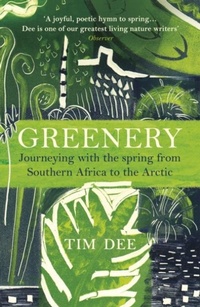
Greenery
Journeying with the Spring from Southern Africa to the Arctic
Published on 25. March 2021
Book
Paperback/Softback
368 pages
978-1-78470-789-7 (ISBN)
Description
'A joyful, poetic hymn to spring... Dee is one of our greatest living nature writers' Observer
One December, in midsummer South Africa, Tim Dee was watching swallows. They were at home there, but the same birds would soon begin journeying north to Europe, where their arrival marks the beginning of spring.
Greenery recounts how Tim Dee tries to follow the season and its migratory birds, making remarkable journeys in the Sahara, the Straits of Gibraltar, Sicily, Britain, and finally by the shores of the Arctic Ocean in northern Scandinavia. On each adventure, he is in step with the very best days of the year - the time of song and nests and eggs, of buds and blossoms and leafing.
'A masterpiece... I can't imagine I'll ever stop thinking about it' Max Porter
'Fascinating, horizon-expanding, life-enhancing' Lucy Jones, author of Losing Eden
One December, in midsummer South Africa, Tim Dee was watching swallows. They were at home there, but the same birds would soon begin journeying north to Europe, where their arrival marks the beginning of spring.
Greenery recounts how Tim Dee tries to follow the season and its migratory birds, making remarkable journeys in the Sahara, the Straits of Gibraltar, Sicily, Britain, and finally by the shores of the Arctic Ocean in northern Scandinavia. On each adventure, he is in step with the very best days of the year - the time of song and nests and eggs, of buds and blossoms and leafing.
'A masterpiece... I can't imagine I'll ever stop thinking about it' Max Porter
'Fascinating, horizon-expanding, life-enhancing' Lucy Jones, author of Losing Eden
Reviews / Votes
A joyful, poetic hymn to spring...[by] one of our greatest living nature writers... Greenery is an education in looking at, and loving, nature... It is a lesson in how to love the world, in how to look at it, and behind everything there beats a deeper message: that spring cannot exist without winter, that life needs death to define it. -- Alex Preston * Observer * This book has changed the way I think about seasons and migration, humans and birds, time and life. He is a virtuoso handler of sound, knowledge and language. It's a masterpiece. I can't imagine I'll ever stop thinking about it. -- Max Porter A masterpiece of nature writing... No one else in the genre shows anything like Dee's command of prose, tone, voice, pace, depth and phrasing... It's the sort of book that, in its expressive power, its creativity, the richness of its humanity, might make the world worth saving. -- Richard Smyth * New Statesman * "Nature Writing", says the classification on the back. Partly true. He's good at that. But leaving it there is a bit like saying that Wordsworth was a gardener and Springsteen is a harmonica player. Dee is one of our best living writers of non-fiction, and Greenery...is perhaps his best book yet... It couldn't be more timely. -- Michael Kerr * Daily Telegraph * A superb nature writer... Miraculous... Ardent, playful, quietly subversive - this is how Dee has always written, but his originality and learning mean he never needs to resort to the devotional swooning that has always plagued writing about the non-human world... It's a deeply affecting [ending]... The effect is like a painter's varnish, deepening shadows but intensifying colours. You go back to the start. -- William Atkins * Guardian * Greenery...brims with the same thrilling sense as the season it charts... Dee writes like no other nature author I know. -- Mark Cocker * New Statesman *Books of the Year* * Greenery is as full of the sensibility and wit that marked Dee's previous books... The prose is as sharp and agile as the beak and movements of his 'most needed' bird, the redstart, and the range of reference and thought is astonishing. -- Caspar Henderson * Spectator * His writing is a delight, both elegant and provocative... This charming, meandering...book ends with a completely unexpected double whammy, which had me first wiping away tears and then smiling in delight. It's a reminder that, however grim things look, there is always the freshness and rebirth of spring to look forward to. -- Constance Craig Smith * Daily Mail * For a beautiful evocation of this restorative draft of a season, look no further than Tim Dee's new book Greenery - a poetic and profound meditation on the natural (and human) world encountered as he follows spring around the globe. It'll lift your heart and take you places while reminding you that the most important things are close at hand. -- Rob Cowen, author of Common Ground * Yorkshire Post * Extraordinary... Dee has an enormous aptitude for burrowing into research and then opening it out map-like over the tangible natural world... [Greenery is his] most personal and spectacular nature memoir to date. * Irish Independent *More details
Language
English
Place of publication
London
United Kingdom
Publishing group
Vintage Publishing
Product notice
Paperback (UK-B)
Dimensions
Height: 194 mm
Width: 126 mm
Thickness: 24 mm
Weight
292 gr
ISBN-13
978-1-78470-789-7 (9781784707897)
Copyright in bibliographic data and cover images is held by Nielsen Book Services Limited or by the publishers or by their respective licensors: all rights reserved.
Schweitzer Classification
Other editions
Additional editions
Person
Tim Dee has been a birdwatcher all his life. His first book, The Running Sky (2009), described his first five birdwatching decades. In the same year he collaborated with the poet Simon Armitage on the anthology The Poetry of Birds. Since then he has written and edited several critically acclaimed books: Four Fields (2013), a study of modern pastoral, which was shortlisted for the 2014 Ondaatje Prize; Ground Work (as editor, 2017), a collection of new commissioned writing on place by contemporary writers; and most recently, Landfill (2018), a modern nature-junk monograph on gulls and rubbish. He left the BBC in 2018 having worked as a radio producer for nearly thirty years. He lives in three places: in a flat in inner-city Bristol, in a cottage on the edge of the Cambridgeshire Fens, and in the last-but-one house from the south western tip of Africa, at the Cape of Good Hope.