

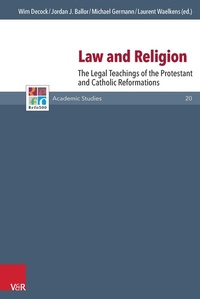
Law and Religion
The Legal Teachings of the Protestant and Catholic Reformations
1st Edition
Published on 17. September 2014
Book
Hardback
278 pages
978-3-525-55074-8 (ISBN)
Description
Wim Decockcollects contributions by internationally renowned experts in law, history and religion on the impact of the Reformations on law, jurisprudence and moral theology. The overall impression conveyed by the essays is that on the level of substantive doctrine (the legal teachings) there seems to be more continuity between Protestant and Catholic, or, for that matter, between medieval and early modern jurisprudence and theology than usually expected. As it is illustrated with regards to topics ranging from just war doctrine over business ethics to marriage law, at the very least there appears to have been an on-going conversation between jurists and theologians across the confessional divide. This does not prevent some contributions from highlighting that on the institutional level, for instance in university politics, radical tensions between Reformers and Counter-Reformers played a paramount role. This book also offers approaches to the relationship between Church(es) and State(s) in the early modern period and to the practical as well as doctrinal use of natural law in both Protestant and Catholic lands.
More details
Other editions
Additional editions
Wim Decock | Jordan J. Ballor | Michael Germann
Law and Religion
The Legal Teachings of the Protestant and Catholic Reformations
E-Book
09/2014
1st Edition
Vandenhoeck & Ruprecht
€150.00
Available for download
Persons
Editor
Wim Decock is LOEWE Research Group Leader at the Max-Planck-Institute for European Legal History and Assistant Professor at the Faculty of Law, KU Leuven.
Jordan J. Ballor, Ph.D., is a Research Fellow at the Acton Institute for the Study of Religion and Liberty, where he also serves as Executive Editor of the Journal of Markets & Morality.
Michael Germann is Professor of Public Law, State and Church Law, and Ecclesiastical Law at Martin Luther University Halle-Wittenberg.
Laurent L.J.M. Waelkens is Full Professor of Roman law and Legal History at the Law Faculty of the University of Leuven (KU Leuven).
Contributions
Prof. Dr. Mathias Schmoeckel, Jahrgang 1963, lehrt seit 1999 Rechtsgeschichte und Zivilrecht an der Rheinischen Friedrich-Wilhelms-Universität Bonn. Seine geschichtlichen Forschungsschwerpunkte liegen im Beweisrecht, im neueren Völker- und Zivilrecht sowie im Einfluss der Reformation auf das Recht.
Associate editor
Dr. Günter Frank ist Direktor der Europäischen Melanchthon-Akademie Bretten und außerplanmäßiger Professor am Karlsruher Institut für Technologie.
Barbara Mahlmann-Bauer ist Professorin em. für "Neuere deutsche Literatur" an der Universität Bern.
Johannes Schilling ist Professor im Ruhestand für Kirchengeschichte an der Universität Kiel.
Dr. Günther Wassilowsky ist Professor für Kirchengeschichte an der Humboldt-Universität zu Berlin.
Prof. Dr. Siegrid Westphal ist Inhaberin des Lehrstuhls für Geschichte der Frühen Neuzeit an der Universität Osnabrück sowie Direktorin des Forschungszentrums Institut für Kulturgeschichte der Frühen Neuzeit.
Tarald Rasmussen ist Professor für Kirchengeschichte an der Universität Oslo.
Dr. Bruce Gordon is Professor of Ecclesiastical History at Yale Divinity School.
Content
Wim Decockcollects contributions by internationally renowned experts in law, history and religion on the impact of the Reformations on law, jurisprudence and moral theology. The overall impression conveyed by the essays is that on the level of substantive doctrine (the legal teachings) there seems to be more continuity between Protestant and Catholic, or, for that matter, between medieval and early modern jurisprudence and theology than usually expected. As it is illustrated with regards to topics ranging from just war doctrine over business ethics to marriage law, at the very least there appears to have been an on-going conversation between jurists and theologians across the confessional divide. This does not prevent some contributions from highlighting that on the institutional level, for instance in university politics, radical tensions between Reformers and Counter-Reformers played a paramount role. This book also offers approaches to the relationship between Church(es) and State(s) in the early modern period and to the practical as well as doctrinal use of natural law in both Protestant and Catholic lands.>