

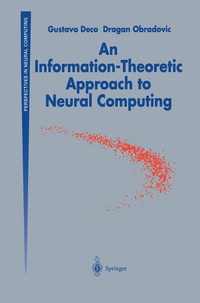
An Information-Theoretic Approach to Neural Computing
Published on 8. February 1996
Book
Hardback
XIV, 262 pages
978-0-387-94666-5 (ISBN)
Description
Neural networks provide a powerful new technology to model and control nonlinear and complex systems. In this book, the authors present a detailed formulation of neural networks from the information-theoretic viewpoint. They show how this perspective provides new insights into the design theory of neural networks. In particular they show how these methods may be applied to the topics of supervised and unsupervised learning including feature extraction, linear and non-linear independent component analysis, and Boltzmann machines. Readers are assumed to have a basic understanding of neural networks, but all the relevant concepts from information theory are carefully introduced and explained. Consequently, readers from several different scientific disciplines, notably cognitive scientists, engineers, physicists, statisticians, and computer scientists, will find this to be a very valuable introduction to this topic.
More details
Series
Edition
1st ed. 1996. Corr. 2nd printing 1997
Language
English
Place of publication
New York
United States
Target group
Professional and scholarly
Research
Edition type
Revised edition
Illustrations
XIV, 262 p.
Dimensions
Height: 241 mm
Width: 160 mm
Thickness: 20 mm
Weight
588 gr
ISBN-13
978-0-387-94666-5 (9780387946665)
DOI
10.1007/978-1-4612-4016-7
Schweitzer Classification
Other editions
Additional editions
Gustavo Deco | Dragan Obradovic
An Information-Theoretic Approach to Neural Computing
E-Book
12/2012
Springer
€96.29
Available for download
Gustavo Deco | Dragan Obradovic
An Information-Theoretic Approach to Neural Computing
Book
09/2011
Springer
€106.99
Shipment within 15-20 days
Content
1 Introduction.- 2 Preliminaries of Information Theory and Neural Networks.- 2.1 Elements of Information Theory.- 2.2 Elements of the Theory of Neural Networks.- I: Unsupervised Learning.- 3 Linear Feature Extraction: Infomax Principle.- 4 Independent Component Analysis: General Formulation and Linear Case.- 5 Nonlinear Feature Extraction: Boolean Stochastic Networks.- 6 Nonlinear Feature Extraction: Deterministic Neural Networks.- II: Supervised Learning.- 7 Supervised Learning and Statistical Estimation.- 8 Statistical Physics Theory of Supervised Learning and Generalization.- 9 Composite Networks.- 10 Information Theory Based Regularizing Methods.- References.